To really get better at reading comprehension, you first need to build a solid base. This all starts with growing your vocabulary and making a conscious effort to link new information with what you already know. These are the core skills that lay the groundwork for understanding more complicated texts down the track.
Build a Strong Foundation for Better Reading
Before you can jump into the more advanced reading strategies, it’s absolutely vital to get the basics right. Think of it like building a house—without a solid foundation, the whole structure will be wobbly. For reading, that foundation rests on two key pillars: a rich vocabulary and a decent amount of background knowledge.
Many students I've worked with struggle with comprehension not because they're 'bad readers', but simply because they're missing these foundational tools to make sense of what's on the page. It's a surprisingly common hurdle. In fact, in Australia, about one-third of school children don't read at the level expected for their age, which points to a real gap in these fundamental skills. Often, this is more about the teaching methods used than the student's actual ability.
Expand Your Vocabulary in Context
A strong vocabulary is your number one tool for unlocking the meaning in a text. But here’s a tip from experience: just memorising word lists from flashcards is a pretty poor way to learn. Our brains are wired to remember words far better when they’re connected to a real context.
So, instead of just looking up a word's definition, really dig into how it’s being used in that specific sentence or paragraph. Ask yourself: What other word could the author have used here? Why did they choose this one? This simple shift turns a passive task into an active, and much more effective, learning experience.
Here are a few practical ways to build your vocabulary naturally:
- Keep a Word Journal: When a new word pops up, jot it down in a notebook along with the sentence you found it in. This simple act helps lock in the context.
- Look for Word Parts: Get familiar with common prefixes (like ‘pre-’), suffixes (like ‘-ology’), and root words. Understanding these building blocks can help you make an educated guess about unfamiliar words you encounter.
- Read Widely: Don’t just stick to one thing. Expose yourself to different types of writing—fiction, news articles, academic journals, even technical manuals. Each genre uses language in unique ways, which broadens your exposure and your vocabulary.
Activate Your Background Knowledge
What you already know is one of the most powerful—and most overlooked—tools you have for improving your reading comprehension. Your brain isn't a blank slate; it's constantly trying to connect new information to the mental maps you've already created.
Before you even start reading a text, take a moment to deliberately think about the topic. Ask yourself: What do I already know about this? What ideas or memories does the title bring to mind?
This simple act of "priming your brain" gets it ready to absorb and organise new information much more effectively. For example, if you're about to read an article on space exploration, spending a minute recalling basic facts about planets or astronauts creates mental 'hooks' for the new details to hang on to. You can find more practical advice on how to remember what you learn in our other articles on effective learning strategies.
By focusing on these two foundational elements—vocabulary and background knowledge—you’re setting the stage for a much deeper understanding. This preparation isn't just a warm-up; it’s the most critical first step on your journey to becoming a more confident and skilled reader.
Implement Active Reading Strategies That Work
Have you ever finished a page, only to realise your eyes were just drifting over the words and you absorbed nothing? It’s a common frustration, and it’s usually because of passive reading. The real secret to understanding and remembering what you read isn't about reading faster; it's about engaging with the material on a deeper level. To really boost your reading comprehension, you need to become an active reader—someone who interacts with, questions, and even challenges the text.
This isn't as hard as it sounds. It actually starts before you read the first sentence. Make it a habit to preview what you're about to read. A quick scan of headings, subheadings, and any intro or summary paragraphs gives your brain a mental map of where the author is taking you. Think of it as looking at a GPS route before you start driving; it primes you for the journey ahead.
This quick preview kicks off a powerful cycle of engagement. The process below shows a simple, effective flow for getting the most out of your reading time.
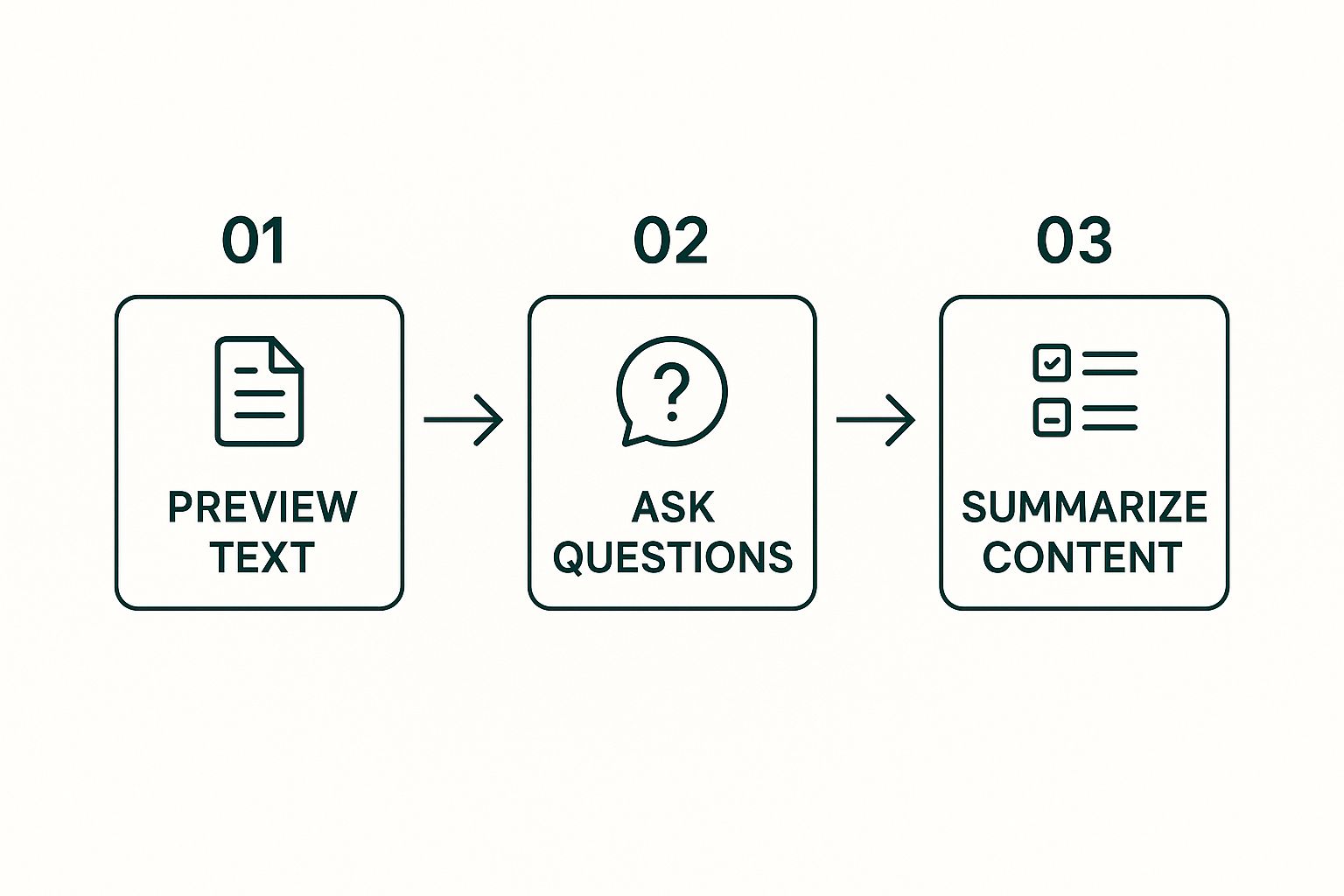
As you can see, reading isn't a one-way street. It’s a continuous loop of previewing, questioning, and summarising that cements the information in your mind.
Let's look at how to break those passive habits and build active ones that stick.
Active vs Passive Reading Habits
It's easy to fall into passive reading traps without even realising it. The key is to consciously swap these habits for more engaged, active alternatives. Here's a comparison to help you identify where you can make a change.
| Passive Reading Habit | Active Reading Alternative | Why It Works |
|---|---|---|
| Eyes glaze over the text | Ask questions as you read | Forces your brain to search for answers and stay focused on the content. |
| Reading without a goal | Set a purpose before you start | Gives your reading direction and helps you filter for relevant information. |
| Highlighting everything | Annotate with specific notes/symbols | Creates a personal summary and makes it easier to review key points later. |
| Accepting info at face value | Connect the text to your own knowledge | Links new information to what you already know, which drastically improves recall. |
| Forgetting it immediately | Summarise each section in your own words | Tests your understanding and forces you to process the information, not just see it. |
Turning these active alternatives into habits is what transforms reading from a chore into a skill.
Turn Reading into a Conversation
The real magic of active reading happens when you stop seeing it as a monologue from the author and start treating it like a dialogue. As you read, constantly ask questions. This simple act keeps your mind switched on and actively searching for answers within the text.
Here are a few questions to keep in your mental toolkit:
- What's the main point the author is trying to make here?
- What facts or examples are they using to back it up?
- Do I agree with this? Why or why not?
- What part of this is confusing me?
By constantly probing the text with questions, you force yourself to think critically about the material instead of just accepting it at face value. This mental back-and-forth is where real comprehension happens.
Make Your Mark with Purposeful Annotation
Highlighting can be a fantastic tool, but let's be honest—many of us are guilty of turning entire pages yellow without a clear purpose. The goal of annotation isn't just to colour in what seems important; it's about creating a personalised record of your conversation with the text.
Instead of just highlighting blocks of text, try these more focused techniques:
- Underline key arguments and circle specific words that carry the most weight. This is a great way to focus on impactful language.
- Jot down short summary notes in the margins. Can you boil a whole paragraph down to a few words? This is a brilliant test of your understanding.
- Use simple symbols. A question mark (?) for confusing parts, an exclamation mark (!) for surprising ideas, or a star (⭐) for main points.
This kind of annotation makes it so much easier to review material later and quickly recall the main ideas and your own thoughts. It's an essential skill for anyone studying for exams or needing to retain complex information for their job.
Having a strong vocabulary is also a huge asset here. If you're circling powerful words, you're already on your way. You can learn more about how to increase your vocabulary with strategies that really work. By combining these active approaches, you’ll see a massive shift in how much you absorb and remember.
Analyse Texts for Deeper Understanding
Engaging with a text actively is a fantastic start, but to really master the material, you have to peel back another layer. This is where analysis comes in—the skill of dissecting a text to figure out not just what it says, but how and why it says it.
This is the skill that pushes you from a surface-level reader to someone with a deep, lasting grasp of the content. It’s a bit like becoming a detective. You’re on the hunt for clues that reveal the author’s intentions, the way they’ve built their argument, and any meanings hiding just beneath the surface.
Look for the Author's Purpose and Tone
Every single piece of writing has a purpose. It might be to inform you, to persuade you, to entertain you, or a mix of all three. Figuring out this purpose gives you a powerful lens to view the entire text through. Just ask yourself: What is the author trying to get me to think or do here?
Once you’ve got a handle on the purpose, start listening for the author's tone. Are they being formal, casual, sarcastic, or purely objective? Their word choices, sentence structures, and the examples they pick are all massive clues. For instance, an article full of phrases like "it's obvious that" and "a foolish mistake" has a completely different agenda than one using "research suggests" and "an alternative perspective."
A key part of analysis is spotting potential biases. An author's personal beliefs can subtly shape their argument. Looking for biased language or one-sided evidence doesn’t mean you should dismiss the text; it just means you read it with a sharper, more informed eye.
Summarise to Confirm Your Understanding
One of the most powerful ways to check if you’ve actually understood a complex section is to explain it in your own words. This isn’t about just repeating what the author said; it’s a true test of whether you've processed the information.
After reading a tricky paragraph, just pause and ask yourself, "Right, how would I explain this to a friend?" If you can't, you probably haven't nailed the core idea yet. This little trick forces you to internalise the information, making it your own.
Visualise Information to Connect Ideas
Let's be honest, sometimes words on a page just aren't enough, especially when you're dealing with dense or abstract ideas. This is where visualising information can bring a huge amount of clarity. You don't need to be an artist; simple diagrams are incredibly effective.
- Create a mind map: Pop the main idea in the centre and draw branches for key supporting points and evidence. It’s a brilliant way to see how everything connects.
- Draw a simple flowchart: If the text is describing a process or a cause-and-effect relationship, a flowchart can make the sequence of events so much easier to follow.
- Use a T-chart: For texts that present two opposing arguments, a simple T-chart is perfect for comparing them side-by-side.
By breaking down a text’s structure, purpose, and tone, you stop being a passive reader and become an active analyst. It’s the one skill that truly separates good readers from great ones.
Navigating Reading in the Digital Age
Let's be honest: reading on a glowing screen just isn't the same as reading on paper. Our brains react differently. With endless notifications, tempting hyperlinks, and other digital noise, we often slip into a 'skimming' mode without even noticing it.
This shallow reading style makes it incredibly difficult to truly understand and absorb what we're reading. When your mind is busy fighting off pop-ups or the urge to click another interesting link, your focus is split. This leaves less mental energy for the real task: processing the text itself. It’s not just a feeling, either—research consistently shows we tend to retain less information when reading from a screen.
This is becoming a real challenge. In fact, recent OECD findings suggest that Australian adults' literacy levels may have declined in the last decade, particularly when it comes to digital reading. While comprehension is often better with printed materials, our work and study lives demand sharp digital reading skills. New assessments even test how well we navigate online information and use our working memory, which can be tough for many. You can dive deeper into these adult literacy findings and their implications over at Spelfabet.com.au.
So, how do we get better at understanding what we read online? The trick is to become more intentional and take back control from the screen.
Minimise Digital Distractions
First things first: you need to create a focused reading space, even on a cluttered screen. Think of it like soundproofing a room so you can actually hear yourself think.
- Embrace Reader Mode: Nearly all modern web browsers have a 'Reader View' or 'Reader Mode'. It’s a lifesaver. This feature strips away all the ads, sidebars, and visual clutter, leaving you with nothing but clean text. It’s the single best tool for focused online reading.
- Go Full-Screen: Maximise the window you're reading in. It’s a simple click, but it hides your taskbar, open tabs, and other on-screen temptations, helping you stay locked in on the content.
- Silence the Noise: Before you start reading, turn off notifications. Every 'ping' from your email or pop-up from social media is an invitation to break your concentration.
When reading online, distraction is the default setting. To achieve deep comprehension, you have to consciously build a bubble of focus around yourself. It won’t happen by accident.
Adjust Your Reading Pace and Strategy
Because our brains are so conditioned to skim online content, you have to make a conscious effort to slow down. Forcing yourself to read at a more deliberate pace signals to your brain that this text is important and requires deeper processing.
This is especially critical when you're dealing with non-linear texts like websites, which are packed with hyperlinks. It’s far too easy to fall down a rabbit hole, clicking from one link to the next until you've completely forgotten where you started.
Before you click on a link, pause and ask yourself: "Do I really need this information right now to understand the main text?" If the answer is no, save it for later.
By actively managing your digital environment and consciously shifting your reading habits, you can overcome the common barriers to screen-based comprehension. It’s an essential skill for finding success in almost any field today.
Build a Consistent and Rewarding Reading Practice
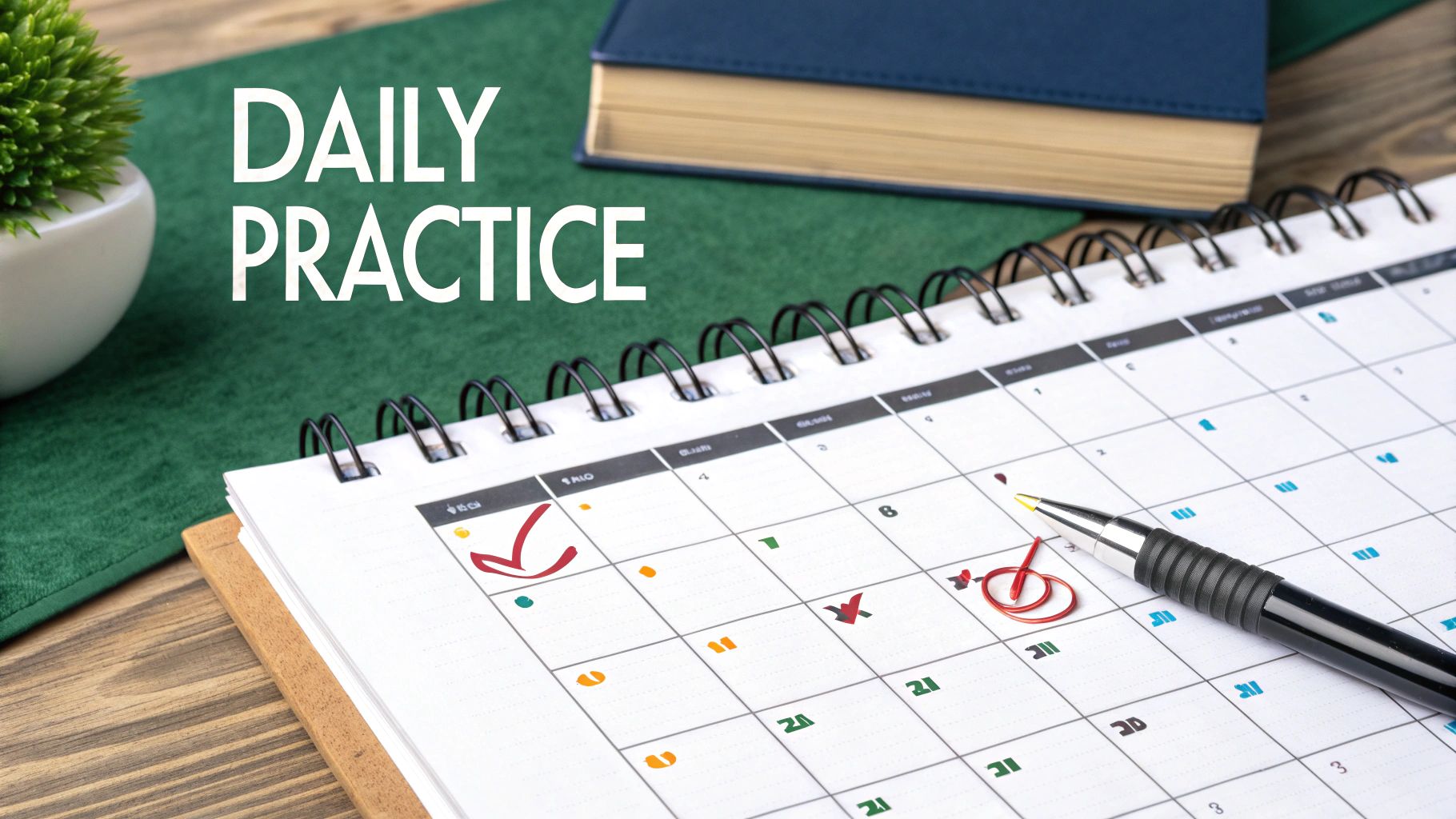
Getting better at reading isn't a one-and-done project. It’s a skill you develop over time, much like you’d strengthen a muscle at the gym. Consistency, more than anything else, is what makes the real difference. A truly rewarding reading practice is built on realistic goals and genuine interest, not on huge targets that just lead to burnout.
Instead of trying to smash through a whole book in a week, why not start smaller? Just committing to 20 minutes of focused reading each day is a fantastic place to begin. This approach builds a powerful habit and creates momentum, slowly turning what might feel like a chore into a genuinely enjoyable part of your routine.
Choose Materials That Genuinely Interest You
The quickest way to kill your motivation is by forcing yourself to read something you find boring. The real secret to a reading habit that sticks is picking things you’re actually curious about. When you're engaged with the subject, your brain naturally works harder to understand it.
Don't feel like you have to stick to "serious" literature, either. The goal is to build your comprehension skills, and that can happen with any kind of text.
- For fun: Grab a novel, a magazine about one of your hobbies, or even online blogs covering topics you love.
- For learning: Pick up a non-fiction book about a skill you're keen to develop, or an article explaining a current event you want to understand better.
- For a challenge: Now and then, try diving into something more complex, like a technical manual or an academic paper related to your work or studies.
Mixing it up with a variety of texts is excellent practice. It trains your brain to adapt to different writing styles, structures, and levels of difficulty, which builds a more versatile and robust reading ability.
The key takeaway is simple: reading more is the best way to get better at it. But what you read really matters. Engagement is what drives comprehension, so just follow your interests.
Track Your Progress to Stay Motivated
There’s nothing more motivating than seeing yourself improve. While progress can sometimes feel slow, tracking it can be surprisingly simple. You could keep a reading journal and just jot down what you've read, maybe with a quick one-sentence summary. When you look back after a few weeks, you'll be amazed at how much you’ve accomplished.
This practice is especially vital for younger learners. Australia has seen steady progress in reading proficiency, with the proportion of Year 5 students meeting national standards climbing from 91% to 95% over the last decade. But gaps still exist, highlighting that consistent, targeted practice is crucial for every student. You can learn more about these insights on Australian literacy levels from the AIHW.
By building a steady habit, you’re not just helping yourself; you're actively developing a skill that will pay dividends for the rest of your life.
Common Questions About Improving Reading Comprehension
As you start putting these new strategies into practice, it’s completely normal for questions to bubble up. Getting to grips with common challenges is a huge part of learning how to improve reading comprehension for good. Let's tackle some of the most frequent questions I hear from learners.
Many people wonder if they're on the right track or if their struggles are unique. The truth is, most of us face the same hurdles when we're trying to build better reading habits. Getting clear, straightforward answers can be just the thing to keep you motivated and on track.
How Long Does It Take to See Real Improvement?
This is probably the question I get asked most, and the honest answer is: it really depends. Lasting improvement doesn't just happen overnight; it’s a gradual process that hinges on one thing: consistency. If you can commit to just 15-20 minutes of focused, active reading each day, you'll almost certainly notice small but meaningful changes within a few weeks.
At first, you might just notice you can concentrate for longer, or that you’re remembering more details from what you read the day before. The big shifts in your overall comprehension ability, however, usually take a few months of dedicated practice. The trick is to be patient with yourself and celebrate those small wins along the way.
Don’t get discouraged if you don’t see dramatic results right away. Think of it like getting fit – you wouldn't expect to run a marathon after just a week of jogging. Consistency is so much more important than intensity.
Is It Better to Read Fast or Slow for Comprehension?
This is a classic dilemma. While speed reading has its moments—like when you’re skimming a simple article or hunting for one specific fact—it's generally the enemy of deep understanding. When you read too fast, your brain simply doesn't have enough time to process the information, link it to what you already know, or really chew on the author's argument.
For most situations where you actually need to learn something, slowing down is your best bet.
- Slow Reading: This gives you the space for active engagement—asking questions, pausing to summarise, and making connections. It’s absolutely essential for dense or complex material like textbooks or academic articles.
- Fast Reading: This is great for getting a general overview or finding a specific piece of information quickly. It’s not the tool for material you need to understand deeply and remember long-term.
The best readers are flexible. They learn to adjust their speed based on what they're reading and why they're reading it.
What Should I Do When I Don’t Understand a Sentence?
We’ve all been there. You hit a sentence or a whole paragraph that feels like a brick wall. It’s incredibly frustrating, but it happens to everyone. The absolute worst thing you can do is just skip over it and hope for the best. Instead, have a simple game plan ready to tackle the confusion.
- Re-read it: Read the sentence again, but this time, say it out loud. You'd be surprised how often hearing the words can make the meaning click into place.
- Break it down: Look at the sentence piece by piece. Are there specific words you don’t recognise? Look them up.
- Check the context: Read the sentences immediately before and after the tricky one. The surrounding text often holds the clues you need to unlock the meaning.
- Paraphrase what you do get: Try to explain the parts of the sentence you understand in your own words. This can often illuminate the missing piece of the puzzle.
Pushing through these small roadblocks is a huge part of building confidence, a skill that's also vital when you're preparing for major assessments. You can find more practical advice in our guide with study tips and preparations for exams.
If you or your child needs personalised support to master these skills, Evergreen Tutoring Services offers one-on-one guidance tailored to every learner's needs. Our expert tutors can help build confidence and achieve academic goals. Learn more at https://www.evergreentutoringservices.com.au.