Cramming for an exam, rereading textbooks for hours, and highlighting entire pages in fluorescent ink. These are the classic images of studying, but they are often surprisingly inefficient. While sheer effort is commendable, the goal isn't just to spend more time with your books; it's to learn more effectively in less time. Many students fall into the trap of using passive, low-impact study methods without realising there are more powerful, evidence-based strategies available. The difference between struggling to recall information and confidently applying it often comes down to how you study, not just how long you study.
This guide moves beyond generic advice to provide a practical toolkit of effective study techniques. We will explore ten specific, actionable methods designed to help you understand, retain, and recall information with greater ease. From Active Recall and Spaced Repetition to the Feynman Technique and Dual Coding, each strategy is broken down into simple, implementable steps. You will learn not only what these techniques are but also how to integrate them into your routine, regardless of whether you are a university student, a high school student tackling your VCE or HSC, or an adult learner returning to study. Prepare to transform your approach and unlock your true academic potential.
1. Active Recall: Train Your Brain to Retrieve Information
Forget passively re-reading your notes or highlighting textbooks. Active recall is one of the most effective study techniques because it forces your brain to actively retrieve information from memory, strengthening the neural pathways that make that information stick. Instead of simply recognising concepts, you are practising the mental act of remembering them, just like you’ll need to do in an exam.
This method shifts your focus from putting information into your brain to pulling it out. It's the difference between looking at a map and then trying to draw it from memory. The effort involved in recalling the information is what makes it so powerful.
How to Implement Active Recall
Here are some practical ways to integrate this technique into your study routine:
- Flashcards (Digital or Physical): Create cards with a question or term on one side and the answer on the other. Test yourself regularly.
- The "Brain Dump": After studying a topic, take a blank piece of paper and write down everything you can remember. Afterwards, compare it with your source material to identify and fill in the gaps.
- Practice Questions: Work through end-of-chapter questions, past papers, or create your own questions based on your notes. The key is to answer them without looking at your study materials first.
Use active recall after you've initially learned a concept. It’s perfect for solidifying knowledge for subjects ranging from science and history to mathematics, ensuring you can access what you've learned when it counts.
2. Spaced Repetition: Beat the Forgetting Curve
Spaced repetition is a powerful study technique built on the science of memory and the "forgetting curve". It involves reviewing information at increasing intervals of time, strategically interrupting the process of forgetting just before information disappears from your memory. This method optimises your study sessions to build durable, long-term knowledge with less overall time investment.
Instead of cramming information all at once, you space out your reviews. This process signals to your brain that the information is important and needs to be stored for the long haul. It's an exceptionally efficient way to memorise large volumes of information, making it one of the most effective study techniques for subjects heavy on facts and vocabulary.
How to Implement Spaced Repetition
Here are some practical ways to integrate this technique into your study routine:
- Use Spaced Repetition Software (SRS): Apps like Anki and Quizlet (with its Spaced Repetition mode) use algorithms to automatically schedule reviews for you. This is the easiest way to get started.
- The Leitner System: A manual method using physical flashcards and several boxes. Correctly answered cards move to a box that gets reviewed less frequently, while incorrect ones move back to a box for more frequent review.
- Create a Review Calendar: Manually schedule your review sessions for a new topic. For example: Day 1, Day 3, Day 7, Day 16, and so on.
This technique is a game-changer for medical students preparing for board exams, language learners memorising vocabulary, or anyone facing standardised tests like the GAMSAT or UCAT. The key is consistency; start early and stick to your review schedule.
This diagram illustrates the basic flow of reviewing information at increasing intervals to strengthen memory retention.
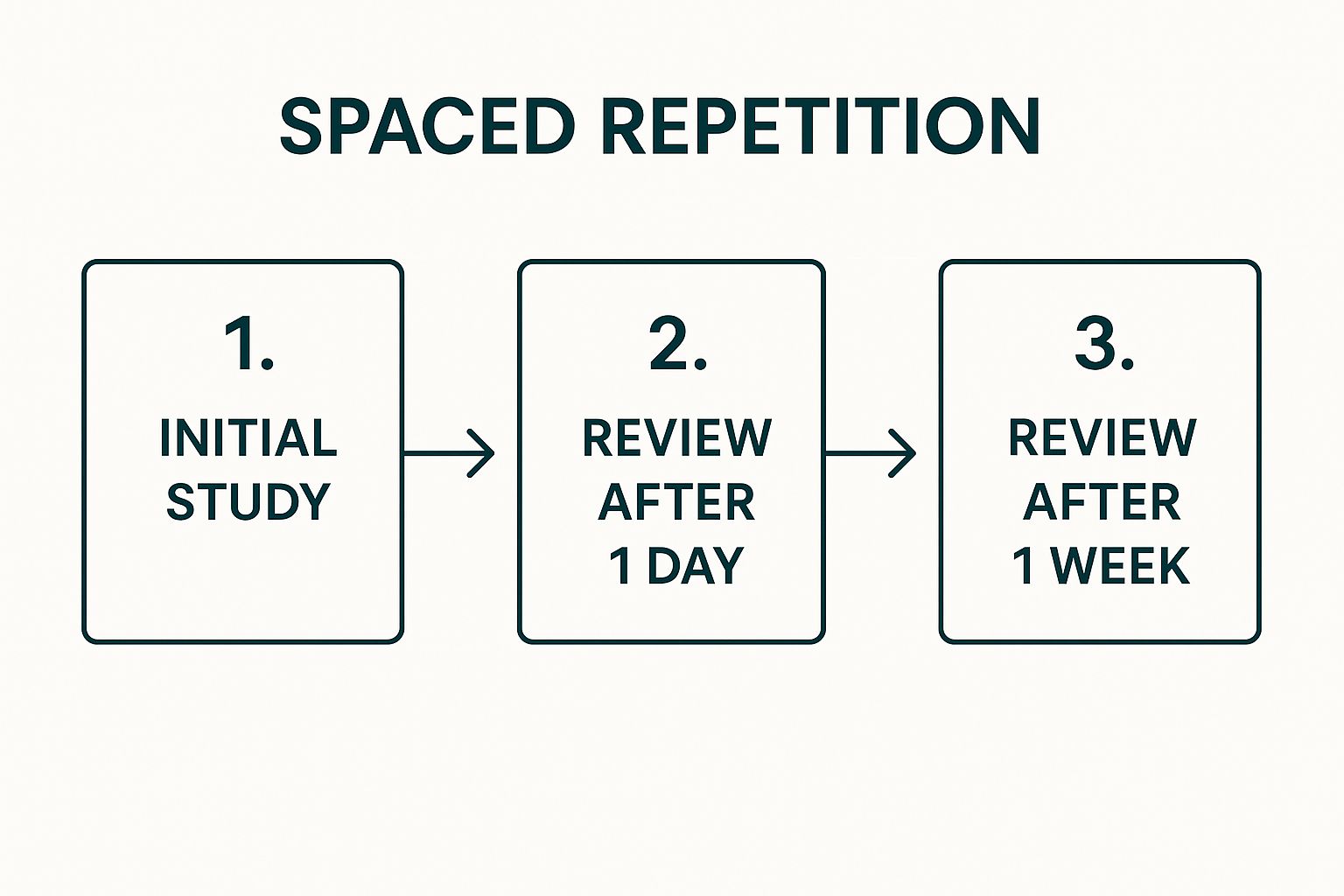
As shown, the time between each review session deliberately lengthens, which is the core principle that makes this method so effective for long-term learning.
3. The Pomodoro Technique: Master Your Focus with Timed Intervals
Studying for long, uninterrupted hours often leads to burnout and diminishing returns. The Pomodoro Technique is an effective study technique that tackles this by structuring your study sessions into focused, timed intervals. This time management method, developed by Francesco Cirillo, helps you maintain peak concentration and prevents mental fatigue by building in regular breaks.

The system is simple: you work in 25-minute sprints (called a "pomodoro"), followed by a 5-minute break. After completing four pomodoros, you take a longer break of 15-30 minutes. This cycle breaks down overwhelming tasks into manageable chunks, making it easier to start and stay engaged. For more ideas on managing your study schedule, explore these tips on time management for students.
How to Implement the Pomodoro Technique
Here are some practical ways to integrate this technique into your study routine:
- Eliminate Distractions: Before starting a 25-minute pomodoro, turn off all phone notifications and close unnecessary browser tabs. The goal is pure, uninterrupted focus.
- Keep a Distraction Pad: If a random thought or task pops into your head, jot it down on a notepad to address later. This clears your mind without breaking your focus.
- Use Breaks Wisely: Your short breaks are for rest, not more screen time. Stand up, stretch, grab a glass of water, or walk around. This physical movement helps reset your brain.
- Be Flexible with Timings: If 25 minutes feels too short or too long, adjust it. The core principle is the cycle of focused work and planned breaks, not the exact minute count.
This method is ideal for tackling large study tasks, exam preparation, or writing assignments, as it builds momentum and makes the entire process feel less daunting.
4. The Feynman Technique: Master Complexity Through Simplicity
The Feynman Technique, named after Nobel laureate physicist Richard Feynman, is a powerful method for truly understanding a topic. This approach operates on a simple principle: if you can't explain a concept in simple terms, you don't really understand it. It moves beyond rote memorisation to ensure you grasp the core principles of a subject.
This technique is one of the most effective study techniques because it forces you to deconstruct complex information and rebuild it using your own words. The process of simplification uncovers the weak points and gaps in your knowledge, allowing you to go back and reinforce them. It’s like being a translator, converting dense academic language into plain, everyday English.
How to Implement the Feynman Technique
Here are some practical ways to apply this method to your learning:
- Choose a Concept and Study It: Start by selecting a topic you need to learn. Read your textbook, go over your notes, or watch a lecture about it.
- Teach It to a Novice: Pretend you are explaining the concept to someone with no prior knowledge, like a child or a friend in a different field. Write or speak your explanation, avoiding jargon and using simple analogies.
- Identify Gaps and Simplify: As you explain, you’ll notice where you struggle or resort to complex language. This is where your understanding is weak. Go back to your source material to fill these gaps, then simplify your explanation again.
- Review and Refine: Read your simplified explanation aloud. If it sounds confusing or convoluted, continue refining it until it’s clear and concise.
The Feynman Technique is brilliant for subjects that rely on understanding complex systems or abstract ideas, such as physics, medicine, economics, or computer science. It ensures you have a rock-solid foundation of knowledge.
5. Mind Mapping: Visualise and Connect Your Ideas
Mind mapping is a powerful visual study technique that moves away from linear, list-based note-taking. It involves creating a diagram where information is organised in a hierarchical structure, radiating outwards from a central topic. This method leverages colours, images, keywords, and branches to build a visual representation of concepts and their relationships, engaging both analytical and creative parts of your brain.
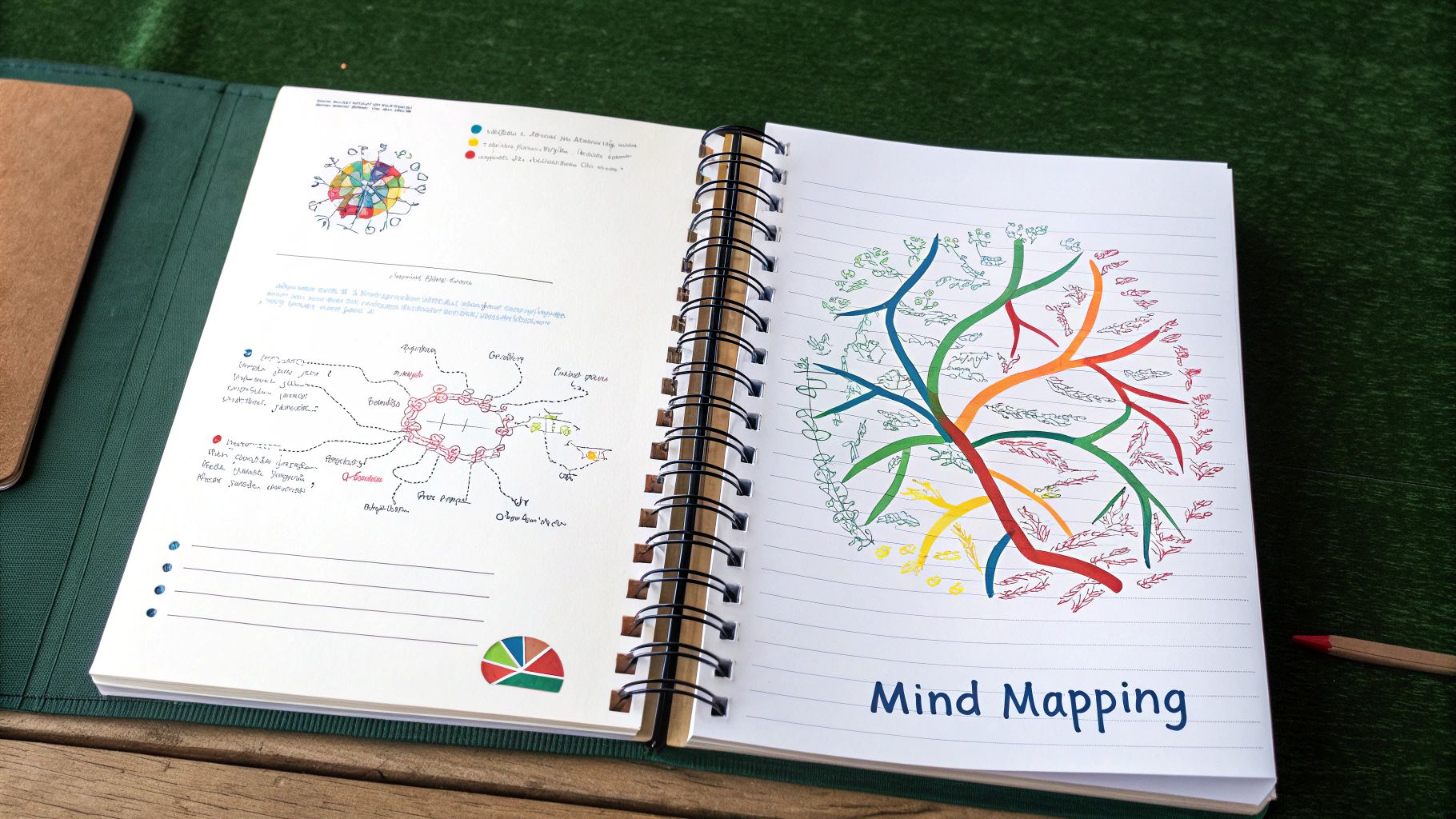
By mirroring how our brains naturally make connections, mind mapping helps to clarify thoughts, simplify complex topics, and improve memory recall. It transforms a dense page of notes into an organised, memorable, and easy-to-review visual summary, making it one of the most effective study techniques for visual learners.
How to Implement Mind Mapping
Here are some practical tips to get started with mind mapping:
- Start in the Centre: Begin with a central image or a clear topic in the middle of a blank page. For example, a Biology student might draw a cell, or a History student could write "World War I".
- Use Colours and Keywords: Create main branches for key themes, using a different colour for each. Label these branches with single, powerful keywords rather than long sentences.
- Branch Out with Details: Add smaller "child" branches to your main branches to fill in supporting details, facts, or examples.
- Include Symbols and Images: Add small drawings and symbols to make your map more engaging and memorable. This visual element is key to the technique's success.
Mind mapping is incredibly versatile. It's ideal for brainstorming essays, summarising complex chapters, or visualising relationships between characters in a novel or events in history. Reviewing your mind map regularly helps to reinforce the connections and provides a quick, big-picture overview of a topic.
6. The Cornell Note-Taking System: Organise for Clarity and Recall
Traditional note-taking can often result in pages of disorganised information that are difficult to review. The Cornell Note-Taking System is an effective study technique designed to solve this by providing a systematic format for condensing and organising notes. It divides a single page into distinct sections, promoting active engagement with the material during and after the lecture.
Developed by a Cornell University professor, this method transforms your notes from a passive record into an active study tool. It encourages you to summarise, question, and synthesise information, making the review process significantly more efficient and helping you to identify key concepts that require further attention.
How to Implement the Cornell Note-Taking System
Setting up your page is the first step. Before class, divide your paper into three sections:
- Main Notes Area (Right Column): During the lecture or while reading, take your primary notes in this large, right-hand column. Use shorthand and abbreviations to capture information quickly.
- Cue Column (Left Column): Shortly after class, review your notes and pull out key terms, concepts, or potential test questions. Write these cues or questions in the smaller, left-hand column.
- Summary Section (Bottom): Within 24 hours, synthesise the information on the page into a one or two-sentence summary at the bottom. This reinforces your understanding and creates a quick reference.
This structured approach is ideal for lecture-heavy courses, like those in law or medicine, as it forces you to process and reorganise information. When it's time to study, cover the main notes area and use the cue column to test your recall.
7. Interleaving: Mix Up Your Subjects to Deepen Understanding
Instead of studying one topic for a long block of time, the interleaving technique involves mixing different, yet related, subjects or problems within a single study session. This method is one of the most effective study techniques because it trains your brain to identify the correct strategy for a problem, rather than just repeating the same one over and over. It enhances your ability to discriminate between concepts and apply knowledge more flexibly.
This approach challenges your brain to constantly switch gears, forcing it to retrieve different information and problem-solving methods. While it may feel more difficult and less productive initially, this "desirable difficulty" is precisely what strengthens long-term retention and your ability to transfer skills to new situations, which is crucial for exam performance.
How to Implement Interleaving
Here are some practical ways to integrate this technique into your study routine:
- Mix Problem Types: If you're studying maths, don't just do a block of algebra problems. Instead, create a practice set that mixes algebra, geometry, and calculus questions together.
- Alternate Between Subjects: For language learners, try switching between practicing vocabulary, then grammar rules, and then conversation practice within one study block, rather than dedicating a whole day to just one.
- Plan Your Sessions: Before you start studying, create a schedule that intentionally alternates between a few different topics. For example, 45 minutes of chemistry, followed by 45 minutes of physics, and then 45 minutes of biology.
Use interleaving once you have a basic grasp of the individual topics. It’s perfect for subjects that involve problem-solving or distinguishing between categories, like science, maths, and even art history, ensuring you can correctly identify and apply what you’ve learned when it matters most.
8. Elaborative Interrogation: Ask 'Why' to Deepen Understanding
True learning goes beyond memorising facts; it involves understanding the connections between them. Elaborative interrogation is a powerful study technique that prompts you to generate explanations for why facts are true. By repeatedly asking 'why,' you force your brain to link new information with your existing knowledge, creating a richer, more organised mental framework that boosts retention.
This method encourages you to move from being a passive recipient of information to an active participant in your own learning. Instead of just accepting a statement like "World War I started in 1914," you ask, "Why did it start then?" This simple question unlocks a deeper exploration of causes, contexts, and consequences, making the information far more memorable than a standalone date.
How to Implement Elaborative Interrogation
Here are some practical ways to use this technique to enhance your comprehension:
- Ask a Chain of 'Why' Questions: Start with a core fact from your notes. Ask "why is this true?" and then ask "why" about the answer you just generated. For example, a history student might ask why a particular treaty was signed, then why the involved nations agreed to its terms.
- Connect to Personal Experience: Try to relate the explanation back to something you already understand. An economics student questioning a market trend might relate it to their own purchasing decisions to make the concept more concrete.
- Explain it to Someone Else: Formulate your 'why' answers as if you were teaching the concept to a friend. This forces you to structure your thoughts clearly and identify any gaps in your own understanding.
This is one of the most effective study techniques for subjects that require deep conceptual knowledge, such as the sciences, history, and psychology. By focusing on causation and reasoning, you not only improve recall but also significantly enhance your reading comprehension.
9. Dual Coding: Combine Visuals and Words
Our brains process information through two main channels: verbal (words) and visual (images). Dual coding theory, developed by Allan Paivio, suggests that we learn and remember information more effectively when it is presented through both channels simultaneously. This creates two distinct but interconnected memory traces, making retrieval easier and more reliable.
This technique moves beyond simple text-based learning by integrating meaningful visuals. It’s not just about decorating your notes with pictures; it’s about creating a rich, multi-sensory learning experience. By combining words with diagrams, timelines, or concept maps, you give your brain multiple pathways to access the same information, which is a powerful strategy in any study arsenal.
How to Implement Dual Coding
Here are some practical ways to integrate this effective study technique into your routine:
- Create Your Own Diagrams: After reading a chapter, translate the key concepts into a visual format. This could be a flowchart for a process, a mind map for interconnected ideas, or a simple sketch for a scientific concept.
- Annotate Images: Don't just look at diagrams in your textbook. Actively label them, add detailed descriptions, or draw arrows to show relationships between parts. For example, a history student could add descriptive notes to a map of a historic battle.
- Visual Timelines: For subjects like history or literature, create a timeline that incorporates not just dates and events, but also small images or symbols to represent them.
Use dual coding when you encounter complex information that can be represented visually. It is particularly effective for subjects like biology, chemistry, engineering, and history, where abstract concepts can be clarified with visual aids.
10. The Testing Effect: Solidify Knowledge Through Practice Testing
Closely related to active recall, the testing effect is a powerful study technique that leverages the act of testing itself to improve long-term memory. Research by cognitive psychologists like Henry Roediger III has shown that retrieving information for a test is a more effective learning event than simply re-studying the material. This method moves you from passive review to active application, strengthening memory consolidation.
Every time you take a practice test, you are not just measuring what you know; you are actively enhancing your ability to recall that information later. It works because it forces your brain to reconstruct knowledge, which solidifies the neural pathways associated with it. This is why students who use past exams for VCE, HSC, or university preparation often outperform those who just re-read their notes.
How to Implement the Testing Effect
Here are practical ways to make practice testing a core part of your study system:
- Simulate Real Conditions: When possible, take practice tests under timed conditions without notes. This prepares you for the pressure of the actual exam environment.
- Analyse Your Mistakes: Don’t just check your score. Go back through every incorrect answer and understand why you got it wrong. This turns mistakes into valuable learning opportunities.
- Use Varied Formats: Mix up question types. Use multiple-choice questions, short-answer prompts, and essay questions to test your knowledge from different angles.
- Space It Out: Instead of cramming with multiple tests in one day, space your practice testing sessions out over several days or weeks. This leverages spaced repetition for maximum retention.
The testing effect is one of the most well-supported and effective study techniques available. To explore more about exam preparation strategies, you can find further study tips and preparations for exams.
Top 10 Study Techniques Comparison
| Technique | Implementation Complexity | Resource Requirements | Expected Outcomes | Ideal Use Cases | Key Advantages |
|---|---|---|---|---|---|
| Active Recall | Moderate – requires self-discipline and creation of questions | Minimal – flashcards or self-quizzing tools | Strong long-term retention, quick identification of gaps | Any subject needing memory retention | Efficient memory strengthening, time-effective |
| Spaced Repetition | High – needs setup and consistent scheduling | Software/tools like Anki recommended | Maximizes retention with minimal time | Large volume memorization, language learning, exam prep | Optimizes review timing, focuses on weak areas |
| Pomodoro Technique | Low – simple timer setup | Timer or apps | Improved focus, reduced mental fatigue | Tasks needing sustained attention and productivity | Boosts focus and productivity, easy to implement |
| Feynman Technique | Moderate to high – requires time and effort to simplify concepts | Minimal, just paper or digital note tools | Deep understanding, reveals knowledge gaps | Complex concepts across all fields | Improves comprehension and communication |
| Mind Mapping | Moderate – time consuming to create detailed maps | Pen and paper or digital mapping tools | Visual organization, enhanced creativity | Subjects needing concept relationships visualized | Engages visual memory and creative thinking |
| Cornell Note-Taking | Moderate – requires format discipline | Paper or digital note-taking templates | Organized notes, active review, easier recall | Lecture-heavy courses, workshops | Systematic format aids review and self-testing |
| Interleaving | Moderate – needs careful planning | Minimal, planning tools helpful | Enhanced transfer, concept discrimination | Mixed skill/practice sessions, problem-solving | Builds flexible thinking, improves application |
| Elaborative Interrogation | Moderate to high – requires background knowledge and time | Minimal | Deeper understanding, better retention | Factual learning with cause-effect relationships | Encourages critical thinking and meaningful learning |
| Dual Coding (Visual & Verbal) | High – time and skill to integrate visuals | Visual creation tools/software | Improved recall, better understanding | Complex concepts benefiting from visuals | Creates multiple retrieval pathways, engages diverse learners |
| Testing Effect | Moderate – requires quality practice tests | Practice questions/quizzes | Dramatic retention improvement, gap identification | Exam preparation, certification readiness | Builds confidence, reduces test anxiety |
Putting It All Together: Your Personalised Study Blueprint
We've explored a powerful arsenal of ten evidence-based, effective study techniques, moving far beyond the passive rereading and last-minute cramming that often lead to frustration. From the dynamic duo of Active Recall and Spaced Repetition to the organisational genius of the Cornell Note-Taking System and the creative clarity of Mind Mapping, you now have a comprehensive toolkit to revolutionise your learning process.
The journey to academic success isn’t about finding a single "magic bullet" technique. Instead, it’s about understanding that different tasks and subjects demand different tools. The true power lies in strategically combining these methods to create a study system that is uniquely yours. Think of yourself as a strategist, carefully selecting the right approach for the challenge at hand.
Crafting Your Personalised Approach
The most important takeaway is the principle of intentionality. Effective learning is an active, not a passive, endeavour. It requires you to engage, question, connect, and create. You are no longer just a consumer of information; you are an active architect of your own knowledge.
Here are your actionable next steps to build your personalised blueprint:
- Start Small: Don't try to implement all ten techniques at once. Choose one or two that resonate most with your current challenges. Perhaps start by integrating the Pomodoro Technique to manage your time and combining it with Active Recall at the end of each session.
- Experiment and Adapt: Treat this as a personal experiment. Use the Feynman Technique for a concept you find particularly difficult in your science class. Try Interleaving to mix up problem sets in your maths revision. See how Dual Coding helps you remember key historical timelines. Pay attention to what feels effective and what doesn't.
- Schedule and Systemise: True mastery comes from consistency. Use a planner or digital calendar to schedule not just what you will study, but how you will study it. For example, a calendar entry might read: "7:00 pm – 8:30 pm: Modern History – Cornell Notes on Chapter 4, followed by 3 x 25-min Pomodoro sessions creating practice questions (Testing Effect)."
Mastering these effective study techniques is about more than just achieving a higher ATAR or passing your next TAFE assessment. It's about developing the metacognitive skills, the discipline, and the confidence to become a lifelong learner. These are the skills that will empower you to tackle complex problems, acquire new professional qualifications, and adapt to a constantly changing world long after you've left the classroom. By moving from passive memorisation to active, strategic learning, you are building a foundation for enduring success in all your future endeavours.
Feeling overwhelmed or unsure where to begin? A personalised plan can make all the difference. The expert tutors at Evergreen Tutoring Services specialise in helping students identify and implement the most effective study techniques for their individual learning style and academic goals. Visit Evergreen Tutoring Services to learn how one-on-one support can help you build your blueprint for success.