
At its core, scaffolding in education is a teaching method where an educator provides temporary, targeted support to help a student master a new skill or concept. Think of it like teaching a child to ride a bike; you start with training wheels, then hold the seat, and finally let go once they find their balance. This support is gradually removed as the student becomes more competent and confident.
What Is Educational Scaffolding in Simple Terms
Scaffolding isn’t about just giving students the answers. Instead, it’s a dynamic, responsive process that provides the necessary tools and guidance for them to build their own understanding. It’s like a bridge a teacher constructs to help a student get from what they already know to what they need to learn next.
The entire process is designed to be temporary. Just as a builder’s scaffold is taken down once a building can stand on its own, a teacher’s support is gradually faded away. This ensures the student doesn’t become dependent on the help and can ultimately perform the task independently.
The ultimate goal of scaffolding is to empower students, moving them from guided practice to confident, independent achievement. It fosters resilience and turns challenges into manageable learning opportunities.
Finding the Sweet Spot for Learning
Effective scaffolding happens within a specific learning window known as the Zone of Proximal Development (ZPD). This term was coined by psychologist Lev Vygotsky to describe the ideal space between what a student can do entirely on their own and what they can accomplish with expert guidance. It’s the "sweet spot" where learning is most effective because the task is challenging but not so difficult that it becomes frustrating.
A tutor's or teacher's role is to accurately identify this zone for each student and provide just the right level of support to help them progress. This can involve a few key actions:
-
Breaking down tasks into smaller, more manageable steps.
-
Modelling the thinking process aloud to make problem-solving strategies visible.
-
Using prompts and cues to guide students without giving the solution directly.
-
Activating prior knowledge to connect new concepts to what students already understand.
This approach is all about creating a supportive and structured environment where students feel safe to take risks and build new skills. From writing a persuasive essay to tackling a complex maths problem, scaffolding provides the framework for deep, lasting learning.
To better understand how these elements work together, here’s a look at the core principles that make scaffolding so effective in the classroom.
Core Principles of Educational Scaffolding
|
Principle |
Description |
Classroom Goal |
|---|---|---|
|
Clear Learning Goal |
The teacher and student both understand the intended outcome of the lesson or task. |
To ensure every action is purposeful and directed towards a specific skill or concept. |
|
Task Simplification |
The complex task is broken down into smaller, sequential steps that are easier to manage. |
To reduce cognitive load and prevent students from feeling overwhelmed by the challenge. |
|
Teacher Modelling |
The educator demonstrates the task or skill, often thinking aloud to reveal the process. |
To provide a clear, expert example that students can imitate and learn from. |
|
Guided Practice |
Students attempt the task with prompts, cues, and feedback from the teacher. |
To build confidence and competence in a supported, low-stakes environment. |
|
Gradual Fading |
The teacher slowly withdraws support as the student demonstrates mastery. |
To foster independence and ensure the student can perform the task on their own. |
|
Student Independence |
The student can successfully complete the task without any external assistance. |
To achieve the final learning objective and internalise the new skill or knowledge. |
These principles show how scaffolding isn’t a single action but a thoughtful process designed to move a student from dependence to complete autonomy.
This infographic shows the typical progression of support in a scaffolded lesson, from heavy guidance to complete student independence.
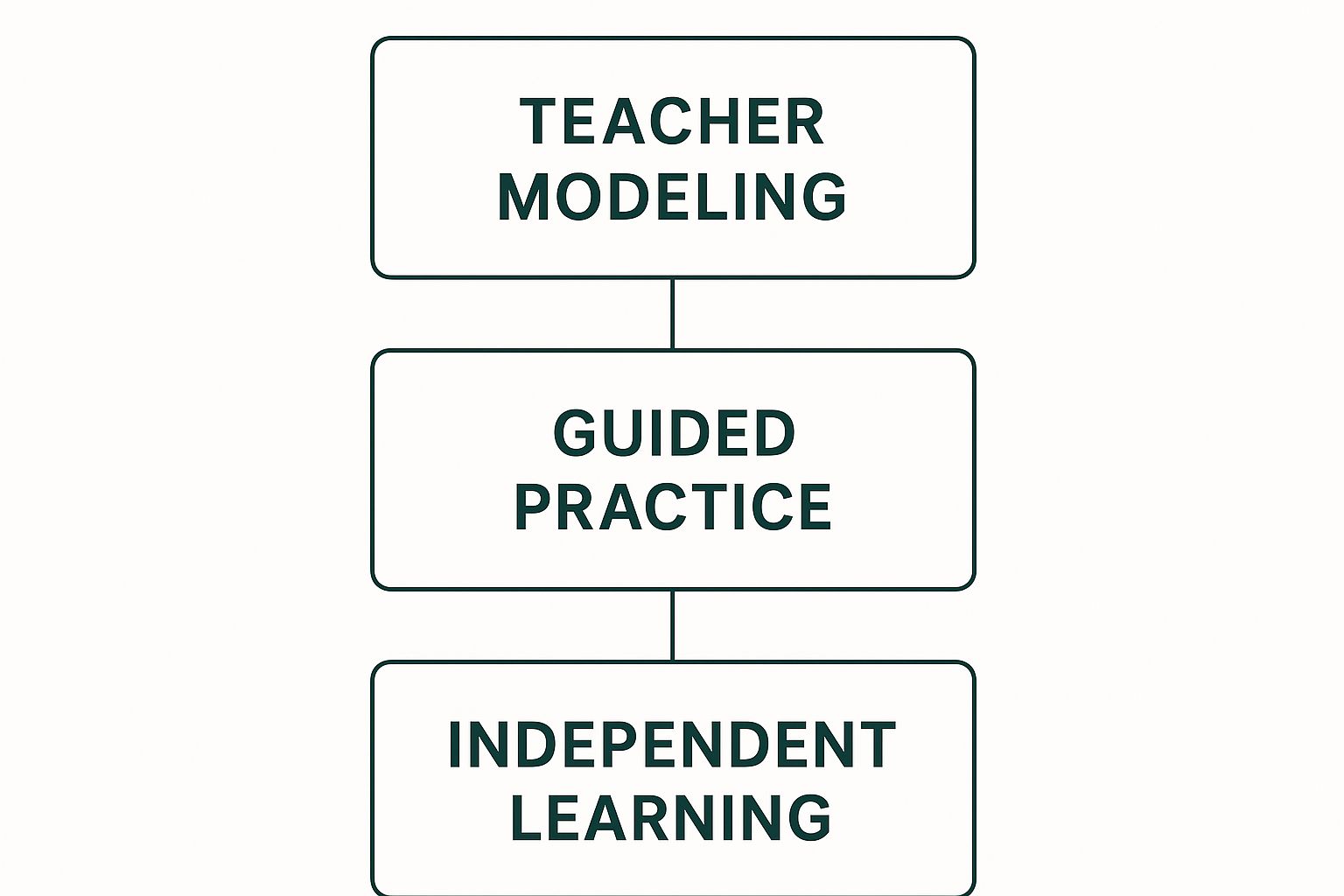
As the visual clearly illustrates, the responsibility for the task gradually shifts from the teacher to the learner over time, which is the true hallmark of successful scaffolding.
The Theory Behind Scaffolding in Learning
To really get what scaffolding in education is all about, we need to look at the powerful ideas it’s built on. This isn't just a grab-bag of teaching tricks; it's a method deeply rooted in how our brains learn, shaped heavily by the work of psychologists like Lev Vygotsky and Jerome Bruner.
Vygotsky, in particular, was a game-changer. He argued that learning is fundamentally a social activity. He saw that students don't just build knowledge on their own; they construct it through interaction and collaboration. This simple but profound idea shifts the spotlight from the solo student to the student learning alongside others.
This social view is exactly why scaffolding is so effective. It gives a clear structure for that collaboration, transforming learning from a lonely struggle into a shared journey.
The Zone of Proximal Development
At the very heart of Vygotsky’s theory is a concept he called the Zone of Proximal Development (ZPD). Think of it as the 'sweet spot' for learning. It’s that perfect space between what a student can already do by themselves and what they could do with a bit of expert guidance.
If a task is too easy, a student gets bored. If it’s way too hard, they get frustrated and often just give up. The ZPD is where the real magic of learning happens. It’s a challenge, yes, but one that’s achievable with the right support.
The main job of a teacher or tutor using scaffolding is to pinpoint this zone and offer just the right amount of support to help the student cross that gap from confusion to understanding.
The More Knowledgeable Other
For scaffolding to work its magic within the ZPD, the student needs a helping hand from a More Knowledgeable Other (MKO). This is simply anyone who has a better grasp of the task, concept, or process than the learner does.
And an MKO doesn't always have to be the teacher. In a modern Australian classroom or a personalised tutoring session, the MKO could be:
-
A Teacher or Tutor: The classic example, offering expert guidance and instruction.
-
A Peer: A classmate who has already mastered the concept can be a fantastic MKO, explaining things in a way that’s instantly relatable.
-
A Digital Tool: Think educational apps, interactive websites, or even a YouTube tutorial. These can act as an MKO by providing instant feedback and step-by-step guidance.
It's these core ideas from Vygotsky and Bruner that give scaffolding its power. They show us that learning is a team sport, where timely support from an expert helps students reach new heights they couldn't have managed alone. This makes it one of the most powerful tools in any educator's kit.
How Scaffolding Supports Every Learner in Australia
In Australia’s wonderfully diverse classrooms, a one-size-fits-all teaching approach just doesn't cut it. That’s where scaffolding comes in. It’s more than just a theory—it’s a practical tool for equity that gives every student a fair go, no matter their background or learning needs.
Think of it as a bridge. Scaffolding closes the gap between what a student can already do and the new academic challenges they face. For many kids, this kind of targeted support is the difference between feeling completely overwhelmed and feeling genuinely empowered to learn.
Supporting Students with Diverse Linguistic Backgrounds
In a multicultural nation like Australia, plenty of students walk into the classroom speaking a language other than English at home. These kids aren't just learning new subjects; they're also trying to master academic English at the same time, which is a massive task.
This is where thoughtful scaffolding becomes absolutely essential. In New South Wales public schools, for instance, about 25% of students are learning English as an additional language or dialect (EAL/D). The NSW Department of Education rightly calls scaffolding a form of "temporary, future-oriented, targeted help" for these learners. It gives them the specific support they need to develop their academic English and engage with the curriculum just like their peers.
You can get a better sense of this commitment in the NSW Government's EAL/D advice for schools. Ultimately, this isn't just about good teaching—it's about educational fairness, making sure every student can truly participate.
Actionable Scaffolding Strategies for Your Classroom
Understanding the theory is one thing, but the real magic happens when you know how to put it into practice. These scaffolding strategies are practical tools you can start using right away to give students targeted, temporary support that builds both their confidence and their skills.
The trick is finding that sweet spot: offering just enough help to stop a student from getting frustrated, but not so much that you take away the productive struggle they need to actually learn. Think of these techniques as your personal toolkit for building that perfect support structure.
Modelling and Think Alouds
One of the most powerful things you can do is make your own thinking visible. Instead of just presenting the finished product, you need to walk students through the messy, step-by-step process of how you got there.
For example, if you’re tackling a complex history question, you could say something like, “Okay, the first words that jump out at me are ‘analyse’ and ‘consequences.’ That’s my clue that I need to do more than just list what happened; I have to explain the ripple effects.” This think-aloud approach gives students a clear, real-time blueprint of expert thinking.
By verbalising your thought process, you demystify complex tasks. You show students that experts also follow a sequence of steps and questions to arrive at a solution, making the task feel much more approachable.
Using Prompts and Cues
Think of prompts and cues as gentle nudges. They point students in the right direction without simply giving them the answer, which is brilliant for fostering independent problem-solving.
They come in a few different flavours:
-
Question Prompts: Asking things like, "What have we learned before that might help us out here?" or "What do you think the very first step should be?"
-
Sentence Stems: Giving students a running start to help them structure their thoughts. For example, "I believe the main character's motivation was…" or "The evidence seems to suggest that…"
-
Visual Cues: Using tools like Venn diagrams or flow charts to help students organise their thoughts visually.
These little supports can be a game-changer, especially for students who freeze up when faced with a blank page. They create momentum and reduce that initial feeling of being overwhelmed.
Activating Prior Knowledge
Connecting new ideas to what a student already knows is a cornerstone of deep, lasting learning. Before you dive into a fresh topic, take a moment to dust off their existing knowledge.
You could kick off a science lesson on ecosystems by asking, "What do we already know about food chains?" This simple act does two crucial things: it boosts a student's confidence by starting on familiar ground, and it creates a mental hook where the new information can be easily attached.
This is especially helpful for dense texts. Pre-teaching tricky vocabulary can turn a frustrating reading task into an achievable challenge. To explore this further, check out these expert tips on how to improve reading comprehension for more detailed strategies.
Structuring Cooperative Learning
Learning isn’t always a solo activity; in fact, it’s often deeply social. Group work is a fantastic form of scaffolding because students can act as the More Knowledgeable Other for their peers.
But just throwing students into groups and hoping for the best rarely works. For cooperative learning to be effective, it needs structure. You could assign specific roles—like a note-taker, a time-keeper, or a presenter—or use a "jigsaw" activity where each group member masters one piece of a topic before teaching it to their team.
This approach builds both individual accountability and teamwork, creating a supportive space where students can genuinely learn from one another.
The Lasting Impact of Scaffolding on Student Success
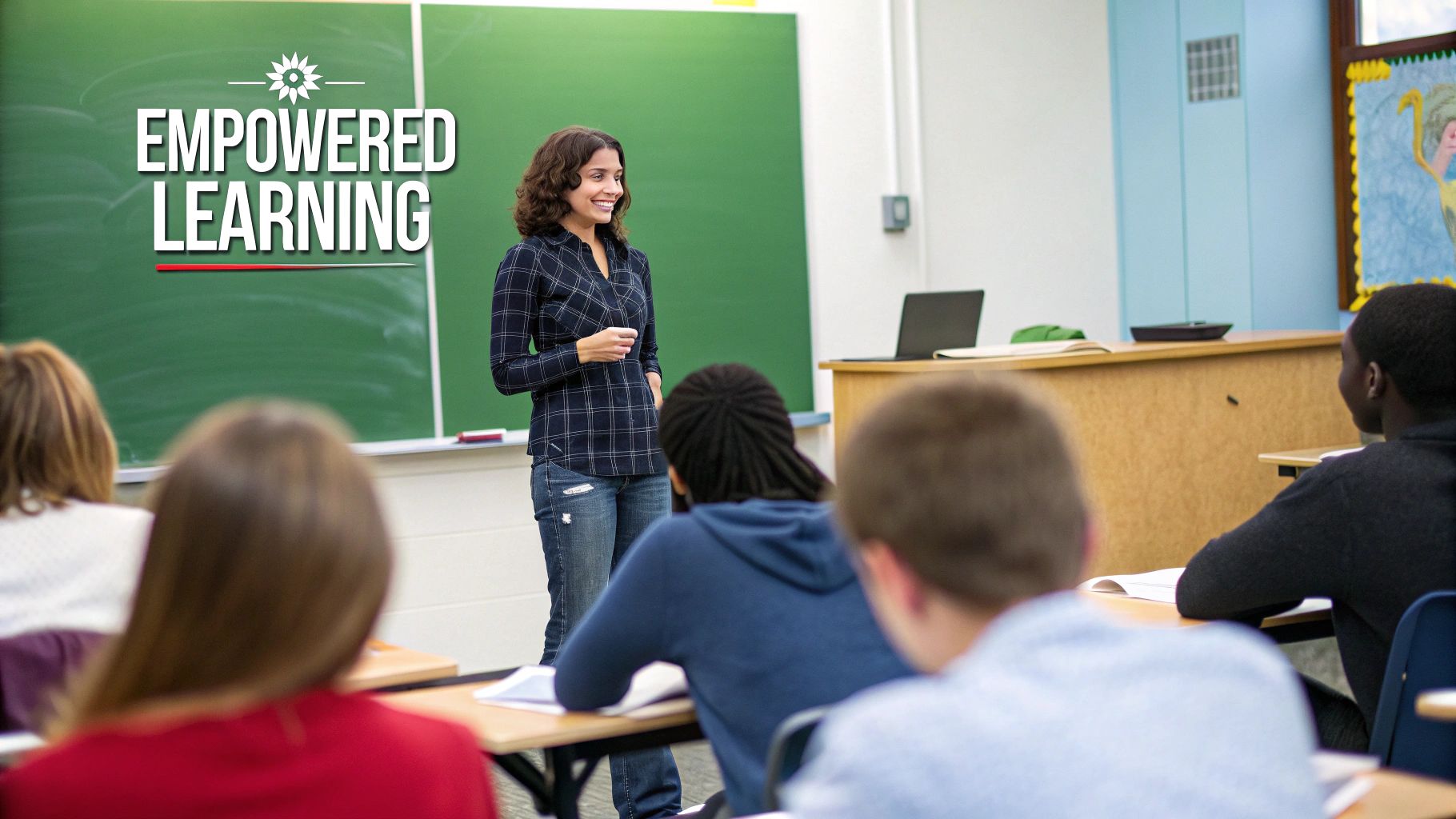
The real magic of scaffolding in education isn’t just about helping a student ace their next test. Its benefits ripple outwards, shaping learners who are not just academically capable but also more confident and resilient. When a student learns how to tackle a problem, instead of just being handed the solution, they build a powerful toolkit for life.
This supportive process is a fantastic way to nurture crucial life skills. Every time a student overcomes a tricky task with just the right amount of help, they learn that difficult challenges are actually manageable. This builds a powerful sense of self-efficacy—the belief in their own ability to succeed.
Building Futures Beyond the Classroom
Scaffolding turns learning from a passive chore into an active journey of discovery. By slowly pulling back the support, educators empower students to take real ownership of their learning. This fosters key skills that are vital for success long after they’ve left school:
-
Problem-Solving: Students get great at breaking down big, scary problems into smaller, more actionable steps.
-
Resilience: They learn that it's completely okay to struggle and that sticking with it, using the right strategies, is the path to mastery.
-
Metacognition: Scaffolding encourages students to think about their own thinking—a skill that is absolutely fundamental to becoming a lifelong learner.
Fostering Confidence and Independence
Ultimately, the whole point of scaffolding is to make the support redundant over time. Each successfully completed task builds a student's confidence, making them much more willing to tackle the next challenge with more independence. They move from "I can't do this" to "How can I do this?" and, finally, to "I can do this myself."
This shift is the most profound impact of all. Scaffolding doesn’t just build knowledge; it builds confident, capable individuals who are prepared to face future academic and personal challenges head-on.
By providing this thoughtful guidance, educators and tutors aren’t just teaching a subject. They are actively involved in creating independent learners who have the skills and self-belief to succeed in any path they choose. It’s a true investment in their future.
Of course! Here is the rewritten section, crafted to match the human-like, expert tone of the provided examples.
Common Questions About Scaffolding in Education
Even when you grasp the concept of scaffolding, putting it into practice can bring up a few tricky questions. Teachers and parents often wonder: How do I know when to step in? What if I'm helping too much?
Let's tackle some of the most common queries head-on. These practical answers will help you move from theory to real-world application with confidence, ensuring your support is effective, timely, and genuinely helps your child build independence.
Is Scaffolding Just Giving Students the Answers?
This is a big one, but the answer is a firm no. In fact, scaffolding is the complete opposite of just handing over the answers. It’s all about giving a student the right tools, strategies, and structured support they need to figure out the answer for themselves.
Think of it like this: giving a student the answer is like handing them a fish. Scaffolding is teaching them how to fish. You might show them how to cast the line, help pick the right bait, or point to a good spot in the river, but the student is the one who ultimately catches the fish.
How Do I Know When to Reduce Support?
Knowing when to start fading, or removing, the scaffold is where the real art lies. The key is to be a careful observer. When a student starts tackling parts of a task with more confidence, speed, and accuracy, that’s your signal they’re ready for a little more independence.
Look out for these signs:
-
They no longer need you to prompt them on a specific step.
-
They start talking through their own thinking process, much like a "think-aloud."
-
They can finish smaller bits of the task without any help at all.
-
You see their frustration levels drop and their confidence visibly lift.
The process should always be gradual. Think of it as a responsive dance, not an abrupt stop. You might remove one support, like sentence starters, but keep a graphic organiser in place for a bit longer until they're truly ready.
Can Scaffolding Work for All Subjects?
Absolutely. While people often connect it with reading and maths, the principles of scaffolding are universal and can be adapted for any subject.
-
In Science: A teacher could provide a structured lab report template to guide students through the scientific method.
-
In History: Scaffolding might involve pre-teaching key vocabulary before students dive into a complex historical document.
-
In Physical Education: A coach breaks down a tennis serve into smaller movements, giving feedback on each part before the student puts it all together.
The core idea is the same no matter the discipline: break down the complexity, model the process, and offer temporary support until the learner can stand on their own two feet. It’s a flexible framework that makes any challenging topic more approachable.
At Evergreen Tutoring Services, our expert tutors are masters of scaffolding. They work one-on-one with students to identify their unique Zone of Proximal Development and provide the precise, personalised support needed to build skills and confidence. Find out how our tailored approach can help your child succeed by visiting Evergreen Tutoring Services.



One Response
Thanks for sharing this detailed piece on scaffolding in education. The way it explains how teachers provide support, gradually reduce that support, and help students build confidence and independence is really clear and valuable. Providing scaffolding that aligns with students’ current level — and then gently withdrawing it as they become more capable — makes learning a lot more effective.
It’s also great to see how the concept connects to broader learning theories, such as the zone of proximal development, which emphasises what a learner can do with support versus independently. Understanding this helps educators tailor tasks and support to every learner’s needs, promoting deeper understanding and long-term success rather than simply completing assignments. Thanks for the insight.