
Trying to manage your time at university can feel like a losing battle. It’s a strategic game of planning and controlling how you spend your time on specific activities, all to boost your productivity and get things done. For Australian uni students, this often means walking a tightrope between demanding coursework, a part-time job, and trying to have some semblance of a social life. Nailing this skill is one of the surest ways to improve your grades and cut down on stress.
Why Managing Your Time in University Feels Impossible
That feeling of drowning in deadlines, staring at endless reading lists, and feeling the constant pull of social plans is a story almost every student knows by heart. If you're feeling perpetually overwhelmed, trust me, you are not alone. It’s less about you failing and more about the unique pressures of uni life, where simply ‘trying harder’ almost never works long-term. The first step to getting on top of it all is understanding what’s really going on.
Many students struggle because the jump from the structured world of high school to the self-directed chaos of university is genuinely massive. All of a sudden, you're the only one in charge of your schedule. You’re responsible for everything from dragging yourself to lectures to chipping away at massive projects that span an entire semester.
The Procrastination Pattern
Procrastination isn't just about being lazy; it's often a direct response to academic pressure and the anxiety that comes with it. When an assignment feels huge or a deadline seems miles away, it's a natural human reaction to just put it off. This kicks off a stressful cycle where you delay, feel guilty about it, and then scramble to finish everything at the last minute, which never leads to your best work.
This pattern is incredibly common. For Australian students, the challenge is often amplified by trying to balance study with work and social commitments. The data backs this up, showing a clear link between this behaviour and academic results. In fact, 76% of students who handed in their assignments early scored higher grades compared to just 60% of those who put it off. What’s more, a huge 58% of Australian students tend to submit their work within 24 hours of the deadline, even when they’ve had a whole week. You can see more student time management stats on Lifehack Method to get the full picture.
The Juggling Act of Modern Student Life
Another big reason time management feels so tough is that being a student today means juggling several major life commitments at once. For many, uni isn't a full-time job in itself—it's just one of them. The competing priorities usually look something like this:
-
Academic Work: All the lectures, tutorials, readings, research, and assignments.
-
Part-Time Employment: An absolute necessity for covering tuition, rent, and general living costs.
-
Social Life: Keeping up with friends and taking part in uni culture, which is so important for your mental wellbeing.
-
Personal Responsibilities: The everyday stuff like groceries, exercise, appointments, and all that fun life admin.
Trying to be amazing in every single area at the same time without a clear plan is a recipe for burnout. The trick isn't to get rid of any of these things, but to organise them so they feel intentional instead of just chaotic.
By accepting that these struggles are real and pretty much universal, you can stop blaming yourself. The challenge is genuine, but so are the solutions. The road to effective time management starts with an honest look at these hurdles, which opens the door to strategies that actually bring back a sense of control and clarity.
Create a Time Management Plan That Works for You

When it comes to time management, a one-size-fits-all approach is almost always destined to fail. Your friend’s perfect schedule might be your worst nightmare simply because their courses, work hours, and social life are completely different from yours. The secret to effective time management for students is building a personalised framework that genuinely fits your unique life.
It all starts with an honest audit. Before you can decide where your time should go, you need to know exactly where it is going right now. For one full week, track your activities without judgement. Use a simple notebook or a notes app on your phone to log what you’re doing and for how long.
Get specific. Don't just write "study"—write "read Chapter 4 of HIST101" or "researched for sociology essay." This isn’t about shaming yourself for watching three hours of Netflix; it's about gathering raw, honest data. You might be surprised at how much time certain tasks actually take up.
How to Prioritise When Everything Feels Important
Once you have a clear picture of your week, the next challenge is deciding what actually deserves your focus. When you're juggling multiple subjects, a part-time job, and personal commitments, everything can feel urgent. This is where a simple but incredibly powerful tool called the Eisenhower Matrix comes in.
Popularised by Stephen Covey, this technique helps you sort tasks based on two simple criteria: urgency and importance. This creates four distinct quadrants:
-
Urgent & Important: These are your immediate priorities that need your attention now. Think of an assignment due tomorrow or studying for an exam that’s happening this week.
-
Not Urgent & Important: This is the sweet spot for long-term success. It includes tasks like working on a major research project, planning your semester, or even getting enough exercise and rest. These activities are crucial for your goals but don't have a pressing deadline.
-
Urgent & Not Important: These are the classic time traps. This quadrant is full of interruptions like some emails, non-essential calls, or requests from others that feel pressing but don't contribute to your main goals. Learning to delegate or politely say no here is a game-changer.
-
Not Urgent & Not Important: These are your biggest time-wasters. Mindless scrolling on social media, binge-watching shows you're not that into, or other distractions fall into this category. The goal is to minimise these.
By sorting your to-do list into these boxes, you gain amazing clarity. You’ll probably find that most of your stress comes from the "Urgent & Important" quadrant, but the real progress happens when you consistently invest time in the "Not Urgent & Important" tasks. This proactive approach stops things from becoming last-minute emergencies in the first place.
From Semester Syllabus to Daily To-Do List
A full semester syllabus can feel like an insurmountable mountain of work. The trick is to break it down into a series of smaller, more manageable hills. This process of breaking things down is fundamental to good student time management.
Start by creating a Master Plan. Go through each of your course outlines and map out all the major deadlines for the entire semester onto a single calendar. This gives you a bird's-eye view of your busiest periods.
Next, break it down further into a Weekly Plan. Every Sunday, look at your Master Plan and decide what needs to be done in the coming week to stay on track. This could be finishing a specific reading, drafting an essay outline, or completing a set of practice problems.
Finally, create a Daily Plan. Each morning, or the night before, pull from your weekly plan and choose 1-3 priority tasks for the day. This transforms a vague goal like "work on research paper" into a clear, achievable action like "find five academic sources for research paper."
This structured approach takes the guesswork out of your day. You're no longer waking up and wondering what to do; you have a clear, actionable roadmap that connects your daily efforts directly to your long-term academic success.
This method is also a great way to tackle procrastination. A huge project feels intimidating, but a small, 30-minute task feels doable. If you find procrastination is a major hurdle, understanding its psychological roots is the first step. You can explore our expert advice on how to stop procrastinating to build more productive habits. After all, a plan is only as good as your ability to stick with it.
Use Strategic Scheduling to Boost Your Focus
Having a plan is a great start, but a truly effective schedule is more than just a to-do list. It’s a roadmap for focused, productive work. This is where strategic scheduling comes into play, helping you organise your time in a way that respects your natural energy levels and protects you from the burnout so common in student life.
One of the best ways to do this is with time blocking. Instead of staring at a massive, intimidating list of tasks, you give every block of time in your day a specific job. This means scheduling not just lectures and tutorials, but also dedicated blocks for things like "Draft Psychology Essay Intro" or "Finish Maths Problem Set 5."
This approach does two brilliant things. First, it makes you get real about what you can actually get done in a day. Second, it takes away the mental drain of figuring out what to do next. You just look at your calendar and get to it.
Pinpoint Your Peak Performance Times
We all have a natural rhythm to our energy and focus. Some of us are sharpest first thing in the morning, while others only really hit their stride late at night. A huge part of managing your time as a student is figuring out when these personal peak times are—and then protecting them fiercely.
Think about your week. When do you feel most alert, creative, and ready for deep thinking? Is it those quiet hours before your flatmates are up? Or maybe that burst of energy after your afternoon coffee? These are your golden hours.
Once you know your peak performance window, guard it. This is the time to tackle that complex theoretical reading or the challenging assignment that needs serious concentration. Don't waste this precious energy on low-value tasks like answering emails or organising your notes.
It’s a simple shift, but a powerful one. By matching your hardest tasks with your highest energy, you’ll find you get more done in less time and the quality of your work improves.
This chart gives you a simple way to think about assigning your time based on priority, making sure your most critical academic work gets the attention it deserves.
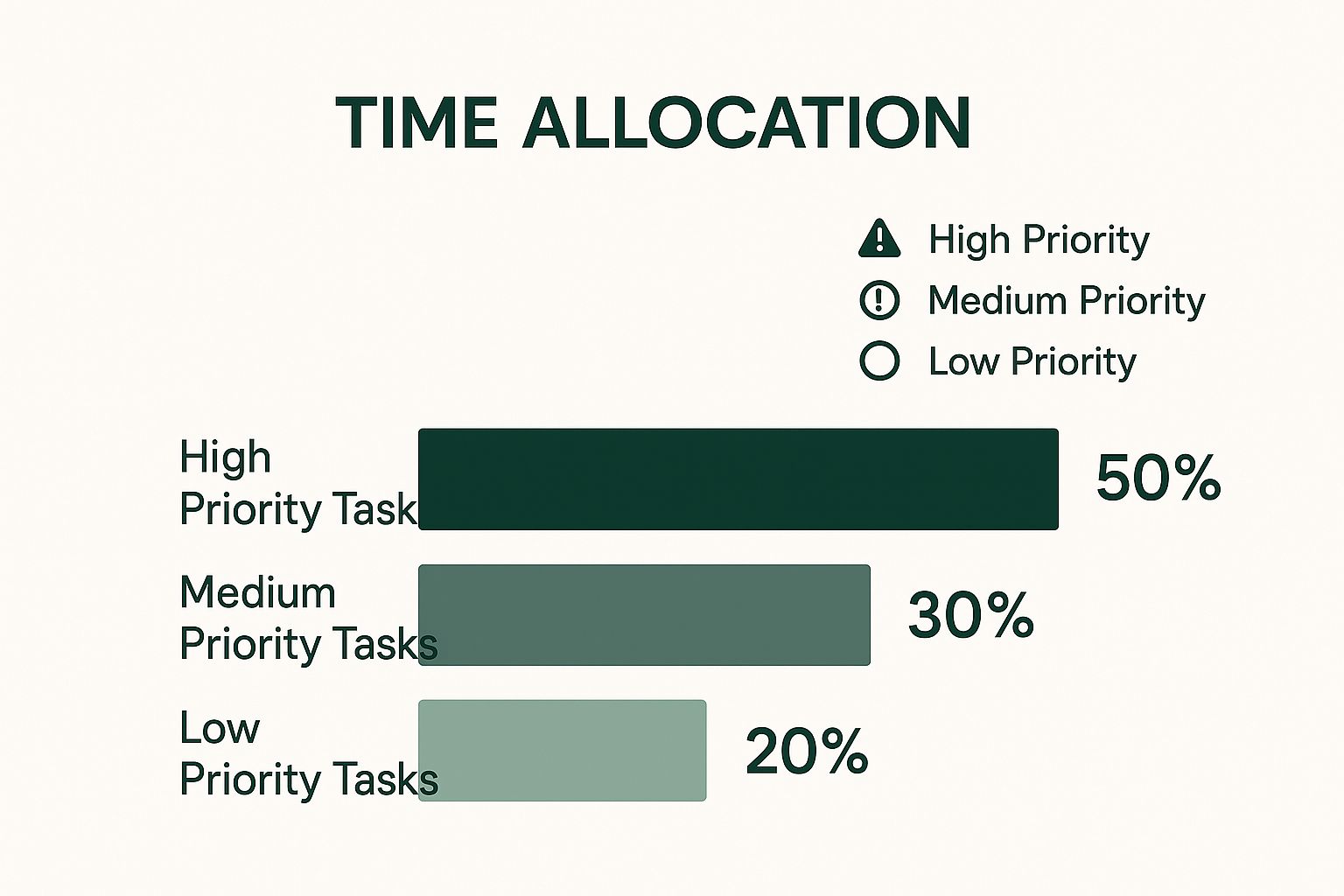
Dedicating around 50% of your study time to high-priority tasks ensures you're always moving forward on the things that will have the biggest impact on your marks.
Master Your Study Sessions with Popular Time Management Techniques
Even with the best schedule, trying to maintain focus for hours on end is a recipe for disaster. Our brains just aren't wired for it. This is why so many students turn to specific techniques to break up their work into focused, manageable chunks.
Finding the right technique often comes down to your own personality and study style. Here’s a quick comparison of a few popular methods to see which one might click for you.
Comparing Popular Time Management Methods
Find the right time management technique for your personality and study habits with this side-by-side comparison.
|
Technique |
Best For |
Key Benefit |
|---|---|---|
|
Students who get easily distracted or find tasks overwhelming. |
Creates urgency with short, 25-minute sprints and prevents burnout with built-in breaks. It makes big tasks feel much less daunting. |
|
|
Time Blocking |
Students who like structure and want to be more realistic with their daily capacity. |
Eliminates decision fatigue. You know exactly what you should be working on and when, which protects your focus. |
|
The Eisenhower Matrix |
Students who struggle with prioritisation and spend too much time on “busywork.” |
Forces you to categorise tasks by urgency and importance, ensuring you focus on what truly moves the needle on your goals. |
Experimenting with a method like the Pomodoro Technique, for example, can completely change your study sessions. The built-in breaks stop you from getting mentally fried and help you maintain a high level of performance over a longer period.
Treat Breaks and Social Time as Essential
One of the biggest mistakes students make is seeing breaks, hobbies, and social time as distractions—things you only earn after the "real work" is done. The truth is, they are a vital part of any sustainable time management plan. You simply can't be productive if you're burnt out.
Be intentional about your downtime. Schedule it in your calendar just like you would a study block. Lock in time for exercise, catching up with friends, or just vegging out with a movie. Knowing you have a proper break coming up can make it much easier to power through a tough study session.
This isn't about being lazy; it's a strategic approach to rest. You’re recharging your mental and physical batteries, which is absolutely essential for learning and memory. By building rest into your routine, you create a healthy rhythm that keeps academic burnout at bay and makes every hour you do spend studying far more effective.
How to Juggle Work, Study, and Your Sanity

For a huge number of Australian students, university life isn't just about lectures and assignments. It's a constant, demanding juggle between those academic duties and the absolute necessity of a part-time job. This balancing act can feel incredibly draining, often leaving you feeling like you’re doing a mediocre job at everything instead of excelling at anything.
The key to managing this dual demand without losing your mind is to approach it with a clear strategy. Effective time management for students in this position isn't just about scheduling; it’s about smart integration and communication. The goal is to make your work and study schedules complement each other as much as possible, rather than constantly being in conflict.
Aligning Your Work and Study Schedules
First things first: you need to get brutally honest about your non-negotiables. These are the sacred blocks of time you must protect for your studies, no matter what. Think of that weekly three-hour lecture for a core subject or the two-hour block every Tuesday afternoon that you dedicate to deep work on your trickiest course.
Block these out on your calendar before you do anything else. They are the pillars around which your work schedule has to be built. When you talk about availability with a current or potential employer, present these study blocks as fixed commitments, just like any other important appointment.
A great way to handle this conversation is to frame it positively. Instead of saying, "I can't work on these days," try something like, "My availability is strongest on Mondays, Wednesdays, and weekends, as my key uni commitments are on Tuesdays and Thursdays." It shows you're organised and proactive, not just inflexible.
Communicate Proactively With Your Employer
So many students hesitate to discuss their academic needs with their boss, worrying it will make them seem less committed to their job. In reality, open communication is your greatest ally. A good employer would much rather know about your study commitments upfront than deal with last-minute shift change requests during exam season.
Before a semester starts, sit down with your manager and share a high-level overview of your timetable. Make sure to highlight your busiest periods, like mid-semester assessments and final exams.
This simple conversation allows you to:
-
Request flexibility in advance: Ask if it's possible to reduce hours or avoid extra shifts during your peak study weeks.
-
Set clear boundaries: Explain that you won’t be able to check work emails or take calls during your scheduled lecture or study times.
-
Show your commitment: By planning ahead, you prove that you take both your job and your studies seriously.
Managing the mental load of being a working student is just as important as managing your calendar. You're not just switching between tasks; you're switching between completely different mindsets, which is exhausting.
This is where the connection between time management and wellbeing becomes crystal clear. Research on Australian university students highlights this link perfectly. One survey showed that while 80% of students want to prioritise their study time, the reality is that over 80% work while studying, creating a significant source of stress. The same data revealed that students with lower academic results were far more likely to experience frequent stress, showing a direct link between effective time prioritisation and academic outcomes. You can see the full survey findings on YouthInsight for a deeper look.
Protect Your Sanity and Avoid Burnout
When you’re juggling everything, you have to be ruthless about protecting your downtime. It's not a luxury; it's a non-negotiable part of your performance plan. If you don't schedule time to rest and recharge, your body will eventually schedule it for you—usually in the form of burnout or getting sick.
Treat your personal time with the same respect you give an assignment deadline. Block out time for exercise, seeing friends, or simply doing nothing at all. This planned downtime will make your study and work hours far more focused and productive.
Remember that exam periods demand a different strategy. It’s often necessary to scale back on work hours temporarily to create the space needed for intensive revision. Having those early conversations with your employer makes this process much smoother. For more targeted strategies, our guide on powerful exam study tips can help you make the most of that crucial revision time.
Ultimately, succeeding as a working student is about creating a sustainable system that honours all your commitments—including the one you have to yourself.
Find the Right Apps to Streamline Your Student Life
While a solid plan is the bedrock of good time management, the right technology can be a massive help. The goal isn’t to drown yourself in a sea of notifications and new apps, but to build a simple, powerful tech stack that automates your organisation.
This frees up your precious mental energy for what actually matters most—learning and understanding your course material. Think of these tools not as another chore, but as your own digital personal assistant. They can centralise your notes, manage deadlines, and even block out the endless distractions of the internet when you’re on a tight deadline.
Building Your Digital Command Centre
The key is to pick a few core apps that work well together, creating a seamless system. For most students, this system needs to cover three essential areas: task management, note-taking, and scheduling. Let's look at how to build a simple but effective command centre.
Todoist for Task Management: Forget complicated project management software. An app like Todoist is perfect for turning your semester plan into daily, actionable items. You can create different 'projects' for each of your subjects, add due dates for every assignment, and even set recurring tasks for weekly readings. Its natural language input is a lifesaver—typing “Submit history essay draft next Friday” automatically creates the task with the right deadline.
Google Calendar for Scheduling: This is your home base for time blocking. By syncing it with your task manager, you can drag and drop tasks into specific time slots on your calendar. This visual map of your day makes it instantly clear if you’ve overcommitted yourself and helps you protect those dedicated study blocks.
Creating Your Second Brain with Notion
One of the biggest challenges for students is keeping track of all the information you gather—lecture notes, research articles, reading summaries, and those random flashes of insight. This is where an app like Notion truly shines. It allows you to build a personalised digital workspace, often called a 'second brain', where all your knowledge can live.
For example, you could create a master database for a research project. Each entry could be a source you’ve found, with fields for the citation, a PDF of the article, your personal notes, and a status tag like 'To Read' or 'Summarised'. This keeps everything organised and searchable, so you’re not scrambling to find a specific quote or reference weeks later.
The real power of this approach is connection. Instead of having isolated notes in different documents, you can link ideas together. A note from a lecture can link directly to a relevant research paper and a specific task on your to-do list, creating a powerful web of knowledge.
For group projects, Notion can be a game-changer. You can set up a shared workspace with a simple project board. Create columns for 'To Do', 'In Progress', and 'Done', and assign tasks to different group members. This transparency ensures everyone knows who is responsible for what, preventing miscommunication and last-minute panic.
Taming Distractions with Focus Apps
Even with the best-laid plans, a single notification can derail an entire study session. This is where focus apps come in. Tools like Freedom or Forest are designed to help you reclaim your attention by temporarily blocking distracting websites and apps on your devices.
You can create custom blocklists for your biggest time-wasters (hello, TikTok and Instagram) and schedule recurring focus sessions that align with your time-blocked study periods. Some apps, like Forest, gamify the experience by growing a virtual tree while you focus—if you leave the app, the tree dies. It sounds simple, but it’s surprisingly effective.
By combining these tools, you build a powerful, streamlined system. For even more strategies on optimising your study habits, check out our comprehensive guide on essential study tips for Australian students. This integrated approach to time management ensures you stay on track and make the most of your valuable study time.
Stay Consistent and Avoid Student Burnout

Let's be honest: creating the perfect schedule is one thing, but actually sticking to it when life gets messy is the real challenge. Consistency is the final, crucial piece of the time management for students puzzle. It’s all about building a system that’s not just effective on paper but sustainable for the long haul, helping you get through your entire degree without losing your mind.
This last part of the journey is about resilience. It’s about learning how to adapt your plans, protect your mental health, and sidestep the all-too-common trap of student burnout. The goal isn't just to survive your studies, but to finish them feeling capable and confident.
The Power of a Weekly Review
Think of your schedule as a living document, not something set in stone. It needs to evolve as your semester progresses. The single most powerful habit you can build for long-term success is the weekly review. This is a non-negotiable 30-minute block you set aside every Sunday evening to look back, adjust, and plan for the week ahead.
During your review, ask yourself a few straightforward questions:
-
What went well last week? Acknowledge your wins, no matter how small. Did you nail your study blocks? Get an assignment in early?
-
What didn't go to plan? Be honest, but don't beat yourself up. Did that one reading take way longer than you thought? Did a last-minute social plan throw you off course?
-
What changes do I need to make for next week? Use your answers to tweak your schedule. Maybe you need more time for a tough subject or need to factor in some downtime after a long shift at work.
This simple ritual keeps your time management system relevant and stops small issues from snowballing into major dramas.
Building Flexibility into Your Plans
A rigid schedule is a fragile one. The moment an unexpected group meeting pops up or your boss asks you to stay back, a strict plan can shatter, leaving you feeling like a complete failure. The secret is to build flexibility right into your routine from the start.
Don’t aim for a perfect schedule; aim for a resilient one. True mastery of time management isn't about never deviating from the plan—it's about how quickly and calmly you can get back on track when you do.
A practical way to do this is to schedule a 'catch-all' block of 2-3 hours on a Friday afternoon or Saturday morning. This is unassigned time. Use it to catch up on any tasks that got pushed during the week. And if you’re already on track? Congratulations, you’ve just scored a few hours of bonus free time.
Spotting the Early Signs of Burnout
Burnout doesn’t just happen overnight. It’s a slow creep of exhaustion, cynicism, and feeling like you're just not getting anywhere. Recognising the early warning signs is your best line of defence.
Keep an eye out for these red flags:
-
Constant exhaustion: Feeling tired all the time, even after a full night's sleep.
-
Loss of motivation: Finding it hard to care about subjects you used to find interesting.
-
Increased irritability: Snapping at friends or family over minor things.
-
Feeling overwhelmed: The constant sense that you’re drowning in work with no way out.
For many Australian university students, a huge part of this pressure comes from balancing work and study. Reports show that around 80% of Australian students work while they study, which puts enormous strain on their time and energy. This juggling act often leaves little room for anything but the bare essentials, making proactive self-care vital. You can learn more about the challenges facing today's students in Australia.
Prioritising your wellbeing isn’t a luxury; it’s a core part of academic performance. Make sure you protect your sleep, find time for physical activity, and stay connected with your support network. These are the fundamentals of a successful and sustainable university experience.
Navigating university life, from juggling deadlines to avoiding burnout, can be tough. At Evergreen Tutoring Services, our expert tutors provide personalised one-on-one support to help you build effective study habits and gain confidence in your subjects. Whether you're a university student needing high-level academic assistance or an adult learner looking for assignment help, we can create a plan tailored to your unique needs. Get the expert support you need to excel in your studies.