Conquered Mathematics Advanced and looking for the next challenge? Welcome to Mathematics Extension 1.
Often called MX1, this course picks up where Mathematics Advanced leaves off, pushing students with a solid grasp of fundamentals into more abstract, complex territory. Think of it as the bridge between the structured world of high school maths and the creative problem-solving required in university STEM, finance, or data science degrees.
What Is Mathematics Extension 1 and Why Does It Matter?
If Mathematics Advanced teaches you how to use mathematical tools, Mathematics Extension 1 teaches you how to build them. It’s a significant shift from applying formulas to understanding why they work. This deeper insight is the key to confidently tackling unfamiliar, multi-step problems under exam pressure.
This subject is highly respected because it sharpens your analytical mind, making it a powerful asset for your ATAR and a clear signal to universities that you are prepared for rigorous academic work.
While there has been a national discussion about declining enrolment in advanced mathematics, NSW students continue to recognise the value of MX1. NESA data from 2021 to 2022 shows that enrolments held steady, with 9,437 students taking on the challenge in 2022. This demonstrates that ambitious students consistently choose this pathway for its long-term benefits.
By mastering MX1, you aren't just learning maths; you're developing a logical framework for thinking that is valuable in any career path that demands innovation and critical analysis.
Breaking Down the Mathematics Extension 1 Syllabus
The Mathematics Extension 1 syllabus can look daunting, but it’s best viewed as an interconnected toolkit for advanced problem-solving. Each topic gives you a new lens through which to analyse the world.
Here are some practical examples of what you'll learn:
- Further Calculus: This goes beyond basic derivatives. You’ll learn to solve differential equations, which are fundamental to modelling real-world phenomena. For instance, you could model how a rumour spreads through a school population or calculate the rate at which a hot coffee cools to room temperature.
- Vectors: You'll move from simple 2D diagrams to using vectors to solve complex problems in three-dimensional space. A practical application is in physics and engineering, where vectors are used to calculate the forces acting on a bridge or to project the trajectory of a thrown object, accounting for both horizontal and vertical motion.
- Combinatorics: This is the mathematics of counting and arrangement. It’s not just abstract theory; it's the logic behind calculating odds in card games, designing secure password systems, or even planning efficient logistics for a delivery company by figuring out the number of possible routes.
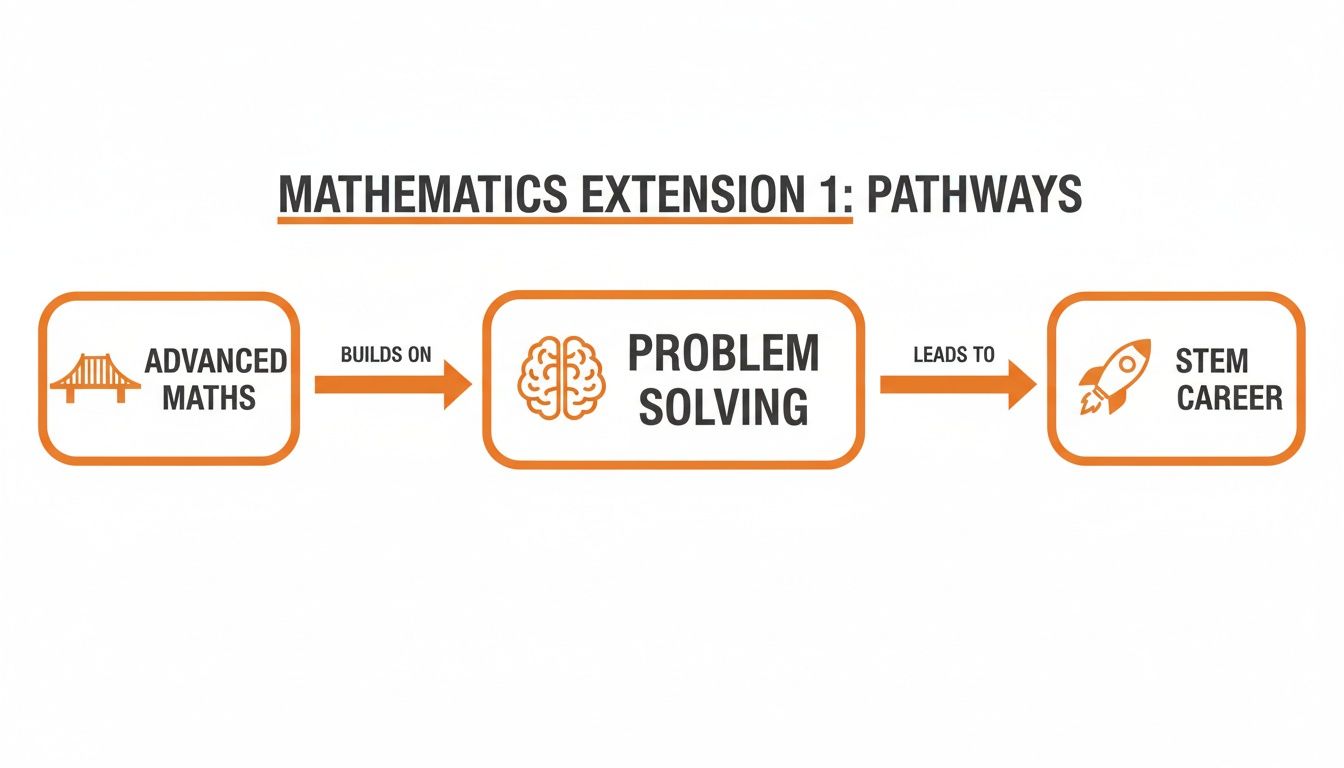
This diagram illustrates the pathway perfectly. Mastering these advanced concepts builds elite problem-solving skills, which directly open doors to competitive STEM and commerce careers.
Is Mathematics Extension 1 the Right Choice for You?
Choosing Mathematics Extension 1 is a significant decision. It’s not just about your marks in Mathematics Advanced; it’s about your mindset, work ethic, and future ambitions. Students who excel in this course typically share a few key traits.
They have strong algebraic fluency, genuinely enjoy the process of solving a difficult problem, and possess the self-discipline to manage a demanding workload. The jump in difficulty from Advanced is substantial—it requires more abstract reasoning and the resilience to persist with a problem that isn’t immediately clear.
Success in this course isn't about being a "genius." It's driven by curiosity, resilience when facing difficult problems, and consistent effort. It powerfully scales your ATAR, opening doors to competitive university degrees.
Enrolment data highlights the course's prestige but also reveals a persistent gender gap. In 2022, NESA data showed 5,721 males versus 3,716 females enrolled. This disparity underscores the importance of creating supportive learning environments that encourage all capable students to take on the challenge.
Ultimately, if you have a genuine interest in mathematics and are prepared to commit the time, Extension 1 is an incredibly rewarding choice that will set you up for future success.
Your Blueprint for Success in the HSC Exam
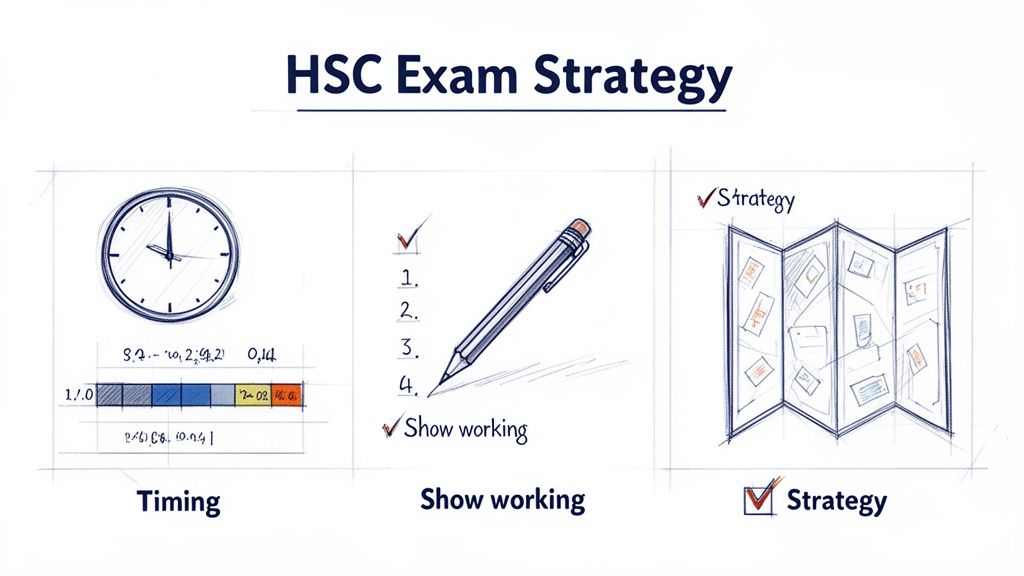
Knowing the content for HSC Maths Extension 1 is only half the battle. The exam is designed to test your application of knowledge under time pressure. A well-honed exam strategy is what separates a good result from a great one.
Here are some actionable insights to build into your preparation:
- Show Your Working: Markers award points for correct methodology, not just the final answer. Methodically showing every step is your safety net—it can secure you partial marks even if a small calculation error occurs. For example, in a multi-step integration problem, correctly identifying the substitution and setting up the integral will earn marks, even if the final arithmetic is wrong.
- Create an Error Log: After completing a practice paper, don't just check the answers. Analyse your mistakes. Keep a log where you categorise them: Was it a simple algebraic slip? A misinterpretation of the question? A conceptual gap? This helps you identify recurring weaknesses to focus on.
- Practice Under Timed Conditions: Move beyond open-book study. Set a timer and complete past papers under strict exam conditions. This builds your stamina and time-management skills, so you know how to allocate roughly 1.5 minutes per mark.
The difference between a Band 5 and a Band 6 often comes down to exam technique. Get into the habit of showing clear working, managing your time per mark, and treating every practice paper like a dress rehearsal for the real thing.
Finally, know the official HSC formula sheet inside and out. Knowing what is provided means you won’t waste precious seconds searching for a formula or trying to memorise one that's already there.
When You Need a Guide for the Climb

Almost every student hits a conceptual wall in Mathematics Extension 1. The leap to abstract thinking is significant, and small gaps in foundational skills can quickly become major obstacles.
This is where personalised, one-on-one support can be transformative. It’s not about doing more practice questions; it's about diagnosing specific weak spots. Perhaps you struggle to visualise vectors in 3D space, or a misunderstanding of logarithmic laws from Year 10 is causing issues in calculus. An expert tutor can identify these root causes and provide targeted exercises to fix them.
The real goal is to turn areas of struggle into sources of confidence. It’s about building a deep understanding of why the maths works, not just memorising formulas.
This targeted guidance builds the resilience needed to tackle unseen problems, a skill essential for the HSC. Working with a professional who knows the curriculum inside out helps you unlock your own potential. If you're considering this path, it's worth understanding how to choose an HSC math tutor who offers this dedicated support. That focused attention is how you transform tricky concepts into your biggest strengths.
Your Top Questions, Answered
Jumping into Maths Extension 1 is a big decision, and it’s natural to have questions. Here are clear answers to the most common queries we receive.
What’s the Real Difference Between Mathematics Advanced and Extension 1?
The primary difference is the required depth of abstract thinking. While Mathematics Advanced equips you with a broad toolkit of skills, Mathematics Extension 1 demands a deeper understanding. You’ll tackle more complex concepts like proof by mathematical induction and advanced mechanics.
For example, in Advanced, you might calculate the area under a curve. In Extension 1, you might be asked to prove the fundamental theorem of calculus itself, connecting the concepts of differentiation and integration on a much more profound level.
How Much Extra Study Time Are We Talking About?
Realistically, successful MX1 students dedicate an extra 4-6 hours of focused study per week, on top of their work for Maths Advanced. Consistency is crucial. The topics are cumulative, meaning a concept you learn in Term 1 is essential for understanding a new topic in Term 3. You can't afford to cram.
A couple of focused hours, a few times a week, will always beat a frantic eight-hour cram session. That consistent effort is what builds the deep, connected understanding you need to succeed in the final exams.
Do I Have to Be a Born Genius to Do Well in Extension 1?
Absolutely not. This is the biggest misconception. Success in Maths Extension 1 is far more correlated with work ethic, resilience, and effective study habits than with innate talent.
The students who achieve top marks are those who persistently ask questions until a concept makes sense, who learn from their mistakes, and who methodically work through challenging problems. A genuine willingness to engage with difficult ideas is far more valuable than 'genius-level' intuition.
Ready to turn your hard work into top marks in Mathematics Extension 1? Evergreen Tutoring Services offers personalised, one-on-one support to help you master difficult concepts and build exam confidence. Find out how our expert tutors can guide you by visiting our website.