Inquiry-based learning puts students in the driver's seat. It's an approach where they ask the questions and actively hunt for the answers, turning education from passive listening into an active investigation. At its core, this method values curiosity and problem-solving over simply memorising facts.
Going Beyond the Textbook Definition of Inquiry-Based Learning

Let's move past a simple definition. Inquiry-based learning isn't just a trendy teaching buzzword; it’s a complete shift in the classroom dynamic. It flips the script, changing the teacher from a 'sage on the stage' to a 'guide on the side' and placing the student's own curiosity right at the heart of their education.
Think of it this way: traditional learning is like a tightly scheduled bus tour. The guide points out the landmarks, tells you the facts, and you follow a set route. Inquiry-based learning, on the other hand, is like being handed a map, a compass, and a destination and being told to find your own way there.
The whole model is built on the simple idea that we remember things better when we figure them out for ourselves. Instead of being told what to think, students learn how to think.
Core Principles of Inquiry Learning
This whole philosophy is driven by a few key ideas that really set it apart from old-school teaching. The main belief is that real, lasting understanding comes from personal discovery and exploration, not from being spoon-fed information.
Here’s what makes it tick:
-
Student-Led Exploration: The journey kicks off with a student's own questions. This makes the learning process feel relevant and exciting right from the get-go.
-
Active Investigation: Students don't just sit back and absorb information. They get their hands dirty—researching, experimenting, and gathering evidence to find their own answers.
-
Constructing Meaning: Instead of memorising pre-packaged facts, students piece together their findings to build their own understanding of a topic.
This approach creates a much deeper connection to the material. When students feel a sense of ownership over what they're learning, their motivation and engagement naturally shoot up. It's a philosophy that ties in closely with other student-led methods, and you can learn more about how personal interests can drive incredible educational outcomes in our guide to interest-based learning.
By focusing on the process of discovery rather than just the final answer, inquiry-based learning equips students with skills that extend far beyond the classroom. It cultivates critical thinking, adaptability, and a lifelong love of learning.
Ultimately, this approach prepares students to navigate a complex, ever-changing world. It teaches them how to ask smart questions, tackle tricky problems, and confidently build their own knowledge base.
The Four Levels of Student-Led Inquiry
Inquiry-based learning isn't a one-size-fits-all model. Think of it less like a rigid method and more like a flexible spectrum that can be adapted to any classroom. It's best imagined as a ladder, where each rung gives students a little more control over their own learning journey.
By understanding these four distinct levels, you can meet students where they are and gradually build their confidence and independence. The process usually starts with the most teacher-supported level and moves toward complete student ownership, ensuring learners aren't just thrown into the deep end.
1. Confirmation Inquiry
This is the most structured level, making it a fantastic starting point. With Confirmation Inquiry, students are given a question, a step-by-step method, and even the expected outcome. Their job is simply to follow the procedure to confirm a known principle.
A classic example is a science teacher asking students to conduct an experiment to prove that plants need sunlight to grow. Everyone follows the same instructions, records their observations, and arrives at a predetermined conclusion, which helps cement a core concept.
2. Structured Inquiry
Moving up the ladder, Structured Inquiry provides the question and the investigation method, but the outcome is left unknown. This is where students start to feel like real researchers, using a framework you provide to discover an answer for themselves.
Imagine a history teacher giving students a set of primary source documents from a specific historical event. The teacher asks them to determine its main cause. The materials and the question are set, but the conclusion is up to the students to piece together from the evidence.
This is where the cycle of critical thinking and engagement really kicks in.
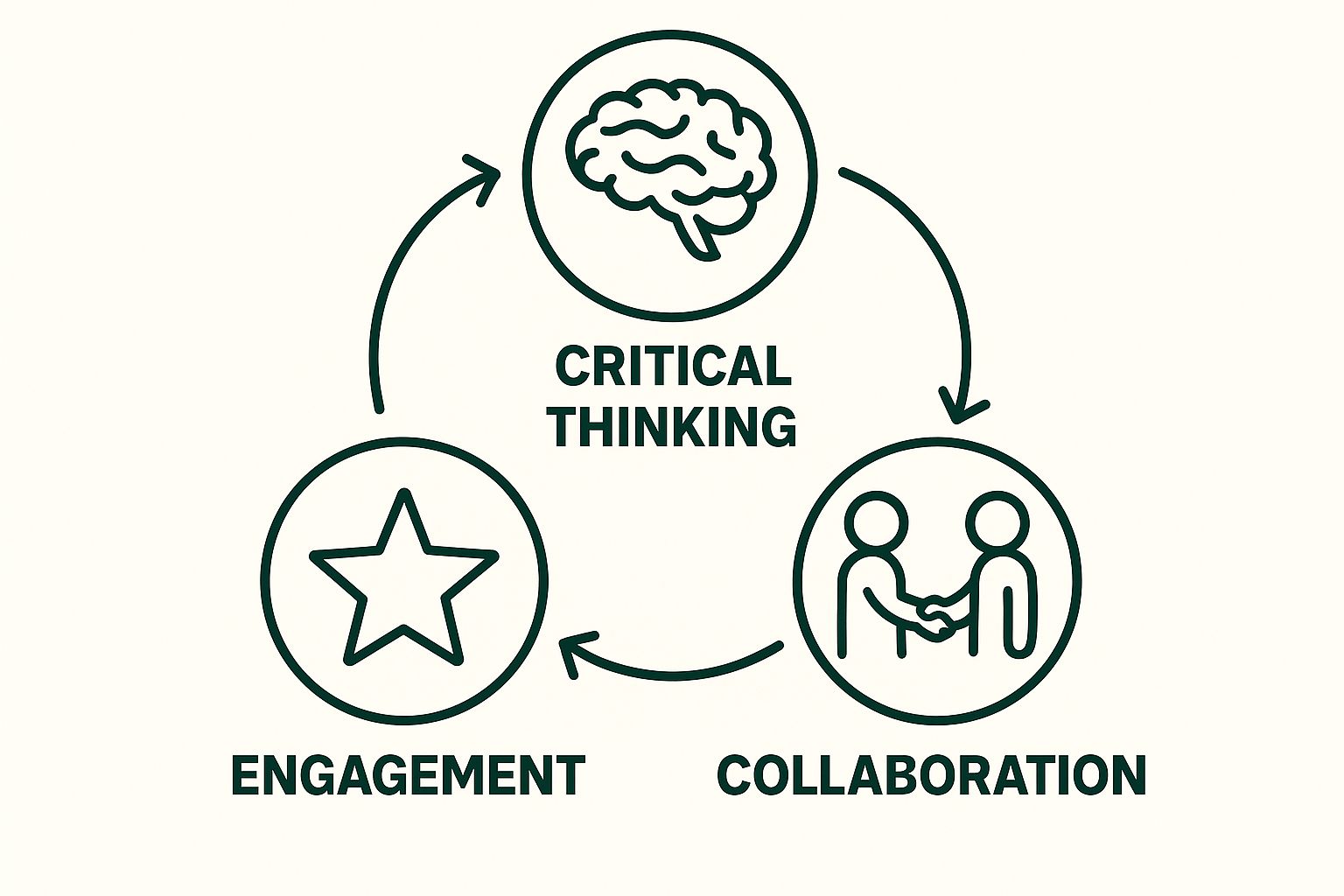
As students investigate and collaborate, they build a self-reinforcing loop that deepens their understanding and sense of ownership over their learning.
3. Guided Inquiry
With Guided Inquiry, the teacher still provides the research question, but students are now responsible for designing their own investigation. This level grants them a lot more freedom, pushing them to think critically about how to find answers. They have to decide which resources to use and how to manage their research from start to finish.
This stage is crucial for developing genuine problem-solving skills. Students learn not just the "what" but also the "how" of learning, building invaluable skills for higher education and their future careers.
4. Open Inquiry
Finally, we reach Open Inquiry, the pinnacle of student-led learning. At this level, students formulate their own questions, design their own investigation methods, and decide how to communicate their findings. It's the most authentic form of inquiry, closely mirroring the work of professionals in any field.
This requires a high degree of independence and is often seen in major projects or advanced classes. It’s the ultimate goal of inquiry-based learning—turning students into true creators of knowledge.
To help visualise how these levels differ, here’s a quick breakdown of the shifting roles for both teachers and students.
Comparing the Four Levels of Inquiry Based Learning
|
Inquiry Level |
Teacher’s Role |
Student’s Role |
Primary Goal |
|---|---|---|---|
|
Confirmation |
Provides question, method, and solution. |
Follows procedures to verify a known concept. |
Reinforce a concept. |
|
Structured |
Provides question and method. |
Follows procedures to discover an unknown solution. |
Practise investigation skills. |
|
Guided |
Provides only the question. |
Designs their own investigation method and process. |
Develop research skills. |
|
Open |
Acts as a facilitator and guide. |
Formulates their own question and designs the entire inquiry. |
Conduct authentic research. |
As you can see, the teacher's role evolves from instructor to facilitator, while the student's role transforms from follower to independent investigator. This gradual release of responsibility is what makes the inquiry-based approach so powerful and adaptable.
How Inquiry Based Learning Develops Essential Skills

Inquiry-based learning isn't just about memorising facts for a test; it’s about building the skills students need to thrive long after they’ve left the classroom. It shifts the focus from just knowing the answer to understanding how to find it, creating more resilient and adaptable learners.
Think of it like training a detective instead of a parrot. Students aren't just repeating information. They’re challenged to analyse clues, connect ideas from different sources, and evaluate evidence to draw their own conclusions. This process is a powerful workout for their critical thinking and problem-solving muscles, getting them ready for complex, real-world challenges.
Fostering Deeper Engagement and Ownership
When a student gets to ask their own questions, their investment in learning skyrockets. That sense of ownership is a game-changer. It turns learning from a passive chore into an active, exciting pursuit of knowledge, and greater engagement naturally leads to remembering things more effectively.
The real magic of an inquiry-based model is its ability to foster a mindset of curiosity and persistence. Students start to see challenges as opportunities for discovery, not roadblocks to be feared.
This shift in perspective is crucial. Research backs it up, too, showing that inquiry-based learning makes a real difference, especially in tricky subjects. For instance, a 2018 study in Australian classrooms found that Year 12 students using this approach in probability lessons showed major improvements in their inquiry skills and overall understanding.
Building Skills for the Future
The skills grown through inquiry are exactly what universities and modern workplaces are looking for. By moving beyond simple rote learning, students become far more resourceful and self-directed.
This method helps nurture a whole range of vital skills:
-
Analytical Reasoning: Students learn to pull complex problems apart, breaking them down into smaller pieces and looking at them from all angles.
-
Information Literacy: They get really good at finding, judging, and using information from all sorts of places.
-
Effective Communication: To share what they’ve found, students have to organise their thoughts clearly and present their conclusions in a persuasive way.
Ultimately, these are skills that can be applied to any career or future challenge. When a student learns out of genuine interest rather than just to pass an exam, they build a foundation for a lifetime of learning. You can read more about why learning for interest is just as important as learning for tests in our other article.
A Practical Framework for Your Classroom
Bringing inquiry-based learning into your classroom doesn't have to be a huge, overwhelming shift. You can make the whole process manageable and genuinely effective by using a clear, cyclical framework to guide you and your students. This approach breaks the journey down into five simple stages, leading students all the way from an initial spark of curiosity to deep, meaningful reflection.
The core cycle is Ask, Investigate, Create, Discuss, and Reflect. Think of it as a loop where each stage flows naturally into the next, creating a path for discovery that's structured but still leaves plenty of room for student choice. Following this framework helps build a classroom culture where asking questions is encouraged and mistakes are seen for what they really are: fantastic opportunities to learn.
The Five Stages of Inquiry
Adopting this cycle gives you a reliable roadmap for any inquiry project, whether it's a quick one-day exploration or a major investigation that spans an entire term. Let's walk through what each step looks like in practice.
1. Ask
This is where it all begins. Curiosity takes the lead, and your job is to fan the flames of interest before guiding students to craft their own open-ended, compelling questions. So, instead of a simple question like, "When was the Great Barrier Reef formed?", an inquiry-based question digs deeper: "What are the biggest threats to the Great Barrier Reef, and how can we help protect it?"
2. Investigate
With a strong question in hand, students dive into the investigation phase. They put on their researcher hats and start gathering information from all sorts of places—books, websites, videos, or even hands-on experiments. Your role here is to point them towards credible sources and teach them how to sift through and evaluate what they find.
3. Create
This stage is all about making sense of the information. Students need to take everything they've learned and build something new with it to show their understanding. This "something" could be anything from a detailed presentation or a formal report to a short film, a 3D model, or even a piece of art. The aim is to turn their research into a tangible, meaningful product.
The "Create" phase is so important because it pushes students beyond just remembering facts. It challenges them to organise their findings, draw their own conclusions, and share what they've learned in a way that's unique and personal to them.
4. Discuss
Learning is always better when it's shared. In this stage, students present what they've created to their classmates, sharing not just their findings but also the journey they took to get there. It’s a fantastic way to build communication skills and allows everyone to learn from one another, seeing the same topic from many different angles.
5. Reflect
The final step—and maybe the most crucial one—is reflection. Students need time to look back on the entire process. What went well? What was a real struggle? What would they do differently next time? This kind of thinking, or metacognition, is what cements their learning and helps them grow into more self-aware, independent learners.
Working Through the Common Hurdles
Let's be honest, shifting to a new teaching model is never a walk in the park. Inquiry-based learning is no different. It asks for a real change in how both teachers and students think about the classroom, and that can feel like a huge ask at first. But knowing what to expect makes these bumps in the road much easier to navigate.
One of the biggest myths is that inquiry is just unstructured chaos. A free-for-all. In reality, good inquiry learning is anything but. It’s built on thoughtful scaffolding and clear guidance from the teacher. The idea is to slowly hand over the reins, not to just leave students to figure it all out on their own.
Another major pressure point is that constant tug-of-war between letting students follow their curiosity and hitting curriculum deadlines or preparing for standardised tests. It can feel like there's just not enough time for genuine exploration when you have a long list of content to get through.
Fitting Inquiry into a Packed Curriculum
The trick is to cleverly weave inquiry into what you’re already doing, rather than seeing it as an extra thing to cram in.
-
Start small. You don't have to overhaul everything overnight. Begin with shorter, more structured inquiry tasks that link directly to a topic you have to teach anyway.
-
Use big questions. Frame a whole unit around an essential question that naturally makes students cover multiple curriculum standards as they search for answers.
-
Rethink how you assess. Move away from just multiple-choice tests. Think about using rubrics to assess the process of inquiry itself—looking at the quality of their questions, their research skills, and how they reflect on their learning.
The real challenge often lies in teacher readiness and professional development. For inquiry to succeed, educators need support in developing the skills to facilitate, rather than direct, learning.
This is a known issue here in Australia. Inconsistent definitions of inquiry and gaps in teacher training can really slow things down. Many teachers say they need more time and opportunity to actually practise and get comfortable with these new skills.
Your Questions on Inquiry Based Learning, Answered
As inquiry based learning becomes more common in classrooms, it’s completely normal for parents and educators to have questions. This approach is a big change from the traditional way of teaching, so getting to grips with the practical side of things is really important. Let's break down some of the most common queries to give you a clearer picture.
Understanding the details helps to see how this flexible method can be shaped to fit different students and learning goals. It’s all about finding the right level of guidance for the learner.
Is Inquiry Based Learning the Same as Project Based Learning?
This is probably the most common point of confusion, and for good reason! While they are closely related and often overlap, the real difference comes down to focus. The easiest way to think about it is that inquiry based learning is all about the process, whereas project based learning (PBL) is all about the product.
-
Inquiry Based Learning (IBL): The main event here is the journey of discovery. It all kicks off with a question, and the real learning happens as students investigate, research, and piece things together. The final outcome isn't as important as the skills and understanding they pick up along the way.
-
Project Based Learning (PBL): On the other hand, PBL is structured around creating a specific, tangible thing at the end. This might be a presentation, a physical model, or even a community event. The project is what drives the learning, and while inquiry is a massive part of it, the ultimate goal is that final creation.
So, a good project will almost always involve a lot of inquiry, but not every inquiry needs to finish with a formal project.
Can This Method Be Used for All Age Groups?
Absolutely. One of the best things about inquiry based learning is just how adaptable it is for different age groups and developmental stages. The trick is to adjust how much independence students have and how much support the teacher provides.
For younger kids in early primary school, it usually looks like structured or guided inquiry. The teacher might pose a specific question and lay out some clear steps for them to follow, offering plenty of help.
As students get older and more confident, they can move towards open inquiry. By the time they're in secondary school or university, students are often ready to come up with their own complex questions, design their own investigations, and manage their learning from start to finish.
The core idea is the same at every age: sparking curiosity and empowering students to find their own answers. The method simply grows up with the learner.
How Do You Assess Students in an Inquiry Based Model?
Assessing learning in an inquiry based classroom looks quite different from your typical tests and exams. The focus moves away from simply grading a single correct answer and towards evaluating the entire learning journey. It's a much more holistic way of looking at a student's progress.
Instead of just relying on tests, educators use a range of tools to see what a student has understood and what skills they’ve developed. These tools help measure not just what students learned, but how they learned it.
Some common assessment methods include:
-
Rubrics: These give clear guidelines for evaluating the quality of a student's questions, how deep their research went, their teamwork skills, and how well they presented their conclusions.
-
Portfolios: Students gather a collection of their work over time, which really showcases their growth and how their thinking has evolved.
-
Presentations and Demonstrations: Students get to share what they’ve found with their peers, which is a great way to demonstrate their understanding and communication skills.
-
Self-Assessments and Reflections: Students are encouraged to think about their own learning process, pointing out what they did well, what they struggled with, and where they could improve.
This approach gives a much richer and more accurate picture of a student's abilities than simple memorisation ever could.
At Evergreen Tutoring Services, our tutors are experts at guiding students through complex topics using personalised learning strategies. If you want to help your child develop strong inquiry and critical thinking skills, explore how our one-on-one support can make a difference. Learn more at https://www.evergreentutoringservices.com.au.