
Right, before you even think about opening a textbook or making a single flashcard, we need to talk about your mindset. Getting your head in the right space is the real first step. Knowing how to study effectively isn't about finding some secret trick; it's about building a solid mental foundation from the get-go.
It’s the difference between seeing revision as a mountain you have to climb and viewing it as a series of manageable hills you’re perfectly equipped to tackle.
A lot of students fall into the trap of thinking that success is just about brute force—staring at notes for hours on end until something sticks. But the students who consistently do well? They’re not just working hard; they’re working smart. They actively cultivate a mindset that helps them learn efficiently and stay calm under pressure. This isn't some innate talent; it's a skill, and it’s one you can absolutely build yourself.
From Anxiety to Action
That pre-exam dread is a huge hurdle for so many students, and it can seriously sabotage your best efforts. When you’re feeling overwhelmed, your brain’s ability to actually absorb and recall information takes a nosedive. The goal isn’t to get rid of stress completely—a little bit of pressure can actually be a good motivator. It’s about managing it so it doesn’t spiral out of control.
A simple way to start is by reframing how you see your tasks. Instead of staring at a huge to-do list and thinking, "I have to get through five chapters tonight," switch your focus. Try this instead: "My goal is to properly understand one key concept from each of those chapters." See the difference? You’ve just turned a massive, intimidating task into a series of small, achievable wins. That’s how you build momentum and confidence.
Here’s another little trick I’ve seen work wonders. Keep a "distraction pad" next to you while you study. The second an anxious thought or a random to-do pops into your head ("Did I reply to that email?" or "What if I fail?"), just jot it down. Promise yourself you’ll deal with it later. The simple act of writing it down gets it out of your head, acknowledging the thought without letting it hijack your focus.
The Power of Learning Readiness
Your mindset has a direct impact on what we call "learning readiness"—it’s a mix of your focus, your belief in yourself, and your sheer grit to keep going. This isn't just a fluffy, feel-good idea; it has a real, measurable effect on your grades.
In fact, a significant 2025 study from the University of South Australia looked at over 215,000 Australian students and found that this readiness was a massive factor in their success in standardised tests like NAPLAN. Students who had better emotional wellbeing and felt engaged and prepared simply performed better under exam conditions. You can read more about the study's findings on ScienceDaily.com.
Your mental state is the foundation upon which all effective study strategies are built. Without a resilient and focused mind, even the best techniques will fail to deliver results.
What this all means is that spending time getting your head right is just as crucial as memorising formulas or writing practice essays.
Cultivating a Growth Mindset
One of the most powerful tools in your mental kit is a growth mindset. This is the simple but profound belief that your intelligence isn’t fixed—it can be developed through hard work and good strategies. When you have a growth mindset, you see challenges as chances to learn, not as some final verdict on your abilities.
Here’s how you can start putting this into practice right now:
- Embrace being wrong. Got a practice question wrong? Great. Don't see it as a failure. See it for what it is: a signpost showing you exactly where your knowledge gap is. Now you know what to work on.
- Focus on the effort, not just the result. Give yourself credit for putting in the work. Acknowledge the consistent study sessions and the tough topics you didn't shy away from. The process is just as important as the final grade.
- Add one powerful word: "yet". If you’re wrestling with a concept, change your inner monologue. "I don't get this" becomes "I don't get this… yet." That one little word completely changes the meaning, implying that understanding is just a matter of time and effort.
When you start building this mental framework, you create a positive feedback loop. Your resilient mindset helps you study more effectively, which brings better results, which in turn boosts your confidence and motivation for the next challenge. This is the foundation that makes all those hours of study genuinely count.
Crafting Your Personal Study Blueprint
A generic, one-size-fits-all study schedule is a fast track to frustration and burnout. If you really want to know how to study effectively for exams, you need a blueprint built for you—one that aligns with your brain, your subjects, and your life. It’s time to forget about copying a friend's timetable and build a dynamic plan that actually works.

The first step is a mental one. Stop seeing your study plan as a rigid list of chores and start treating it like a strategic map to success. The goal isn't to cram every spare minute with revision. It's about making every minute you do spend studying intentional, productive, and focused on the activities that will make the biggest difference.
Deconstruct Your Syllabus to Find Gold
Before you even think about blocking out time in your calendar, lay out the syllabus or course outline for each of your subjects. Your mission here is to identify the most important topics. Trust me, not all chapters or concepts are created equal; some carry far more weight in the final exam than others.
Look for the clues your teacher or lecturer has been dropping all term. What topics did they spend the most time on? Which concepts did they keep referring back to as foundational? These are your high-value targets.
Once you have your list, use a simple traffic light system to categorise everything based on how you feel about it right now:
- Red: Topics you find really difficult or haven't even looked at yet. These are your priority.
- Amber: Topics you sort of get but know you need more practice on.
- Green: Topics you feel confident about but just need to review occasionally so they stay fresh.
This simple audit immediately gives your study plan a clear direction. Instead of randomly picking a chapter to read, you can now pour your most focused energy into those "red" zones, where it will have the biggest impact on your final grade.
A well-structured plan prevents you from wasting precious time on low-priority material. It ensures that when you sit down to study, you are working on the very things that will move the needle on your final grade.
This strategic approach is a key part of meeting proficiency standards. National data highlights just how crucial consistent study habits are. In 2022, for instance, about 57.4% of Australian 15-year-olds met the national proficient standard in reading, with similar figures for maths and science. These results show that targeted, smart study strategies are what help students meet curriculum expectations. You can dig into more of this data on student achievement in the Report on Government Services (2025).
Building Your Schedule Around Active Learning
Now that you know what to study, we can figure out how. One of the most common mistakes I see students make is scheduling passive, vague activities like "read Chapter 5" or "review notes." These sound productive, but they're often ineffective. Your study blueprint must be built around active, specific tasks.
This simple shift forces you to truly engage with the material. It turns study time from a passive flick-through into an active workout for your brain. To help you structure this, here’s a breakdown of the key components to include in your plan.
Study Plan Component Breakdown
This table summarises the core elements of a powerful study plan, giving you a clear framework to build from.
| Component | Description | Example Action |
|---|---|---|
| Topic Triage | Prioritise topics based on exam weight and your current understanding (Red, Amber, Green). | "Spend Monday's session on 'Trigonometric Functions' (Red zone)." |
| Active Recall | Schedule specific tasks that force you to retrieve information from memory. | "Create 20 flashcards for cell division vocabulary." |
| Practice Problems | Allocate time for working through past papers or textbook questions. | "Complete practice questions 1-10 on photosynthesis." |
| Spaced Repetition | Plan to revisit topics at increasing intervals to strengthen long-term memory. | "Quick review of last week's 'Genetics' notes for 15 minutes." |
| Breaks & Downtime | Schedule short, regular breaks and non-study time to prevent burnout and maintain focus. | "Take a 10-minute walk after every 50-minute study block." |
Instead of a calendar entry that just says "Study Biology," it should now say something like, "Complete practice questions 1-10 on photosynthesis." You can find more practical ways to do this in our guide to effective study techniques.
Ultimately, your personal study blueprint should be a living document. It needs to be flexible enough to adapt when a topic takes longer than you thought or when life inevitably gets in the way. The goal isn't to follow it perfectly every single day. The goal is to use it as your guide to stay on track, reduce that feeling of overwhelm, and make sure your hard work is consistently focused on what matters most.
Mastering Active Recall and Spaced Repetition
If I had to name the two techniques that truly separate students who get by from those who excel, it would be these: active recall and spaced repetition. You can forget about passively re-reading your notes or highlighting entire textbooks. Those activities feel productive, but they often create a false sense of learning. Real, lasting knowledge comes from actively pulling information out of your brain, not just cramming it in.
This is the whole idea behind active recall. The mental workout of retrieving a memory is what strengthens the pathway to it, making it much easier to find the next time you need it. Highlighting might seem useful, but it’s like glancing at a city map once and expecting to navigate it perfectly. Active recall is putting that map away and forcing yourself to find your way from memory. It’s definitely harder, but it's the only way you genuinely learn the streets.

Honestly, shifting from passive review to active retrieval is probably the single biggest improvement you can make to your study habits. It turns studying from a dull chore into an engaging, effective workout for your mind.
Putting Active Recall into Practice
The best part about active recall is that you don’t need a complicated new system. You can start using it with tools and methods you already have. It’s all about changing your approach.
Here are a few powerful ways to get started with active recall right now:
- The Blank Page Method: After you've studied a topic, close your book and put your notes away. Take a blank sheet of paper and just write down everything you can remember about it. Sketch diagrams, define the key terms, outline the main points—anything that comes to mind. This process instantly shows you what you actually know, not just what you think you know.
- Teach It to Someone Else: Grab a friend, a parent, or even just pretend you're explaining a concept to an empty chair. If you find yourself hesitating, stumbling over your words, or unable to explain it simply, you’ve just pinpointed a gap in your own understanding. It’s a fantastic way to solidify information.
- Use Practice Questions: Instead of just reading a chapter from start to finish, try tackling the practice questions at the end first. Don't stress about getting them right. The simple act of trying to solve a problem before you've reviewed the material primes your brain to look for the answers, making your study session far more focused and effective.
Supercharge Your Memory with Spaced Repetition
Active recall is a game-changer on its own, but when you pair it with its partner, spaced repetition, the results are incredible. This technique is built around a psychological finding called the "forgetting curve," which basically shows how we naturally forget information over time if we don't use it.
Spaced repetition works by strategically interrupting this forgetting process. When you review information at increasing intervals—say, after one day, then three days, then a week—you're telling your brain, "Hey, this is important stuff! Move it from short-term to long-term memory."
The goal isn't to cram just before you forget something. It's to review material right at the point you are about to forget it. This concept, known as "desirable difficulty," is what truly cements knowledge in your long-term memory.
Think of it like building muscle at the gym. You wouldn’t do all your workouts for the month on a single day. You space them out to give your body time to recover and grow stronger. Spaced repetition does the exact same thing for your memory.
Combining Both for Maximum Impact
So, how do you actually merge these two powerhouse techniques into your study plan? It’s surprisingly straightforward.
- Learn and Recall: Start by using an active recall method (like the Blank Page Method) to learn a new topic.
- Schedule Your First Review: Make a plan to review that same topic the very next day. This first review is critical for fighting off that initial steep memory drop.
- Space It Out: If the recall went well, schedule your next review for a few days later. If you struggled, review it again the next day.
- Increase the Intervals: Keep stretching the time between your review sessions as your recall gets stronger and quicker.
This system ensures you’re putting your effort where it’s needed most. You end up spending less time on things you know well and more time reinforcing the concepts that are still a bit shaky.
A Simple Spacing Schedule
| Review Session | When to Do It | Purpose |
|---|---|---|
| Initial Recall | Immediately after learning | To test your initial understanding and find major gaps. |
| Review 1 | 1 day later | To combat the steepest part of the forgetting curve. |
| Review 2 | 3-4 days later | To start solidifying the memory trace. |
| Review 3 | 1 week later | To strengthen the connection to long-term memory. |
| Review 4 | 2-3 weeks later | To make sure the information is locked in for good. |
This approach also happens to align perfectly with how performance is measured in the real world. A major analysis from the University of New England, looking at 25 years of assessment data, revealed that Australian students' results on tests like NAPLAN have shown steady or even improving trends. This suggests that effective study should focus on mastering curriculum content—which is exactly what active recall and spaced repetition help you achieve. You can explore the full findings on Australian academic trends here.
By making a conscious choice to pull information out of your brain and strategically space out your reviews, you aren't just studying harder—you're studying much, much smarter. It’s an evidence-based approach that builds deep, durable knowledge that will serve you well on exam day and long after.
Optimising Your Environment and Managing Your Time
Let's be honest, how you study is only half the battle. Where and when you hit the books can make or break your revision sessions. Your environment can either be your greatest ally, helping you find that deep focus, or it can be a constant source of distraction.
The idea is to be deliberate. You need to create a study space and a schedule that genuinely work for you, not against you. This goes way beyond just finding a quiet corner; it’s about setting up an environment that tells your brain it's time to learn and a timetable that respects your brain's natural rhythm.
Designing Your Ideal Study Space
The space you study in has a massive impact on your productivity. There’s a psychological principle called context-dependent memory, which basically means you’ll recall information more easily if you learn it in an environment similar to where you’ll be tested.
Think about it: your exams are likely in a quiet hall. Doing at least some of your revision in a similar, distraction-free setting, like a library, can give you a real, tangible edge.
To get your space working for you, concentrate on these simple things:
- Declutter your desk. A messy desk often leads to a messy mind. Keep only what you absolutely need for the task at hand. Everything else? Out of sight, out of mind.
- Minimise digital distractions. Your phone is the number one enemy of focus. Turn it on silent and—this is the important part—put it in another room. If it's within reach, the temptation to check it is just too powerful.
- Set clear boundaries. Let your family and friends know your study times. A simple, "I'm focusing for the next hour, but I'll be free after that," manages expectations and keeps interruptions to a minimum.
Treat your study space like your personal headquarters for focus. When you get it right, you spend less mental energy just trying to get started and can dive straight into effective learning.
Working Smarter with Time Management
The way you structure your study time is absolutely crucial. Many students fall into the trap of long, marathon study sessions, but these almost always lead to diminishing returns. Your focus drifts, and you slip from actively learning into just passively reading words on a page.
A much smarter way to work is to break your time into focused bursts of effort, with strategic rest periods in between.
This is exactly what proven methods like the Pomodoro Technique are built on. You work in focused 25-minute intervals, then take a short 5-minute break. After four of these cycles, you take a longer break of 15-30 minutes. It's a game-changer for maintaining concentration.
The image below really drives home how different study approaches affect what you remember. Active methods—which are much easier to manage in short, focused blocks—deliver far better results than just rereading your notes.
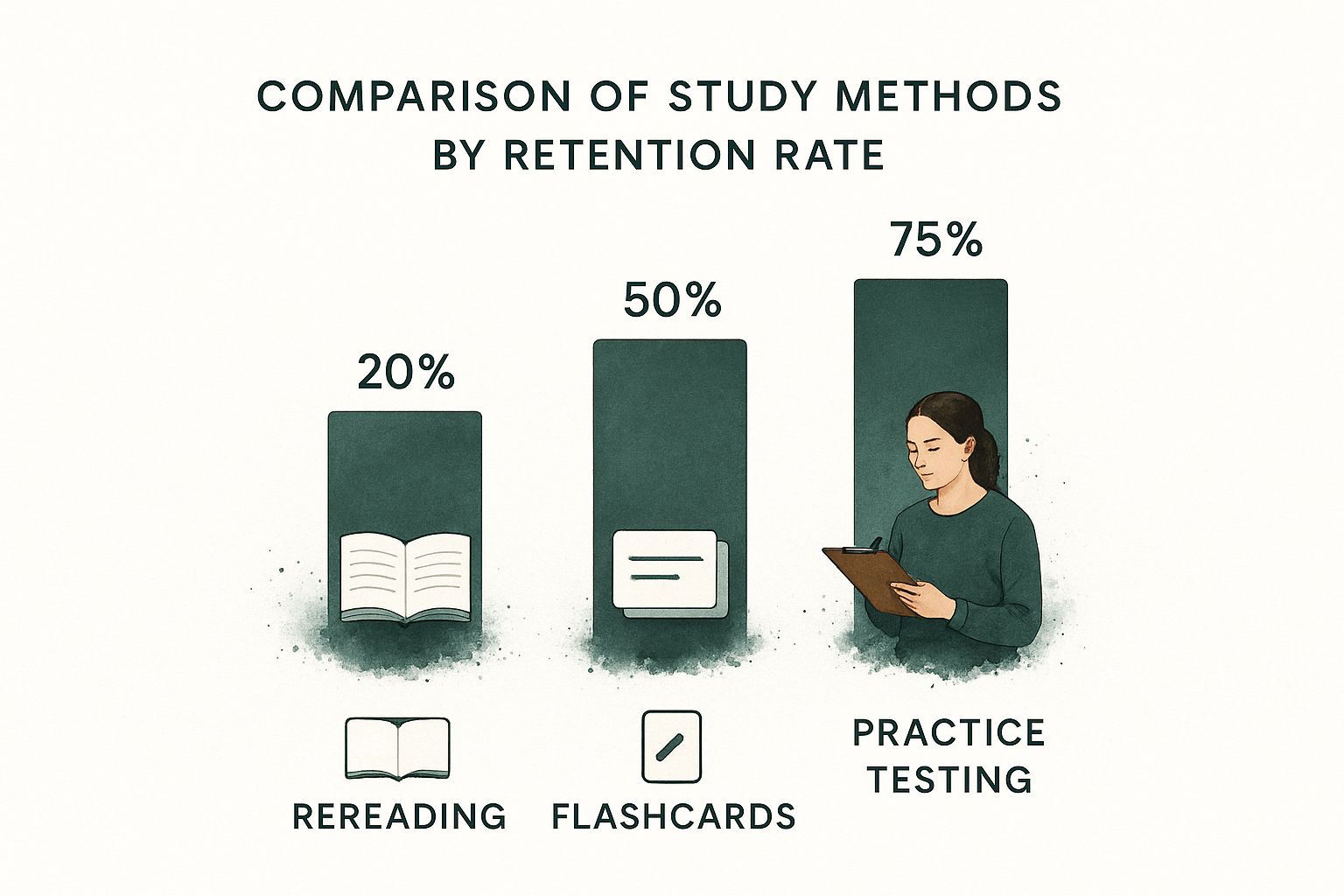
The data doesn’t lie. Actively testing yourself can be almost four times more effective for memory retention than simply rereading your notes—the very thing most students do during those long, unfocused study marathons.
Pomodoro Technique vs Traditional Study Blocks
To see why this works so well, let's compare the Pomodoro Technique to a traditional, long study block. The differences in focus and energy are stark.
| Feature | Pomodoro Technique (e.g., 25/5 min) | Traditional Study Block (e.g., 2 hours) |
|---|---|---|
| Focus Level | High and sustained due to short, intense sprints. | Starts high but drops off significantly over time. |
| Mental Fatigue | Reduced. Regular breaks help reset your brain and prevent burnout. | High. Pushing through exhaustion leads to poor retention. |
| Procrastination | Lower. The idea of "just 25 minutes" makes it easy to start. | Higher. The thought of a two-hour block can feel daunting. |
| Task Management | Encourages breaking down large tasks into smaller, manageable chunks. | Can lead to feeling overwhelmed by the scope of a large topic. |
It's clear that the structured, short-burst approach helps you stay sharp and avoid the mental fog that sets in during long hauls.
The real secret to productivity isn’t about managing your time, but about managing your energy and attention. Strategic breaks aren’t a waste of time; they are a critical part of the work process that keeps you at your best.
By adopting a structured approach, you make time your ally. It helps you build consistency, prevent burnout, and make every minute you spend studying truly count. For a deeper dive into this, check out our detailed guide on practical time management for students. Mastering these skills is a fundamental part of learning how to study effectively for your exams.
Fueling Your Brain for Peak Performance
We spend so much time thinking about how to study for exams—the techniques, the schedules, the note-taking—that we often forget what powers the whole operation: our brain. It’s a biological organ with very real needs. To get it performing at its best, especially under the pressure of final exams, you need to give it the right fuel, proper rest, and a bit of maintenance.
Ignoring these fundamentals is like trying to win a race in a high-performance car filled with the wrong fuel and no oil. It just won't work. Even the most brilliant study strategies will fall flat if your brain is foggy from exhaustion or poor nutrition.
Let's look at a practical toolkit to make sure your body and mind are primed for success.
Eat Your Way to Better Recall
What you eat has a direct and immediate impact on your cognitive function, memory, and ability to focus. While there isn't a single magic "smart food," certain nutrients absolutely play a vital role in brain health and can give you a noticeable edge during revision season.
Think of your brain as being hungry for specific types of fuel.
- Foods rich in omega-3 fatty acids, like salmon, walnuts, and flaxseeds, are essential for building and maintaining brain cells. They're strongly linked to improved memory and thinking skills.
- Antioxidants, found in things like blueberries, spinach, and even dark chocolate, help protect your brain from the stress that comes with intense study.
On the flip side, some foods can actively work against you. Sugary drinks and highly processed snacks are notorious for causing energy spikes followed by dramatic crashes—the absolute last thing you need when trying to focus during a long study session.
Instead, aim for balanced meals with complex carbohydrates (like oats and brown rice), lean proteins, and plenty of vegetables. This will give your brain a steady, reliable supply of energy to keep you going.
The Non-Negotiable Role of Sleep
During exam periods, sleep often feels like a luxury we can’t afford. This is a huge mistake. Sleep is a biological necessity for learning and memory.
While you're asleep, your brain is incredibly busy. It's working to consolidate everything you learned that day, moving information from fragile short-term storage into more stable, long-term memory. Skimping on sleep to cram in a few more hours of study is one of the most counterproductive things you can do.
Research consistently shows that a full night's sleep after learning a new concept significantly improves memory recall compared to staying awake. Think of sleep as hitting the "save" button on your day's work.
Getting quality sleep can be tough when you're feeling stressed. A simple wind-down routine can make a world of difference. Try to avoid screens for at least an hour before bed—the blue light can mess with melatonin production, the hormone that tells your body it’s time to sleep.
Move Your Body to Clear Your Mind
When you’re feeling overwhelmed by study, the last thing on your mind is probably exercise. But here's the thing: even a small amount of physical activity can be one of the most powerful tools for cutting through stress and improving your mental clarity.
Exercise increases blood flow to the brain and triggers the release of endorphins, which are natural mood elevators and stress relievers.
You don’t need to run a marathon. A brisk 20-minute walk is often enough to reset your mind, ease anxiety, and help you return to your desk feeling refreshed and more focused. It’s like a mental palate cleanser, preparing you to absorb the next block of information much more effectively.
Answering Your Top Exam Preparation Questions
Even when you have the best strategies in your toolkit, a few nagging questions always seem to pop up during the intensity of exam season. Getting clear, direct answers is crucial for staying on track and knowing you’re studying effectively when it really counts.

Let's cut through the confusion. Here, we tackle some of the most common questions students face, with some no-nonsense advice for the real-world hurdles of revision.
How Many Hours a Day Should I Realistically Study?
Honestly, there’s no magic number here. The quality of your focus and the consistency of your effort matter far more than just the raw number of hours you spend with your books open.
For most students, aiming for 3 to 6 hours of highly focused, active learning per day is a sustainable and genuinely productive goal. This is so much more effective than slogging through 10 hours of distracted, passive reading.
The secret is to break this time up. A great way to do this is with the Pomodoro Technique—working in focused 25-minute sprints followed by a 5-minute break. It’s a brilliant way to maintain high levels of concentration. And remember, consistent effort spread over several weeks will always beat frantic, last-minute cramming.
What Is the Best Way to Tackle a Difficult or Boring Subject?
We've all been there. Every student has that one subject that just feels like hitting a brick wall. The key isn't to force it; it's to change your approach and engage with the material in a new way.
For a genuinely difficult subject, I always recommend the Feynman Technique.
- Grab a core concept you’re stuck on.
- Try to explain it out loud in the simplest terms you can, as if you were teaching a total beginner.
- This process instantly shines a spotlight on the exact spots where your own understanding is shaky.
For a subject that’s just plain boring, you need to gamify it.
- Turn your notes into a competitive quiz.
- Use flashcard apps that track your score and progress, making it a challenge.
- Find a real-world connection to the material that actually relates to one of your interests.
A pro tip: always tackle these challenging subjects first thing in your study session when your willpower and focus are at their peak.
A hybrid study approach often yields the best results. Use solo time for deep learning and memorisation, then leverage group sessions to test, debate, and solidify that knowledge through active discussion.
Is It Better to Study Alone or in a Group?
The most effective strategy is actually a smart blend of both. Each mode of study serves a distinct and valuable purpose, and you need both in your arsenal.
Solo study is absolutely essential for the initial learning phase. This is your time for deep, uninterrupted focus where you can absorb new information, memorise key facts, and build that solid foundation of knowledge without any distractions.
Group study, on the other hand, is perfect for testing and strengthening what you've learned. Use your study group to:
- Quiz each other on complex topics.
- Debate different viewpoints or solutions.
- Explain concepts aloud to one another (a fantastic form of active recall!).
The golden rule for any group session is to have a clear agenda and stick to it. This prevents the meeting from just turning into a social hour.
How Do I Avoid Burning Out Before the Actual Exam?
Burnout is a very real threat during exam season. Preventing it requires proactive rest, not just trying to push through the exhaustion. Your brain needs that downtime to recover and consolidate memories.
Schedule at least one full day or two half-days off per week where you do absolutely nothing related to your studies. This is non-negotiable. Protect your sleep at all costs, aiming for 7-9 hours a night—this is when most memory consolidation happens.
Also, try to integrate short bursts of physical activity, like a 20-minute walk, into your daily routine. It's amazing for clearing your head and reducing stress. Most importantly, practise self-compassion. Having an off day is completely normal. For more ideas, you can review our collection of top exam study tips.
If you're looking for personalised support to master these techniques and tackle your toughest subjects, Evergreen Tutoring Services is here to help. Our expert tutors provide tailored one-on-one sessions to build your confidence and help you achieve your academic goals. Explore our services at https://www.evergreentutoringservices.com.au.