To really get better at listening, you need to make a conscious shift. It’s about moving from just hearing sounds to actively understanding what’s being said. It's about practising simple techniques like summarising what you've heard, asking smart questions, and intentionally tuning out distractions. This small change turns communication from a one-way broadcast into a real, two-way conversation.
Why Better Listening Is Your Professional Superpower
In a world buzzing with constant digital noise, the ability to genuinely listen is more than just a soft skill—it’s a powerful advantage. Poor listening has real-world consequences. It leads to misunderstandings at work, missed chances for career growth, and unnecessary friction in our personal lives. It’s often the invisible line between a project failing from misaligned goals and a team thriving because everyone is on the same page.
So many of us mix up hearing and listening. Hearing is just a passive, physical process. Your ears work, you hear the noise. Listening, on the other hand, is an active mental game that takes concentration and real effort.
This guide is your roadmap. It’s packed with practical strategies you can start using today to transform how you communicate, whether you're a uni student trying to absorb lectures, a professional navigating team projects, or a parent helping your child develop their own skills.
The first step to getting better is realising that listening is a skill you can build, not some fixed trait you’re born with. Just like any other ability, it gets stronger with focused practice.
The Four Core Types of Listening
To build a solid foundation, it helps to first understand the different ways we actually process what we hear. Think about it: the way you listen to your favourite podcast is completely different from how you listen to a friend who needs to vent. Not all listening is the same.
Recognising these different modes helps you consciously choose the right approach for any situation. Understanding their distinct goals is the key to becoming a more versatile and effective communicator.
| Listening Type | Primary Goal | When to Use It |
|---|---|---|
| Appreciative Listening | To enjoy and derive pleasure from the sound. | Listening to music, a play, or a compelling story. |
| Empathic Listening | To understand the speaker's feelings and perspective. | Supporting a friend, counselling, or resolving conflict. |
| Comprehensive Listening | To learn, understand, and recall information. | Attending a lecture, following instructions, or watching a tutorial. |
| Critical Listening | To analyse, evaluate, and form an opinion. | Evaluating a sales pitch, participating in a debate, or fact-checking news. |
Once you can identify which type of listening a situation calls for, you can adapt your mindset and your responses to connect more effectively. It’s a small piece of knowledge that makes a massive difference in practice.
Mastering The Art Of Active Listening
There's a world of difference between just hearing someone's words and truly listening to what they have to say. When you master active listening, you're making a conscious effort to understand the complete message—not just the words, but the feelings and intent behind them. It's the key to moving from simply nodding along to genuinely connecting with someone.
Think about your next important client meeting, or even a sensitive chat with a friend. In these moments, active listening is one of the most powerful tools you have. It’s all about showing the other person, through deliberate actions, that they have your complete, undivided attention.
Key Techniques for Active Listeners
So, how do you put this into practice? You can start with three core techniques. These might seem simple, but they will immediately make you a more present and insightful communicator.
- Paraphrasing: Try restating what the speaker has just said, but in your own words. For instance, after a colleague outlines a project concern, you could say, "So, if I'm understanding correctly, your main worry is that the timeline is too ambitious with our current resources?" This shows you're engaged and gives them a chance to confirm you’ve got it right.
- Summarising: At natural pauses in a conversation, it’s helpful to briefly recap the main points. In a long meeting, you might offer, "Okay, so far we've agreed on the budget and the marketing channels, but we still need to finalise the launch date." This keeps everyone on the same page and moves the discussion forward.
- Asking Clarifying Questions: Use open-ended questions to dig a little deeper. Instead of just saying "okay," try something like, "Could you walk me through your thinking on that last point?" This invites a more detailed explanation and helps you avoid making assumptions.
Silencing Distractions Inside And Out
One of the biggest roadblocks to active listening is distraction—both from the world around you and from your own busy mind. To really sharpen your listening skills, you have to learn how to manage all that noise.
The real challenge isn't just turning off your phone; it's quieting the internal chatter that pulls your focus away from the conversation. This mental discipline is where true listening begins.
Creating a focused environment is often the first step in cutting down on those external distractions.
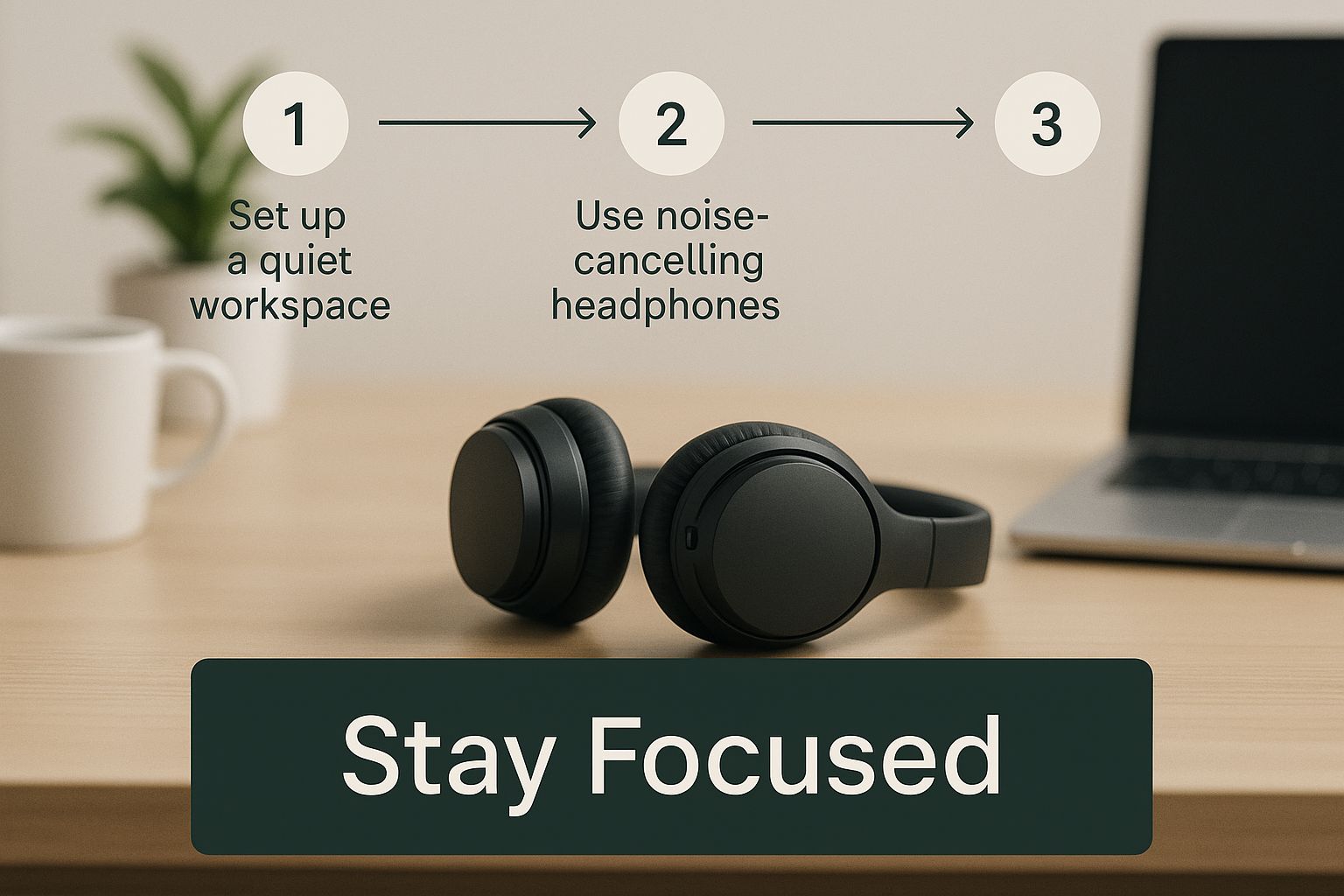
As the image suggests, consciously setting up a quiet space is crucial for effective listening and learning. This is a skill that not only helps in conversations but also strengthens your ability to remember what you learn. For more advice on this, check out our tips for effective learning and how to remember what you learn.
Of course, you can’t always control your surroundings. When that's the case, practice mentally noting your distracting thoughts and setting them aside to deal with later. This simple trick can free up your mental energy, allowing you to fully engage with the speaker.
Practical Exercises to Sharpen Your Listening

Just like any other muscle, your listening skills get stronger with a bit of a workout. The good news is you don’t need to carve out huge chunks of your day for this. The trick is to weave simple, targeted exercises into your daily routine—turning your commute, household chores, or even your downtime into a productive training session.
A fantastic and simple way to start is with what I call the ‘one-minute summary’ drill. After you've listened to a short audio clip—maybe a news bulletin or a segment from a podcast—hit pause. Now, try to explain its main message out loud in just 60 seconds. This exercise is brilliant because it forces your brain to cut through the noise, grab the most important information, and articulate it clearly.
Deeper Listening Drills
Once you’re comfortable with summaries, it's time to dig a little deeper with some critical listening exercises. Next time you're listening to a podcast or an interview, don't just hear what's being said. Instead, start to analyse how it's being said.
Here’s what to listen for:
- Identify Perspectives: Try to figure out the speaker’s point of view. Do they have a potential bias? What's their agenda?
- Analyse Tone: Listen for the emotion behind the words. Is the speaker’s tone passionate, sarcastic, or completely neutral? How does that change the meaning of their message?
- Separate Fact from Opinion: Get into the habit of spotting the difference between a verifiable fact and a speaker's personal belief or interpretation.
This kind of focused listening is a game-changer. It shifts you from being a passive bystander to someone who actively engages with information on a much more profound level.
The real goal here is to move from simply hearing the words to actively pulling apart the entire message. This is how you transform from a passive audience member into an engaged, critical thinker.
From my experience, the fastest progress comes from mixing things up. Combining simple comprehension drills with these more analytical exercises gives you a really well-rounded skillset. In fact, research from Australian universities shows that direct instruction in listening strategies leads to real, measurable improvements. The study also highlighted that students who used multimedia and practised in their own time saw the biggest gains. You can explore the findings of this research on listening comprehension strategies.
These exercises are also incredibly valuable for kids and teens. When you practise active listening with your child, you’re not just having a conversation; you're building foundational skills that will set them up for academic success. For more tips on supporting your child's learning, you might find our guide on how to encourage a child to read helpful.
How to Adapt Your Listening for the Digital Age
Let's face it, our listening habits have changed dramatically. With on-demand media like podcasts and streaming services taking over from traditional radio, we now have an incredible amount of control over what we hear and when we hear it. This shift brings both new challenges and some fantastic opportunities to sharpen our listening skills.
Think about the decline in traditional radio listening. It means we get far less passive exposure to different accents, unique speech patterns, and a broad range of vocabularies. In fact, recent data shows the proportion of Australian adults listening to traditional radio has plummeted from 85% in 2017 to just 65% in 2024. You can read more about these audio trends from ACMA.
This trend highlights a clear move towards more deliberate, on-demand audio consumption. The trick is to turn this modern listening behaviour into an active training exercise. Instead of just letting content wash over you, you can use digital tools strategically to build genuine comprehension.
Turn Digital Content into a Training Ground
It’s entirely possible to transform what feels like passive screen time into a focused, skill-building activity. The controls that every digital platform provides are your new best friends for practice.
Here are a few simple tactics I've seen work wonders:
- Challenge Your Brain with Speed: Almost every video and audio player lets you adjust the playback speed. Try listening to a favourite podcast at 1.25x speed. It might feel odd at first, but it forces your brain to process information faster and really sharpens your focus.
- Embrace Unfamiliar Voices: Make a point to seek out speakers with accents you're not used to. Listening to interviews, documentaries, or talks from different regions trains your ear to adapt to varied cadences and pronunciations. It's a great way to broaden your auditory horizons.
- Use the Power of Pause and Rewind: When you hit a complex idea in an audiobook or a lecture, don't just push through. Hit pause, rewind a few seconds, and listen again. Try to deconstruct the sentence. This simple act turns passive hearing into active, critical analysis.
By consciously using these features, you're no longer just a consumer of media; you're an active participant in your own learning. It’s about being intentional with the content you choose and how you engage with it.
This whole approach gives you a structured way to practice and improve your listening skills on your own schedule, using content you already find interesting. It’s a powerful method to reclaim the diverse listening practice that we’re starting to lose with the decline of traditional media.
Tailoring Listening Skills for Work and Home
Let's be honest, the way you listen to a colleague brainstorming ideas is completely different from how you listen to your child describing their day at school. True listening isn't a single skill; it's about knowing how to adapt your approach to fit the moment, whether you're in a team meeting or sitting at the kitchen table.
Listening Skills for Parents and Educators
For parents and educators, teaching children how to listen is one of the most fundamental parts of their development. This goes far beyond just making sure they follow instructions. It’s about building their ability to understand, feel empathy, and truly learn—skills that are especially vital for children who might have hearing difficulties.
Listening is a skill that needs to be nurtured from an early age. Structured practice doesn't just help with schoolwork; it builds the framework for a lifetime of effective communication and stronger relationships.
Recent Australian research really drives this point home. A study established benchmarks for the Functional Listening Index-Paediatric (FLI-P), a tool that helps clinicians track a child's listening development. This kind of research is brilliant because it supports early detection and helps create tailored support, ensuring every child gets the help they need to thrive. You can read more on this paediatric listening research and its findings.
Listening Skills in the Workplace
In a professional setting, listening skills are just as critical, though they often serve a different purpose. Your ability to listen well has a direct impact on everything from team morale and productivity to the quality of decisions being made.
It's all about switching gears. For instance, you might use empathetic listening during a team meeting to genuinely understand a colleague’s concerns about their workload. This builds trust and a much more supportive environment. On the flip side, you'll need to lean on critical listening when you’re analysing a sales pitch to separate the hard facts from the fluff.
Of course, just staying focused can be a huge challenge, especially with the rise of back-to-back virtual calls where distractions are only a click away. For some practical advice on staying tuned in, our guide on how to manage remote learning and stay sane has some great tips that are just as useful for professionals as they are for students.
Answering Your Top Questions About Listening Skills
We’ve covered a lot of ground on the journey to becoming a better listener. To help bring everything together, let's go over some of the most common questions people ask when they start focusing on this crucial skill.
Think of this as a quick-reference guide to keep you on track.
What’s the Fastest Way to Improve My Listening?
If you're looking for one change that makes an immediate difference, it's this: active summarising.
The next time you're in a conversation, make a real effort to mentally recap what the other person is saying as they go. Then, when there’s a natural pause, check your understanding. You could say something simple like, "So, if I've got that right, you’re saying that…" This single habit forces you to listen with intention and shows the other person you're truly engaged.
How Can I Listen Better When I’m Always Distracted?
Distractions are a huge barrier, but you have more control than you think. Start with your environment. Put your phone away—and I don’t mean just face down on the table. Put it completely out of sight. Close those extra tabs on your computer.
What about those internal distractions—the mental to-do list that pops up at the worst times? Keep a notepad nearby. When a random thought interrupts you, jot it down to deal with later. This little trick of 'parking' the thought clears your mind and lets you refocus on the conversation.
It’s a surprisingly powerful way to stay present.
Can I Really Practise Listening Skills by Myself?
Absolutely. Practising on your own is a fantastic, no-pressure way to sharpen your listening abilities. Here’s a simple exercise you can try today:
- Pick some content: Find a podcast, an audiobook, or a TED Talk you find interesting.
- Listen for a short burst: Play a 5-minute segment without stopping or getting distracted.
- Summarise it out loud: Pause the audio and, speaking out loud, try to explain the speaker’s main idea and at least two or three of their key points.
This drill is brilliant for training your brain to filter through noise and hold onto the most important information—a core skill for any great listener.
At Evergreen Tutoring Services, we know that strong listening skills are the foundation of all learning. Whether for a primary school student or an adult learner, our personalised tutoring focuses on building these essential communication abilities. Discover how our one-on-one approach can help you or your child become a more confident and effective learner.