If you are looking for some help with mathematical methods circle symmetry, then you are in the right place! Read through our break down of how to complete circle symmetry questions with confidence.
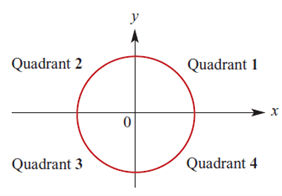
The unit circle is comprised of four quadrants. The y and x-axis break up each quadrant. These quadrants are numbered going anticlockwise from the positive x-axis as seen to the right.
As you may know. The x-axis in the unit circle is the number given by the expression cos(∅), and the y axis is sin(∅) where ∅ is the angle moving anticlockwise from the positive x-axis. Knowing this, we can use symmetry to determine relationships between the circular functions for angles in different quadrants.
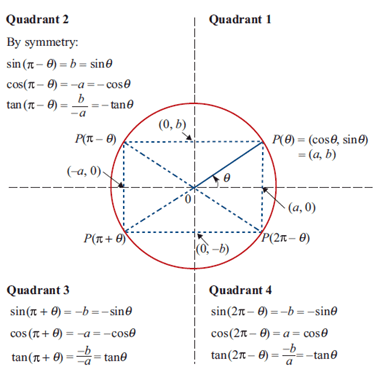
This graph summarises the rules of symmetry, but let’s explore it further:
We see the angle ∅ which is highlighted green in the diagram. Since we know that the angle ∅ is the angle moving away from the x-axis, this gives an element of symmetry as the angle can move in different directions from x.
For example:
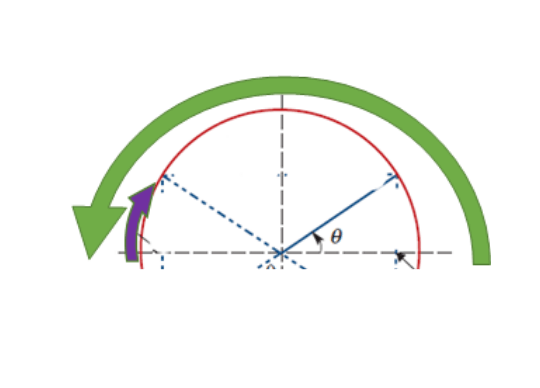
Sin (∅) = b and cos (∅) = a where these are both in quadrant 1. Let’s now flip the angle ∅ across the y axis. We now see that to get to this angle, we must take 2 steps:
1) Get the value of the closest x axis to the angle
2) Add or subtract the angle ∅ from the x axis value
For the following example, we see that the closest x-axis to the flipped angle is the negative x-axis. The value of this part of the graph is π or 180o, so we start with sin(π)
or sin(180o).
We will use π for this example.
The next step is to add or subtract q from what we have. Looking at the example, we see that ∅ is flipped and is being subtracted from what we already worked out. This leaves us with the angle: sin(π –
As we mentioned earlier, sine is the value given along the y-axis. Looking at our example, we can see that the value of y is positive in quadrant 2. Therefore we can say that:
sin(π – ∅) = b
If we take the same example from previously, but instead we see what the cosine value is, we see the angle is still going to be (π – ∅) however this time it is cos so cos(π – ∅). Looking at the graph, we know that cosine values are given along the x-axis. This angle sits in the 2nd quadrant, which gives a negative value of x. Therefore we can say that:
cos(π – ∅) = -a
The positive and negative values of the angles in different quadrants can be summed up by the diagram.
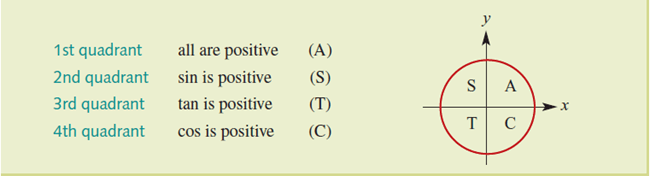
The best way to remember the signs of sin, cos and tan in these quadrants is the ‘ACTS’ diagram shown. If an angle lands in any of these quadrants, the designated sign is given the positive value in that section.
Examples:
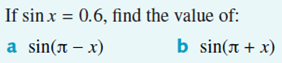
a. First we must distinguish which quadrant it is in. As we can see, it is (π – x). We have π which we know lies on the x-axis. We then have the angle x being subtracted from π. As you can see in the diagram to the right that is in quadrant 2. Using acts, any angle of sin in quadrant 2 becomes a positive value. Therefore, the answer to sin(π – x) = sin(π ) = 0.6
b. Similar to the previous question, we start with π. This time we are adding x to π. As we can see, adding x brings the angle into quadrant 3. In quadrant 3, sin gives a negative value. Therefore, the answer to
sin(π + x) = – sin(π) = – 0.6
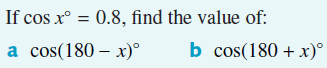
- This question is the same as the previous example, only this time instead of using radians ‘p’ we are using degrees. First, you must see the π = 180o. From here, the next step is, like in the previous example, subtract x from 180o. This leaves you in quadrant two. In this quadrant, cos gives negative values. Therefore, the answer to cos(π – x) = – cos(π) = – 0.8