Critical thinking is the skill of objectively analysing information to form a reasoned judgement. It's the difference between memorising a fact and asking, "Is this fact accurate? Where did it come from? What does it imply?" By questioning, interpreting, and weighing evidence, you can move beyond surface-level knowledge to form your own informed conclusions.
Why Critical Thinking Is a Must-Have Skill Today
Critical thinking is the foundation of academic and professional success. For a student, it transforms learning. Instead of simply recalling information for an exam, they can deconstruct a complex maths problem, analyse a character's motives in a novel, or evaluate the credibility of sources for a history assignment.
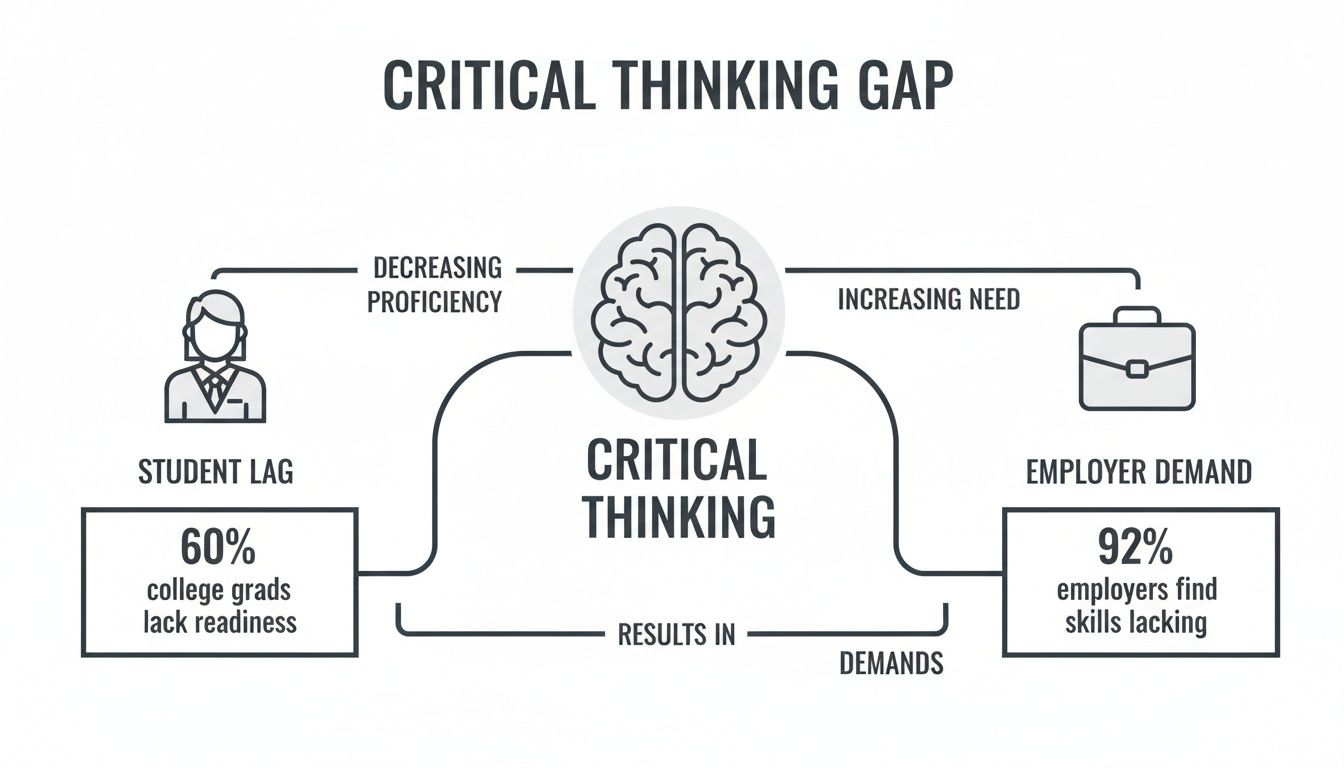
The demand for these abilities has never been higher. As automation reshapes the workforce, employers are prioritising candidates who can solve novel problems and think independently.
Critical thinking is no longer a soft skill—it's a core competency for navigating a world saturated with information. It's what prepares students for jobs that don't even exist yet.
A Simple Framework For Thinking Critically
Developing critical thinking skills isn't about memorising a complex formula. It's about building a set of concrete, teachable habits that change how you approach information. A structured approach makes it easier to tackle any problem, whether it's a school assignment or a major life decision.
This structured development is crucial for bridging the gap between classroom learning and career readiness.
The Australian Council for Educational Research (ACER) has broken down this process into five core skills. These pillars provide a clear roadmap for anyone looking to improve their analytical abilities.
Here are the five pillars ACER identifies:
- Interpretation: Understanding what information means and explaining it clearly.
- Analysis: Identifying the assumptions and reasons behind an argument.
- Inference: Drawing reasonable conclusions from available evidence.
- Evaluation: Judging the credibility and logic of a statement or argument.
- Explanation: Clearly stating your reasoning and supporting it with proof.
Let's see how these skills apply in a practical classroom scenario.
The Five Pillars of Critical Thinking (ACER Framework)
| Core Skill | What It Means | Example in Action (HSC English) |
|---|---|---|
| Interpretation | Grasping the meaning of different types of information and being able to express it clearly. | A student reads a poem by Sylvia Plath and can summarise not just the literal events, but also the underlying tone of despair and frustration. |
| Analysis | Identifying the unstated assumptions, biases, and reasons that form the foundation of an argument. | When analysing an opinion piece, the student identifies that the author’s argument rests on the unproven assumption that technology is the sole cause of social isolation. |
| Inference | Using available evidence to draw logical conclusions that aren't explicitly stated. | After reading a chapter of Nineteen Eighty-Four, a student infers that the constant surveillance is designed to crush psychological independence, not just prevent crime. |
| Evaluation | Assessing the credibility of sources and the logical strength of arguments. | The student compares two different critical essays on the same novel, judging which one presents a more logical and well-supported argument based on textual evidence. |
| Explanation | Articulating your reasoning and justifying your conclusions in a clear, coherent way. | In an essay, the student writes a concluding paragraph that not only restates their contention but also clearly justifies it by linking back to the key evidence they analysed. |
Mastering these pillars often starts with a foundational skill: learning how to break down complex questions into simpler parts. Once you can do that, the rest becomes far more manageable.
Practical Exercises to Build Your Skills
Theory is one thing, but action is where real growth happens. Developing critical thinking comes down to consistent practice. These exercises can be woven into daily learning.
For younger students, start with simple activities. A great exercise is to take statements from a story or news article and sort them into two columns: facts and opinions.
- Fact: "The story is set in Australia." (Verifiable)
- Opinion: "The main character was brave." (Subjective)
This builds the foundational skill of distinguishing objective truth from subjective viewpoints.
Another powerful tool is the ‘Five Whys’ technique. When faced with a problem, ask "why?" five times to drill down to the root cause.
- Problem: The plant is wilting.
- Why? It's not getting enough water.
- Why? The soil is dry.
- Why? I forgot to water it yesterday.
- Why? I was busy with homework.
- Why? I didn't set a reminder.
- Solution: Set a daily reminder to water the plant.
Activities for Older Students
For high school and university learners, apply the same principles to more complex material.
- Deconstruct News Articles: Analyse two articles covering the same event from different outlets. Highlight biased language, identify missing information, and compare the perspectives.
- Use the Socratic Method: When writing an essay, challenge your own assumptions with probing questions. "Is this always true?" "What's the counter-argument here?" "What evidence contradicts this point?"
- Stage a Debate: A structured debate forces students to research both sides of an issue, build a logical position, and defend it with evidence—even if they don't personally agree with it.
These exercises are directly linked to academic performance, as strong critical analysis is key to improving reading comprehension skills.
Using Creativity to Sharpen Critical Analysis
Creativity and critical thinking are deeply connected. Strong analysis often begins with a creative spark—generating multiple possibilities before narrowing them down with logic.
For instance, when analysing a historical event, don't just accept the first interpretation. Instead, creatively brainstorm five different perspectives:
- The economic perspective.
- The political perspective.
- The social perspective of a specific group.
- The long-term impact perspective.
- A contrarian or overlooked perspective.
Only then do you switch to critical thinking, using evidence to test each idea and build a case for the most convincing one.
This combination is a core part of the Australian curriculum's ‘Critical and Creative Thinking’ capability. A 2022 PISA assessment showed Australian students ranked 4th out of 81 countries in creative thinking, revealing a natural strength in generating original ideas. You can read more in this AARE research summary. The challenge is channelling this creativity into a structured analytical process.
This powerful duo is vital when learning how to write a persuasive essay, where exploring multiple viewpoints before constructing your core argument is key to success.
Overcoming Common Thinking Traps
Developing critical thinking isn't just about learning new strategies; it's also about recognising and unlearning the mental shortcuts and biases that lead us astray.
One of the most common is confirmation bias—our tendency to favour information that confirms what we already believe. This creates an echo chamber that prevents us from seeing the full picture.
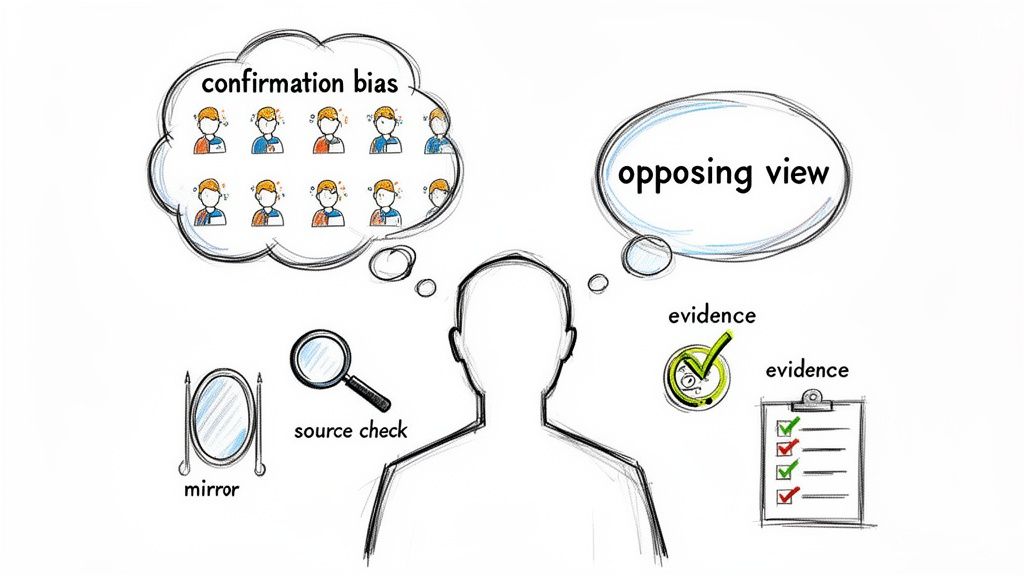
Other challenges include the fear of being wrong, which can stifle curiosity, and the difficulty of spotting misinformation. Tackling these requires deliberate, practical strategies.
Actionable Strategies to Stay Sharp
To fight back against these common traps, integrate these habits into your thinking process:
- Play Devil's Advocate: Actively argue for the opposing viewpoint. This forces you to engage with different perspectives and strengthens your own argument by revealing its weaknesses.
- Vet Your Sources: Don't accept the first Google result. Ask: Who wrote this? What is their expertise? Is this evidence-based or opinion? A university study is more credible than an anonymous blog post.
- Embrace 'I Don't Know': Admitting uncertainty is a sign of intellectual strength, not weakness. It's the first step toward genuine learning.
By consciously practising these techniques, you build the mental resilience needed to think clearly and confidently.
Common Critical Thinking Roadblocks and How to Navigate Them
This table is a quick guide to spotting common obstacles and applying actionable strategies to overcome them.
| Common Obstacle | What It Looks Like | Actionable Strategy to Overcome It |
|---|---|---|
| Confirmation Bias | Only seeking out news or data that supports your existing view. You might dismiss opposing evidence as "biased" or "wrong" without really looking at it. | Actively search for three credible sources that argue against your position. Try to summarise their main points fairly before you form your final opinion. |
| The Dunning-Kruger Effect | Feeling overconfident in your knowledge about a topic where you're actually a beginner. You might think, "This is easy, I get it," without realising the hidden complexities. | Find an expert or a more experienced peer and try to explain the concept to them. Their questions will quickly reveal the gaps in your understanding. |
| Analysis Paralysis | Getting so overwhelmed by information and options that you can't make a decision. You're stuck in the research phase, afraid to commit to a conclusion. | Set a "research deadline." Give yourself a fixed amount of time (e.g., one hour) to gather information, then force yourself to make a decision based only on what you have. |
| Emotional Reasoning | Letting your feelings dictate your reality. You might think, "I feel anxious about this, so it must be a bad idea," without any logical evidence. | Write down the facts of the situation separately from how you feel about them. Ask yourself: "If I felt completely calm, what would the logical next step be?" |
Recognising these patterns is half the battle. Once you can name the trap, it becomes much easier to use a specific strategy to climb back out.
Your Top Questions, Answered
Here are answers to some of the most common questions about developing critical thinking skills.
At What Age Should We Start Teaching Critical Thinking?
You can start fostering critical thinking from a very young age. For preschool and primary children, it's about weaving curiosity into daily life. Ask "why?" and "what if?" during story time or while playing. For example, "Why do you think the wolf wanted to blow the house down?" or "What would happen if we built the tower with round blocks instead of square ones?" The formal strategies kick in during secondary school, but these foundational habits of questioning should start early.
How Can I Actually Tell If My Child Is Improving?
Look for changes beyond grades. A key sign is when they start asking more thoughtful, probing questions instead of accepting information at face value.
You’ll know it’s working when they can confidently explain the reasoning behind an answer, especially in Maths or Science, not just state the final result. They will also get much better at spotting inconsistencies in arguments or pointing out when something doesn't quite add up.
This shift from focusing on the what to digging into the why is the clearest indicator of progress.
Are These Skills Really Only for Humanities Subjects?
Not at all—this is a common misconception. Critical thinking is vital in every subject. In STEM, it's the engine of genuine understanding. It's what allows a student to grasp the logic behind formulas in physics, properly interpret experimental data in biology, and design creative solutions to coding problems in digital technologies. In any field, it’s the skill that moves a student beyond memorisation and toward true innovation.
If you're looking for personalised support to build these essential skills, Evergreen Tutoring Services offers one-to-one online tutoring designed to strengthen your child’s analytical abilities and academic confidence. Explore our programs and see how a dedicated tutor can make a difference.