The fastest way to learn times tables is to ditch pure memorisation and focus on understanding number patterns and relationships. Instead of forcing a child to recall over 100 isolated facts, you can teach them practical strategies like skip counting, doubling, and using fact families. A study from Cambridge Mathematics supports this, highlighting that seeing times tables "as a connected body of knowledge" leads to faster, more meaningful recall by building genuine number sense. This approach builds mathematical confidence and makes learning quicker and less stressful.
Move Beyond Rote Learning for Faster Recall
Many of us learned our times tables through endless drills. While well-intentioned, rote learning often teaches kids that maths is about memorising disconnected facts, not understanding how numbers work. This can lead to anxiety and quick forgetting because the information isn't stored in a meaningful way.
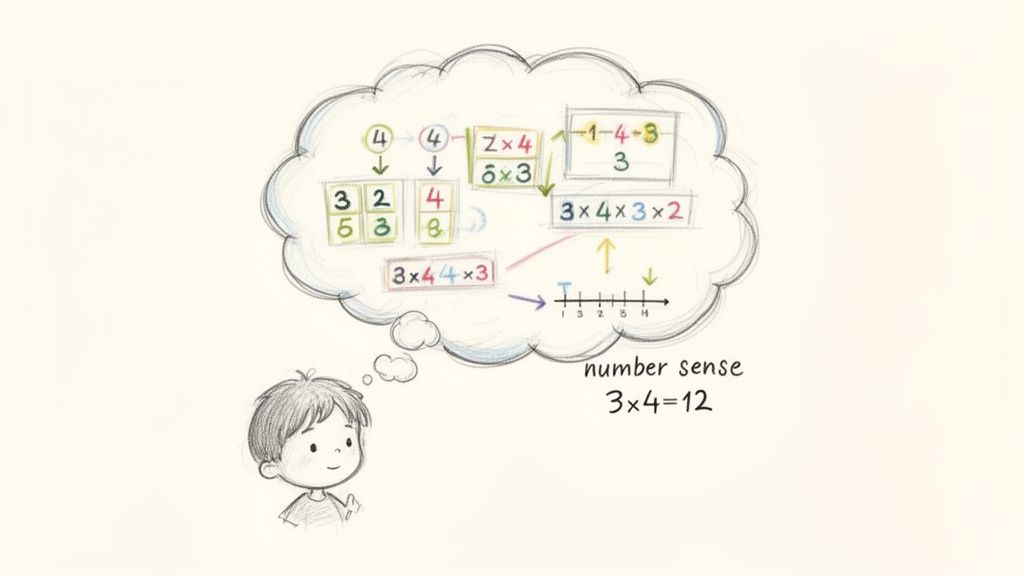
The secret to learning times tables fast isn't drilling harder; it's building number sense—an intuitive feel for how numbers relate to one another.
When a child has good number sense, they don't just see 7 x 8 = 56 as a random fact. Instead, their brain makes connections:
- Practical Example: "I know 7 x 4 is 28. Since 8 is double 4, I just need to double 28, which is 56."
- Practical Example: "I know 7 x 10 is 70. This is two groups of 7 less than that, so 70 minus 14 is 56."
- Practical Example: "I know 7 x 7 is 49. I just need to add one more 7… 49 plus 7 is 56."
This flexible thinking is the cornerstone of mathematical fluency. It transforms multiplication from a daunting list of facts into a connected, logical system that makes sense.
The Problem with Memorisation Alone
Focusing only on memorisation creates roadblocks. Without understanding the why behind the facts, kids have no backup plan when memory fails, especially under pressure. A child relying only on recall might freeze when asked "What is 6 x 7?".
In contrast, a child with number sense can pivot. They might think, "I know 5 x 7 is 35, so I just need to add one more 7… that's 42!" This ability to reason is infinitely more valuable than reciting a memorised answer. This foundational understanding is also critical for success in more complex maths like division, fractions, and algebra. For a deeper dive, our guide on improving mental maths skills explores building these connections.
Shifting Your Mindset as a Parent
The first step is to shift your own perspective. Let go of the idea that speed is the only goal and focus on exploration, strategy, and understanding.
Here are a few actionable ways to foster number sense:
- Encourage "maths talk": Ask your child how they got an answer, not just if it's right. You might hear a clever strategy like, "To get 6 x 8, I did 5 x 8 = 40 and then added one more 8."
- Use visual aids: Arrange Lego bricks in neat rows and columns (arrays) to show what "3 groups of 4" actually looks like.
- Celebrate the strategy: Praise clever thinking, even if there's a small calculation error. The process is what's important.
By embracing this approach, you're building a resilient, confident mathematician who understands that maths is a tool for thinking.
Lay the Groundwork Before You Multiply
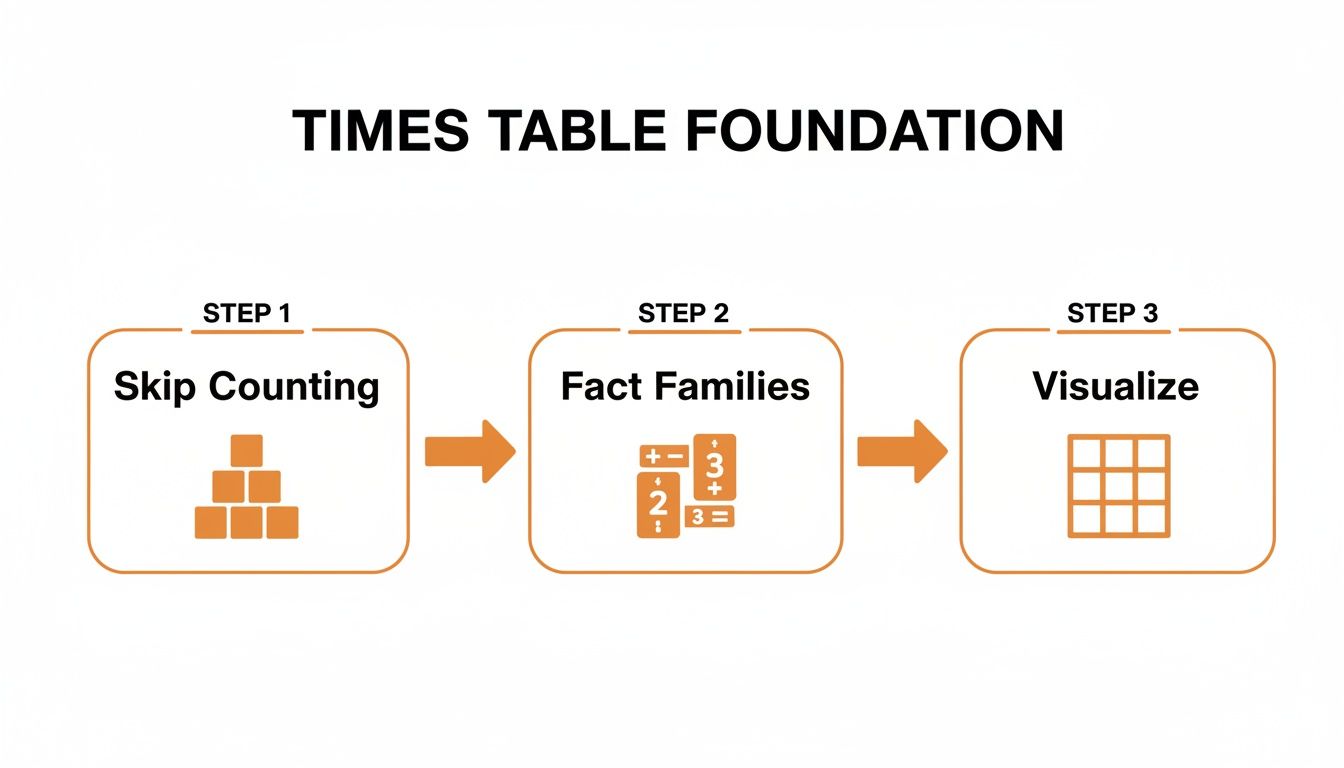
Trying to teach times tables before a child is ready is like building a house without a foundation. Before you bring out multiplication charts, a few core skills need to be in place. This groundwork ensures your child understands what multiplication is. This teaching method is often called scaffolding. You can explore our guide on what scaffolding in education is.
Start with Skip Counting
First, master skip counting. This is the natural gateway to multiplication because it introduces repeated addition in a simple, rhythmic way. A child who can confidently count by 2s, 5s, and 10s has a huge head start.
Actionable ways to practice skip counting:
- Count Coins: Grab a handful of 5c or 10c coins and count them up. This provides a tangible, real-world connection.
- Pair Up Items: When putting away shoes or socks, count them in twos. This naturally reinforces the pattern of doubling.
- Tell the Time: The minutes on a clock face are a perfect, visual way to practise counting by fives.
Introduce Fact Families to Halve the Workload
Once skip counting is second nature, introduce fact families. This powerful concept instantly cuts the number of facts to learn almost in half by showing how multiplication and division are two sides of the same coin.
Take the numbers 3, 4, and 12. They belong to a fact family:
- 3 x 4 = 12
- 4 x 3 = 12
- 12 ÷ 3 = 4
- 12 ÷ 4 = 3
For early learners, the most important part is the commutative property: the idea that 3 x 4 is the same as 4 x 3. Realising that 7 x 8 and 8 x 7 give the same answer means a child doesn't have to learn two separate facts. This dramatically reduces the mental load.
Make Multiplication Visual with Arrays
The final piece is helping your child see what multiplication looks like. An array is just a set of objects arranged in neat rows and columns.
To show 3 x 5, you could:
- Arrange Lego bricks in three rows of five.
- Draw three rows of five stars on a whiteboard.
- Line up crackers on a plate in three rows of five.
This hands-on method connects the equation to a tangible result, moving it beyond abstract symbols. It helps them grasp that multiplication is just a fast way of counting equal groups.
Learn Times Tables Strategically in Manageable Chunks
The secret to learning times tables fast is to stop seeing them as one giant mountain to climb. Instead, use a strategic method called chunking, which groups similar facts together. This allows your child to build momentum with each new set they master.
Mastering skip counting and understanding fact families are essential groundwork. We've broken down the order most students find easiest. It starts with tables that have simple rules and builds from there.
A Strategic Order for Learning Times Tables
This table outlines a logical sequence for tackling the times tables, grouped by the strategy used.
| Learning Tier | Times Tables to Focus On | Key Strategy or Trick |
|---|---|---|
| Tier 1: The Easy Wins | The 0s, 1s, 10s, and 5s | Simple rules and obvious patterns. |
| Tier 2: Doubling Up | The 2s, 4s, and 8s | Using the "double" and "double again" technique. |
| Tier 3: Building Connections | The 3s and 6s | Skip counting and then doubling the 3s facts to get the 6s. |
| Tier 4: The Final Few | The 9s and 7s | Clever tricks for the 9s and using elimination for the 7s. |
Start with the Easy Wins
The first chunk covers tables with simple, predictable rules: the 0s, 1s, 2s, 5s, and 10s. Nailing these provides a huge confidence boost.
- The 0s and 1s: Anything multiplied by 0 is 0; anything multiplied by 1 is itself.
- The 10s Table: Just add a zero to the end of the number (e.g., 7 x 10 = 70).
- The 5s Table: Answers end in 5 or 0. Link this to telling time on an analogue clock.
- The 2s Table: This is just doubling. If a child can add 6 + 6, they know their 2 times table.
Use Doubling for the 4s and 8s
Once the 2s are solid, move to the 4s and 8s. These are related through a strategy called double and double again.
Practical Example for 4 x 6:
- Solve for 2 x 6, which is 12.
- Double that answer: 12 + 12 = 24.
- Therefore, 4 x 6 = 24.
The 8s table is one step further. Double the 4s table answer.
Practical Example for 8 x 3:
- Start with the 2s fact: 2 x 3 = 6.
- Double for the 4s fact: 6 + 6 = 12 (so 4 x 3 = 12).
- Double again for the 8s fact: 12 + 12 = 24 (so 8 x 3 = 24).
This doubling strategy reinforces the connections between numbers, turning memorisation into a problem-solving exercise.
Build on Known Facts for the 3s and 6s
Next are the 3s and 6s tables. Start with the 3s, which is perfect for skip counting (3, 6, 9, 12…). Once the 3s are familiar, the 6s are easier because every answer is double the corresponding answer in the 3s table.
Practical Example for 6 x 7:
- First, figure out the 3s fact: 3 x 7 = 21.
- Now, double that answer: 21 + 21 = 42.
- So, 6 x 7 = 42.
Demystify the Tricky 7s and 9s
Finally, tackle the 7s and 9s. By this point, many facts have already been learned (e.g., 7×2, 7×5, 7×8). The remaining few just need focused practice. The 9s table is full of brilliant tricks.
The Finger Trick for the 9s Table:
- Hold both hands up, palms facing away.
- To solve 9 x 4, count to your fourth finger from the left and fold it down.
- The fingers to the left of the folded one are the tens (3).
- The fingers to the right are the ones (6).
- The answer is 36.
Another pattern: the digits of the answer for the 9s table always add up to 9 (9 x 8 = 72; 7 + 2 = 9). This is a great self-checking trick.
Make Daily Practice Engaging and Fun
Consistent practice turns understanding into fast recall, and it doesn't have to be a chore. The goal is to make it a natural, enjoyable part of the day.
Short, frequent sessions of 10-15 minutes a day are more powerful than long study blocks. This approach, known as distributed practice, moves information to long-term memory and turns practice into a positive habit.
Turn Everyday Moments into Practice Opportunities
Weave practice into activities your child already enjoys.
- In the Car: Spot a licence plate with a '4' and a '6'. Ask, "Quick, what's 4 times 6?"
- At the Dinner Table: Roll two dice. The first person to multiply the numbers and call out the answer gets a point.
- With a Deck of Cards: Remove face cards. Flip two cards and multiply their values (Ace = 1). "Multiplication War" is a fantastic way to fly through facts.
These micro-sessions keep the brain engaged without causing frustration.
The Role of Technology and Timed Drills
High-quality apps can make learning interactive and provide instant feedback. Look for apps that focus on strategy and patterns over pure speed.
Actionable Insight: Frame timed practice as a personal challenge. Use a stopwatch and encourage your child to beat their own previous score. This shifts the focus from "Am I fast enough?" to "Can I get better?"
Creating a Low-Stress Practice Environment
Your attitude has a massive impact.
- Focus on Effort, Not Just Accuracy: Praise the use of a clever strategy, even if the answer is wrong. Say, "I love how you used your 5s facts to figure that out!"
- Mix It Up: Alternate between card games, dice rolls, apps, and verbal quizzing to keep things fresh.
- Know When to Stop: If frustration builds, call it a day. It's better to end on a positive note than to push through tears.
Know When to Seek Extra Support
Sometimes, despite the best strategies, a child keeps hitting a wall. This isn't a failure; it’s a signal that a more personalised approach might be needed. Persistent roadblocks can point to deeper issues that games and drills alone might not solve.
Signs a Different Approach Is Needed
Pay attention to consistent patterns of difficulty. Common signs include:
- Persistent Maths Anxiety: Outright avoidance, physical complaints like a sore tummy, or a complete shutdown when faced with numbers.
- Difficulty Retaining Facts: You practise the 4s table on Monday, and by Wednesday, it’s gone. This could signal an underlying memory-retention challenge.
- Gaps in Foundational Knowledge: A struggle with multiplication might stem from a shaky grasp of repeated addition or skip counting.
Seeking help is a proactive step. A specialist can diagnose the specific challenge and provide tailored strategies that align with your child’s learning style.
How Personalised Tutoring Can Help
A great tutor acts like a maths detective. They can pinpoint where the breakdown is happening and create a supportive environment where it feels safe to make mistakes. A one-to-one setting allows for a custom-fit approach. If you're exploring this, learning about the benefits of one-to-one tutoring can help you decide if it’s the right fit. The goal is to build a healthier relationship with maths, turning "I can't" into "I can try."
Questions That Always Come Up
Here are quick, practical answers to common questions.
How Long Should This Actually Take?
Every child learns at their own pace, so throw out any strict deadlines. With the chunking method and short, daily practice, mastering a new table every week or two is a reasonable goal. Most kids can achieve confident recall up to 10×10 in a few months. The key is ensuring they understand the patterns, which prevents them from having to constantly re-learn memorised facts.
What If My Child Has Maths Anxiety?
The first step is to take all pressure off. No stopwatches or timed tests. Frame practice as "playing with numbers."
- Make it a game: Use dice, cards, or LEGO to make it hands-on.
- Praise the effort: Celebrate how they think, even if the result isn't perfect.
- Stay positive: A calm, encouraging environment is your greatest tool. If anxiety persists, a specialist tutor can provide focused, one-on-one support to rebuild confidence.
Are Online Games and Apps a Waste of Time?
Not at all, when used as a supplement. The best apps reinforce concepts like skip counting or using known facts to solve trickier ones. They provide instant feedback and can make practice feel like play. Just look for options that prioritise strategy over pure speed, and use them to add variety to the routine.
At Evergreen Tutoring Services, we believe every child can feel successful in maths with the right support. If you're looking for personalised strategies to help your child build confidence and truly master their times tables, take a look at our tailored one-to-one online tutoring at https://www.evergreentutoringservices.com.au.