Choosing a homeschooling curriculum in Australia isn’t about picking a single, government-approved program off a shelf. It’s more like being an architect for your child's education. You get to create a personalised learning plan using resources that not only meet your state's requirements but also resonate with your child’s unique way of learning. It’s a flexible framework you build, not just a product you buy.
Starting Your Homeschooling Journey in Australia
More families are discovering the freedom and personal touch that homeschooling provides. The number of registered homeschool students in Australia has grown significantly, with a 2023 report from the Australian Journal of Education noting a near-doubling of numbers in some states between 2019 and 2022. This isn’t just a small trend; it reflects a genuine shift towards education that’s built around the individual child.
This journey is about crafting an education that fits your family like a glove. The first few steps can feel big, but they are all manageable when taken one at a time.
Your actionable first steps are:
- Actionable Insight: Download the specific registration forms from your state's education department website (e.g., NESA in NSW, VRQA in Victoria) to see exactly what information is required.
- Actionable Insight: Schedule a family meeting to discuss your educational goals. What do you want your child to learn beyond academics? This could be life skills, a specific trade, or a deep dive into a passion project.
- Actionable Insight: Observe your child for a week. Note when they are most engaged. Is it during a hands-on building project, while listening to a podcast, or when drawing a concept? This provides direct clues to their learning style.
Breaking the process down makes it less overwhelming. To get you started on the right foot, our guide on homeschooling for children dives deeper into these initial steps, helping you begin with confidence.
To help organise your thoughts, here’s a quick overview of the essential factors you’ll need to weigh up as you get started.
Key Considerations for Starting Homeschooling in Australia
This table breaks down the main areas you'll need to research and decide on as you prepare your homeschooling plan.
| Consideration | Key Focus Area | Practical Example & Verifiable Source |
|---|---|---|
| State Registration | Legal requirements, documentation, and reporting obligations. | NESA in NSW requires a detailed educational plan mapped to NSW syllabuses. Source: NESA website. |
| Curriculum Approach | Deciding between structured programs, unschooling, or an eclectic mix. | You might choose a structured maths program but follow an interest-led approach for history. |
| Learning Styles | Identifying if your child is a visual, auditory, kinaesthetic, or combination learner. | A kinaesthetic learner might grasp fractions by baking, using measuring cups. |
| Family Goals & Values | Aligning educational choices with your family's beliefs and lifestyle. | A family that values environmentalism could build science lessons around local conservation projects. |
Thinking through these points will give you a solid foundation, turning what might feel like a huge task into a clear, actionable plan for your family’s educational journey.
Getting Registered: The Paperwork Side of Homeschooling
Let's be honest, the legal side of homeschooling can feel intimidating. But once you understand the rules for your state or territory, you’ll see it’s perfectly manageable.
While every state has its own registration process, they all share the same goal: ensuring every child receives a quality education. This isn't about jumping through hoops; it's about showing you've got a solid plan. Essentially, you’ll need to submit a learning plan that maps out your educational goals and shows how you'll cover the key learning areas (KLAs) outlined in the Australian Curriculum.
Actionable Insight: Create your learning plan in a digital document. Use headings for each KLA (English, Maths, Science, etc.). Under each, list the specific resources you’ll use (e.g., "Maths: Khan Academy Grade 5, supplemented with board games like Prime Climb") and the topics you'll cover each term. This document becomes your roadmap and your primary piece of evidence for registration.
Finding the Right Homeschooling Approach for Your Family
There’s no single "best" homeschooling curriculum in Australia. The perfect fit depends on your educational philosophy and your child’s learning style. The homeschooling world offers a huge range of approaches, from highly structured, all-in-one packages to completely interest-led learning.
Let's break down some of the most popular paths.
Common Homeschooling Styles
On one end, you have structured, ‘All-in-One’ curricula. This is a fantastic option for parents who are just starting out or who feel most comfortable with clear guidance.
On the other, you have flexible methods. The ‘Eclectic’ approach means you curate your child's education, mixing and matching resources. This is brilliant for tailoring materials to your child's needs. To do this well, it helps to understand what the different kinds of learners are so you can choose resources that genuinely click.
Then there's ‘Unschooling’, the most child-led approach. This style follows a child’s natural curiosity, with learning happening organically through real-life experiences.
The decision tree below visualises these first critical steps—planning your approach, mapping it to state requirements, and figuring out how you’ll record your progress.
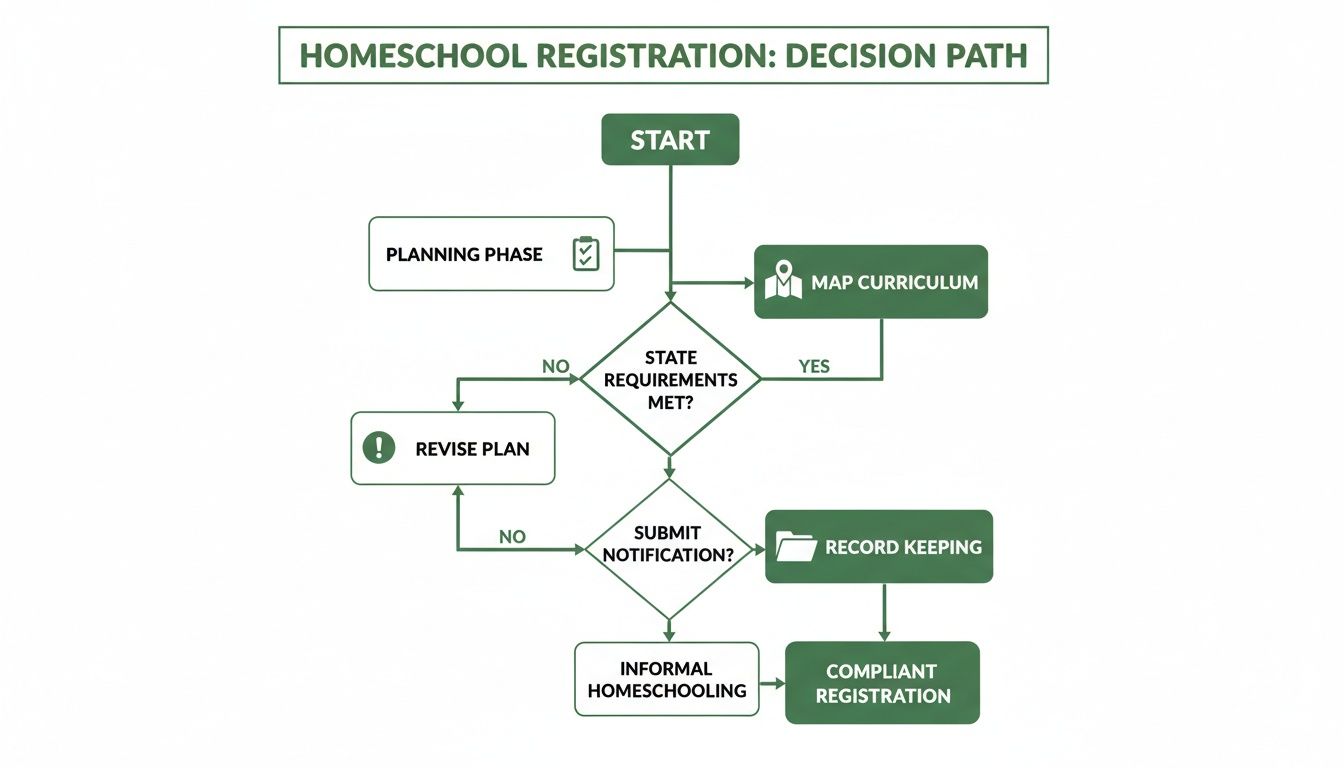
As you can see, the path to successful registration always starts with a clear plan. Choosing your approach, making sure it aligns with your state’s requirements, and keeping solid records are the three pillars of a successful homeschooling journey.
Comparison of Homeschooling Curriculum Approaches
| Curriculum Approach | Best For | Practical Example | Typical Cost | Australian Curriculum Alignment |
|---|---|---|---|---|
| All-in-One (Boxed) | Families wanting structure and minimal prep work. Great for new homeschoolers. | A family uses a complete Year 4 package from a provider, which includes all textbooks and daily lesson plans. | $1,500 – $2,500+ per child/year. | High. Most are explicitly aligned. |
| Eclectic | Families wanting to customise learning to a child's interests and learning style. | Using a Singapore Maths workbook, writing projects from Brave Writer, and hands-on science kits. | Varies widely. Can be budget-friendly or expensive. | Parent-managed. You map resources to the curriculum. |
| Unschooling | Highly self-motivated and curious children. Families prioritising interest-led learning. | A child's interest in video games leads to learning coding, storytelling, and digital art. | Low to Medium. Focus on real-world experiences and free resources. | Parent-managed. Requires careful documentation of learning outcomes. |
| Classical | Families valuing a traditional, rigorous academic approach focused on literature and logic. | A primary student memorises historical timelines while a secondary student studies formal logic. | Medium. Involves purchasing specific book lists. | Partial. Core concepts align, but the structure differs. |
Ultimately, choosing a curriculum isn't a lifelong contract. The most important thing is to pick a path that feels right for you right now, knowing you can always adjust.
How to Choose the Best Curriculum for Your Child
Choosing the right homeschooling curriculum starts with your child. Before you browse websites, observe how they learn best.
Is your child a visual learner who understands concepts through diagrams? Or are they a hands-on, kinaesthetic kid who needs to build and touch? Maybe they're an auditory learner, soaking up information from stories and discussions.
Of course, your child’s age and stage matter immensely. A play-based approach is often perfect for younger children. For older students, you'll need a structure that builds towards their future, whether that’s a vocational pathway or university preparation for the HSC or VCE.
Actionable Insight: Create a simple "Learner Profile" for your child. List their strengths (e.g., "excellent at debating"), interests ("obsessed with ancient Egypt"), and preferred learning environment ("works best in short bursts with hands-on activities"). Use this profile as a filter when evaluating any curriculum or resource. A truly great homeschooling curriculum in Australia always puts the student first.
Planning Your Year and Keeping Great Records
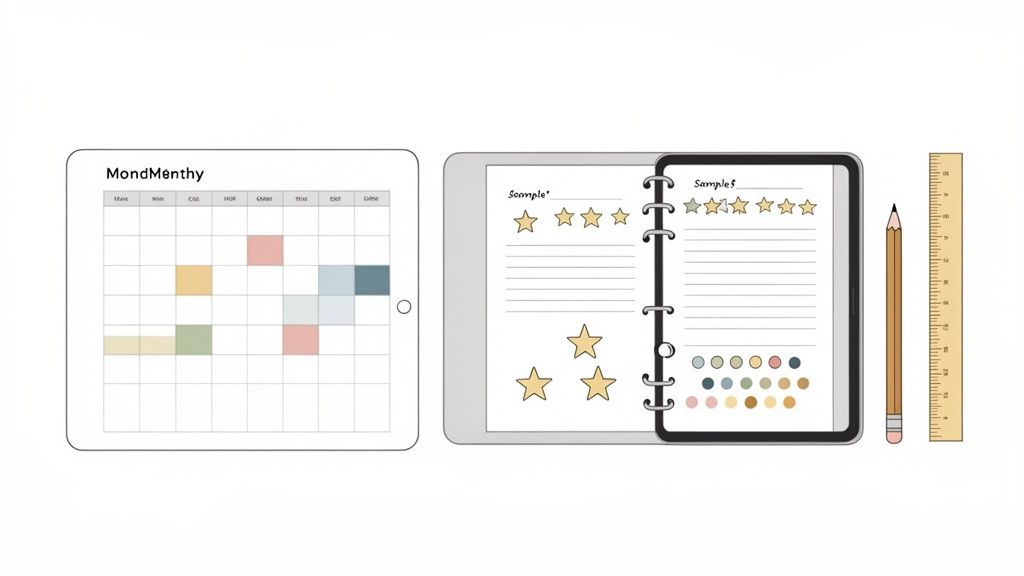
A fantastic curriculum is a great start, but how you implement it matters most. Creating a simple weekly schedule turns your chosen homeschooling curriculum in Australia from a plan on paper into a living part of your week. This provides rhythm, balancing core subjects with art, sport, and downtime.
Record-keeping isn’t as scary as it sounds. It's not just for registration; it's a powerful way to see and celebrate your child's progress.
What to Actually Put in Your Records
You don't need to document everything. Gather a meaningful collection of work that tells a story of their progress.
- Work Samples: Practical Example: Keep the first, middle, and final drafts of a major writing assignment to show clear improvement in structure and vocabulary.
- Reading Lists: Practical Example: Use an app like Goodreads or a simple notebook to log books read, including a one-sentence summary from your child.
- Project Photos: Practical Example: Take photos of a diorama for a history project or a video of a science experiment in action.
- Excursion Diary: Practical Example: After visiting a museum, have your child write three things they learned or draw their favourite exhibit.
This portfolio doesn't just satisfy official requirements—it builds a wonderful keepsake of their achievements.
How Tutoring Can Enhance Your Homeschooling
Homeschooling doesn't mean you have to be an expert in everything. Think of a tutor as a specialist on your team, adding a burst of expertise to enrich your chosen homeschooling curriculum in Australia.
A tutor is invaluable for challenging senior subjects like advanced maths or physics. They are also brilliant for VCE or HSC exam preparation, offering targeted strategies that build confidence. Beyond academics, a tutor can introduce a fresh perspective that sparks new curiosity. They help fill curriculum gaps and support you in delivering an exceptional education.
Practical Example: If your child is preparing for the HSC in chemistry but you feel overwhelmed by the content, a tutor can run weekly sessions focused on complex topics and exam technique, allowing you to focus on managing the overall learning plan.
For a closer look at how personalised lessons can complement your homeschooling approach, explore our guide on homeschool tutoring in Australia.
Common Questions About Homeschooling Curriculums in Australia
Diving into homeschooling curriculums in Australia brings up a few common questions. Let's tackle them head-on.
Do I Have to Follow the Australian Curriculum Exactly?
No, not in a strict, page-by-page way. Your state requires your educational plan to be 'based on' or 'mapped to' the key learning areas of the Australian Curriculum, but this is a framework, not a rulebook. This ensures a well-rounded education while giving you the freedom to choose resources and teaching methods that engage your child.
How Much Does a Homeschooling Curriculum Cost?
Costs vary dramatically. A pre-packaged curriculum can cost $800 to over $2,500 per child per year. An eclectic approach is often more budget-friendly. Actionable Insight: Create a budget spreadsheet. List potential costs for core texts (e.g., maths workbooks), subscriptions (e.g., online learning platforms), supplies (stationery), and excursions (museum entries). This helps you plan and avoid overspending.
Navigating these curriculum choices and planning for the senior years is much easier when you have the right support in your corner. Evergreen Tutoring Services offers personalised online tutoring designed to complement your homeschooling plan, helping students master tricky subjects and walk into exams with real confidence. You can learn more about our homeschooling support.