

An HSC formula sheet is a reference document provided by the NSW Education Standards Authority (NESA) for specific exams like Mathematics and Physics. It's not a cheat sheet, but a toolkit designed to reduce the burden of pure memorisation. This allows you to focus on the skill that truly earns marks: applying formulas to solve complex problems.
What Is the HSC Formula Sheet and Why It Matters
The HSC formula sheet is designed to shift your study focus from rote learning to deeper, critical problem-solving. A 2014 study published in the Journal of Experimental Education found that while memorisation has its place, students who focus on understanding and applying concepts show greater academic success and retention. By providing key formulas, NESA encourages this deeper level of engagement.
This should fundamentally change how you revise. Instead of spending hours memorising every equation, you can invest that time in understanding the underlying principles. Your mindset should shift from "What do I need to remember?" to "How can I use these tools to solve this specific problem?" This is a crucial skill for the HSC and beyond.
A Tool for Critical Thinking
By providing core formulas, examiners can create more challenging, multi-step questions that test your analytical abilities and strategic thinking, not just your memory.
The real value of the HSC formula sheet is that it frees up precious mental bandwidth during an exam. It lets you concentrate on strategy and application instead of struggling with recall.
Take the NESA reference sheet for Mathematics Standard 1 and 2, which has been in use since 2019. Its introduction changed how students prepare by clearly defining what is provided and what you must know. You can find the current version on the official HSC Mathematics reference sheet page on the NESA website.
Decoding Your Formula Sheets Subject by Subject
Knowing what’s on your HSC formula sheet is crucial, but the real secret to success is knowing what’s been left off. NESA provides the toolkit, not the entire workshop. Each subject's sheet is different, offering core formulas while expecting you to bring a wealth of knowledge into the exam room.
For instance, the Physics sheet provides the main equations for motion and electricity. However, it won't list all the rearranged versions needed for a complex problem. Similarly, the Chemistry sheet includes key constants and data, but it won't detail every reaction type or organic chemistry pathway. That knowledge is your responsibility.
What to Expect in Key Subjects
In Mathematics Advanced, the sheet covers trigonometry rules, basic calculus, and sequences. However, you still need to have crucial concepts memorised, such as specific trigonometric identities or the procedure for integration by parts. The best way to identify these gaps is to cross-reference the sheet with the official NESA syllabus for your subject.
This is where strategic study comes in. The formula sheet is designed to free your brain from rote memorisation so you can focus on application and problem-solving.
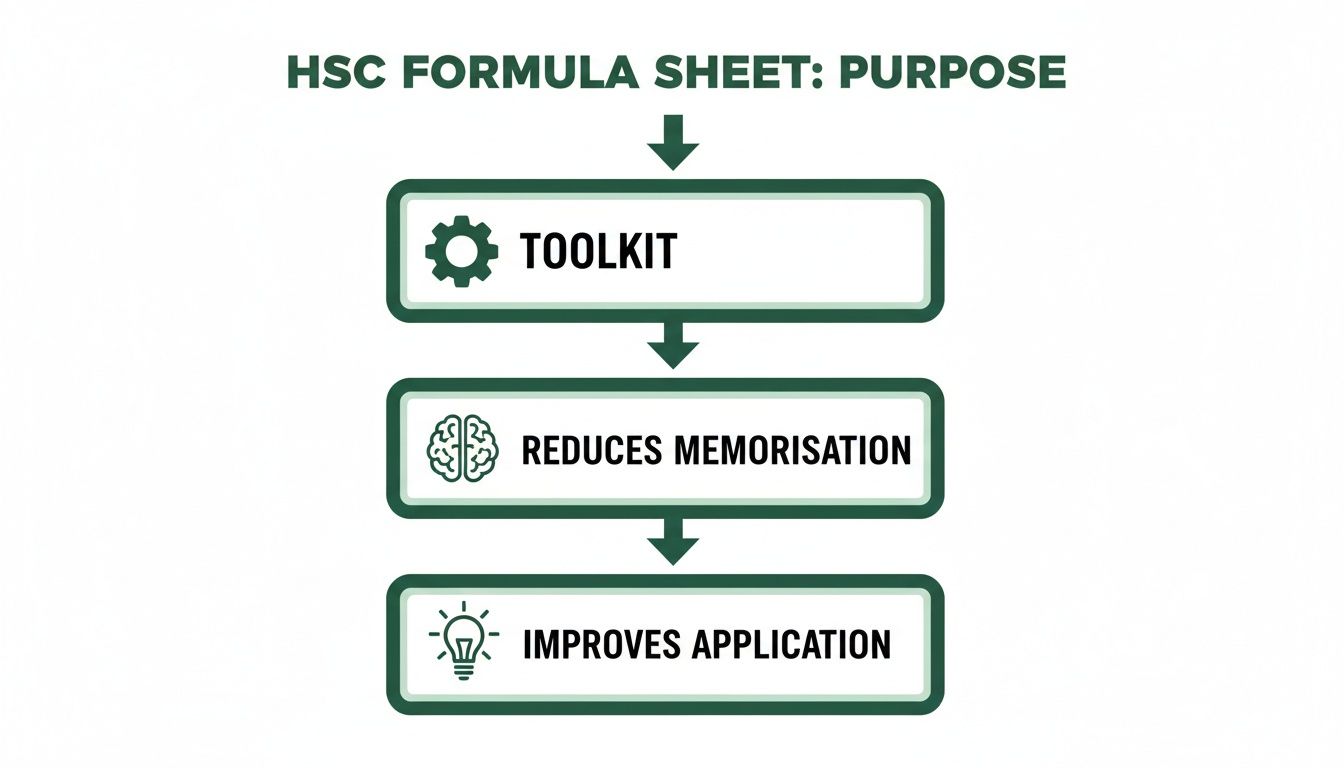
This principle applies beyond just science and maths. Subjects like Engineering Studies and Economics also provide formula sheets to assist with calculations for concepts like the Gini Coefficient.
To give you a clearer picture, I've put together a quick-glance table for some key HSC subjects.
HSC Formula Sheet Coverage by Subject
This table provides a snapshot of which subjects offer a formula sheet and highlights examples of what you'll still need to memorise. Use it to identify potential knowledge gaps in your revision.
| HSC Subject | Official Formula Sheet Provided? | Key Topics Covered on Sheet | Examples of Formulas to Memorise |
|---|---|---|---|
| Mathematics Advanced & Extension 1/2 | Yes | Trigonometry, Calculus (derivatives/integrals), Financial Maths, Sequences & Series | Specific trig identities (e.g., t-formulae), integration by parts, vector dot product properties |
| Physics | Yes | Mechanics (motion, forces), Electricity & Magnetism, Thermodynamics, Quantum Physics | Rearranged equations, specific derivations, lens and mirror formulae combinations |
| Chemistry | Yes | Key constants (Avogadro's, Gas Constant), standard reduction potentials, solubility rules | Specific organic reaction pathways, titration calculations, naming conventions for complex ions |
| Engineering Studies | Yes | Mechanics of materials (stress/strain), electrical circuits, thermodynamics | Specific application formulas, material property values not listed, complex circuit analysis methods |
| Economics | Yes | Gini Coefficient, simple multiplier, elasticity formulas | Formulas for specific economic models, interpretation of graphs, relationships between variables |
| Biology | No | N/A – Biology is concept-heavy, not formula-driven | Hardy-Weinberg equilibrium equation, population growth formulas, magnification formula |
| Business Studies | No | N/A – Focus is on ratios and financial analysis, which must be memorised | All key financial ratios (profitability, liquidity, solvency), break-even analysis formula |
Even with a sheet, there’s still plenty to learn. The goal isn’t just to know the provided formulas, but to understand them so deeply that you also know what’s missing.
Using Your Formula Sheet Under Exam Pressure
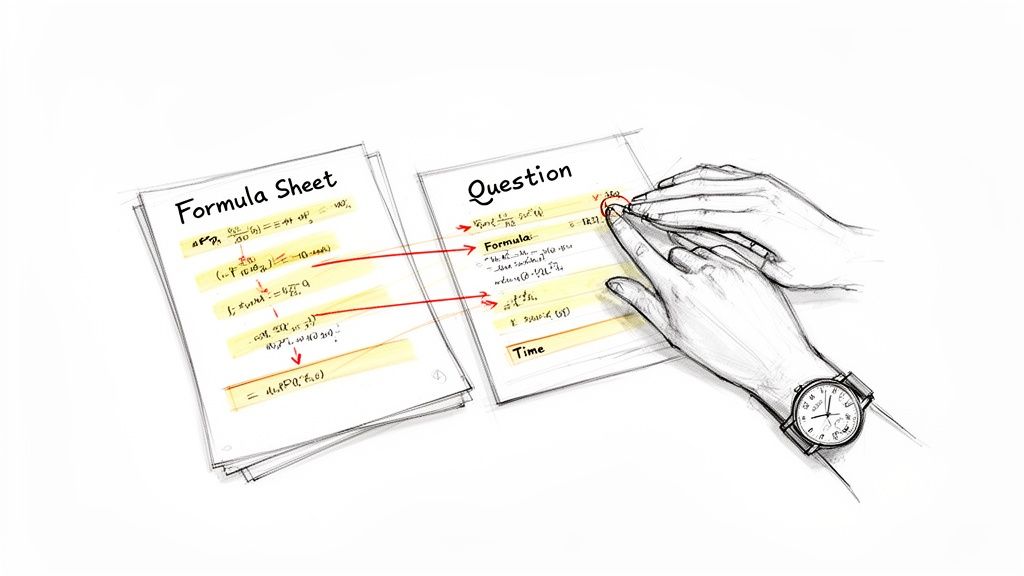
Having the official NESA formula sheet is one thing; using it efficiently when the clock is ticking is another. Under pressure, it’s easy to panic and grab the wrong equation, costing you precious marks and time.
The secret is to treat the HSC formula sheet as an active part of your problem-solving process. Become so familiar with its layout that finding the right formula is automatic. This is a powerful strategy for managing exam stress. For more on this, explore our guide on the effects of academic anxiety and what you can do to stop it.
A Practical Example in Action
Let's walk through a common HSC Mathematics scenario. A question asks for the area of a non-right-angled triangle, giving you two side lengths (e.g., 8 cm and 10 cm) and the angle between them (e.g., 60°).
Here’s an actionable, step-by-step approach:
- Identify Key Information: Scan the problem and extract the knowns: side
a= 8 cm, sideb= 10 cm, and included angleC= 60°. - Navigate the Sheet: Your practice should mean you know exactly where to look. Go to the 'Trigonometry' section and locate the formula that uses two sides and an included angle: Area = 1/2 * a * b * sin(C).
- Substitute and Solve: Plug in your values: Area = 1/2 * 8 * 10 * sin(60°).
- Final Check: Quickly confirm that the variables in the formula match the information you used. This simple verification prevents using a rule meant for right-angled triangles by mistake.
This methodical process turns potential panic into a calm, logical sequence, saving time and boosting your confidence.
Creating a Personalised Summary Sheet

While the official NESA sheet is your tool on exam day, a personalised summary sheet is your secret weapon for revision. The act of creating your own study guide is a form of active recall, which research shows is far more effective for long-term memory than passive reading.
This process forces you to engage with the material on a deeper level, cementing information in your memory and instantly highlighting knowledge gaps. Building this single-page master guide is the perfect way to complement the official sheet. For more on this, see our guide exploring the cognitive benefits of writing your own notes versus buying them.
How to Build Your Summary Sheet
To make your sheet effective, structure it logically. Don't just list formulas randomly; organise them in a way that makes sense to you.
- Group by Topic: Put all trigonometry identities in one section and calculus rules in another. This helps build mental maps, linking related concepts for faster recall.
- Use Colour-Coding: Visual cues can significantly improve memory. Use green for formulas already on the NESA sheet (a reminder you just need to locate them) and red for crucial ones you must memorise.
- Add Context and Cues: This is what makes the sheet truly personal. Next to a formula, add a short note, a quick diagram, or a trigger word. For example, next to the sine rule, a note like "needs a known pair!" is a practical reminder that you need an angle and its opposite side to begin.
Common Mistakes Students Make and How to Avoid Them

The HSC formula sheet is a great tool, but it can also lead to common errors under exam pressure. One of the biggest mistakes is blindly plugging in numbers without understanding what the question is asking.
A classic pitfall is misinterpreting variables. For instance, a Physics question might provide a velocity in kilometres per hour (km/h), while the formula for kinetic energy (E = 1/2 * m * v²) requires velocity in metres per second (m/s). Failing to convert units will lead to an incorrect answer, costing you easy marks.
Another frequent error is forgetting what isn't on the sheet. Relying on it as a crutch can lead to drawing a blank on essential formulas NESA expects you to know.
To avoid these traps, here are some actionable tips:
- Check and Convert Units: Before substituting values, ensure all measurements are in the correct base units (e.g., metres, seconds, kilograms). Mismatched units are a guaranteed way to lose marks.
- Underline Key Terms in the Question: This simple action forces you to slow down and actively identify the exact variables you've been given, preventing careless mistakes.
- Practice with Past Papers: The only way to know what’s missing from the sheet is through practice. As you complete past HSC exams, make a list of formulas you frequently use that are not on the official sheet. These are your top priority for memorisation.
Your Top Questions About the HSC Formula Sheet, Answered
It's normal to have a few questions. Let's tackle some of the most common ones to clear up any confusion.
Can I Bring My Own Formula Sheet into the Exam?
No, you absolutely cannot. The only reference material you are permitted to use is the clean, official NESA formula sheet provided with your exam paper. Attempting to bring in your own notes is a serious breach of exam rules and can result in severe penalties.
Is Every Single Formula I Need on the Sheet?
Definitely not. The sheet is a reference tool, not a comprehensive list. You are still expected to know many key formulas, definitions, and concepts by heart.
Relying solely on the provided HSC formula sheet is one of the biggest mistakes you can make. Think of it as a helpful tool, not a replacement for proper study and a deep understanding of the syllabus.
Does NESA Update the Formula Sheets Often?
NESA generally updates reference sheets only when a subject's syllabus undergoes a major revision. These changes are always announced well in advance to give students and teachers time to adapt. For your exam year, it is critical to use the current version available directly on the NESA website. This is the only way to ensure you are studying with the correct document.
Feeling overwhelmed by HSC prep? The expert tutors at Evergreen Tutoring Services can help you master your subjects, build confidence, and learn how to use resources like the HSC formula sheet to your advantage. Learn more about our personalised online tutoring.


