There’s a reason every high-achieving student talks about chemistry past papers hsc—they are, without a doubt, the single most powerful tool in your exam prep arsenal. Working through them takes you beyond just knowing the syllabus content. It forces you to understand exactly how that content is tested, building the specific skills and quiet confidence you need to walk into that exam hall and perform.
This isn't just about mindless repetition; it's a strategic mission to master the exam itself.
Why Past Papers Are Your Secret Weapon for HSC Chemistry
Let’s be honest: HSC Chemistry is tough. The sheer complexity of concepts, from fiddly equilibrium reactions to sprawling organic chemistry pathways, demands a level of understanding that rote learning just can't deliver. It’s no surprise it consistently ranks as one of the most challenging HSC subjects.
The numbers back this up. HSC Chemistry has a notoriously high dropout rate. Verifiable data from NSW schools shows that roughly one in three students who initially enrol in the course end up dropping it. This isn't a new trend; this figure has been remarkably stable for years, highlighting the persistent challenge. You can dig into these HSC Chemistry dropout trends on artofsmart.com.au if you're curious.
But here’s the good news. This challenge is entirely manageable with the right game plan. Using chemistry past papers hsc isn't about doing more questions; it's about decoding the exam before you even set foot in the hall.
Understand the Exam Blueprint
Every HSC exam has its own rhythm and predictable patterns. Past papers are your blueprint, laying bare how questions are framed, which topics get the most marks, and the specific "trigger words" markers are trained to look for in a Band 6 answer.
For instance, a practical example is noticing that Module 5 questions frequently ask you to "justify" your reasoning with Le Chatelier's Principle, while Module 7 questions often require you to "outline" a multi-step reaction pathway. Picking up on these patterns helps you anticipate what’s coming and tailor your answers for maximum marks.
By completing past papers, you're not just revising content; you're actively training your brain to think like an examiner. This shift in perspective is what separates the students who excel from everyone else.
Master Your Timing and Build Endurance
The HSC Chemistry exam is a three-hour marathon that tests your knowledge and your mental stamina in equal measure. It’s incredibly common for well-prepared students to know the material inside-out but run out of time, leaving easy marks on the table.
Practising full papers under strict, timed conditions is non-negotiable. It builds the mental endurance you need to stay sharp under pressure and helps you internalise how much time you can really afford to spend on each section. For example, you’ll learn that you have roughly 1.8 minutes per multiple-choice question, a crucial piece of data for pacing yourself effectively.
Let's quickly break down why this strategy is so effective.
Strategic Benefits of Using HSC Chemistry Past Papers
This table gives a quick overview of the key advantages of integrating past papers into your study routine.
| Benefit | Why It Matters for HSC Chemistry |
|---|---|
| Pattern Recognition | Helps you spot recurring question types and common themes, allowing for more targeted revision. |
| Timing Optimisation | Develops your ability to allocate the right amount of time to each question, preventing panic and rushed answers on exam day. |
| Weakness Identification | Pinpoints specific topics or skills where you consistently lose marks, so you can focus your study efforts effectively. |
| Confidence Building | Familiarity with the exam format reduces anxiety and builds the self-assurance needed to perform at your best. |
By making past papers a core part of your preparation, you're not just studying harder—you're studying smarter.
Pinpoint and Eliminate Weaknesses
Perhaps the most powerful aspect of past papers is their ability to act as a diagnostic tool. After you finish a paper and mark it—honestly—against the official marking criteria, you get an objective report card of your strengths and weaknesses.
Did you completely bomb the titration calculations in Module 6? Or maybe you struggled to interpret the data in an "Applying Chemical Ideas" question? These aren't failures. They are bright, flashing signposts telling you exactly where to focus your revision. This is an actionable insight: if you lost marks on a Keq calculation, spend your next study session doing only Keq problems until they become second nature.
This kind of targeted approach is far more efficient than just re-reading a textbook chapter for the fifth time. It allows you to systematically turn your weakest areas into strengths, long before you face the real thing.
Finding and Organising Your Exam Resources
A great study plan starts with having the right materials ready to go. Knowing exactly where to find high-quality HSC Chemistry past papers saves you precious time and makes sure you're working with the most relevant resources out there. Let's build your digital library.
Your first and most important stop should always be the official source. The NSW Education Standards Authority (NESA) is the governing body for the HSC, and their website is the gold standard for authentic exam materials.
Navigating the NESA Archives
The NESA website hosts a huge archive of past HSC exam papers. But here’s the crucial bit: they also provide the corresponding marking guidelines, notes from the marking centre, and sample answers. These documents are just as valuable as the papers themselves.
Here’s an actionable step-by-step guide:
- Go directly to the source: Head to the NESA website and navigate to the "HSC Exam Papers" section.
- Filter your search: You can easily filter by subject ("Chemistry") and year. This will bring up a list of available exam packs.
- Download everything: For each year, make sure you download the question paper, the marking guidelines, and the sample answers/notes from the marking centre. These separate documents provide the complete picture.
The marking guidelines are a peek behind the curtain. They reveal the exact criteria examiners use to award marks, showing you the specific keywords and calculation steps they’re looking for. This insight is priceless for sharpening your own answers.
Building Your Digital Study Library
Once you've downloaded a few years' worth of papers, the next step is organisation. A messy downloads folder is a recipe for stress and wasted time. Instead, create a simple, logical filing system on your computer.
A practical structure is to organise by year first, then by resource type.
For example, your main folder could be named "HSC Chemistry Past Papers". Inside, create a folder for each year (e.g., "2023", "2022", "2021"). Within each year's folder, save the files with clear, consistent names:
2023_HSC_Chemistry_Paper.pdf2023_HSC_Chemistry_Marking_Guidelines.pdf2023_HSC_Chemistry_Sample_Answers.pdf
This clean setup lets you find exactly what you need in seconds. You can even take it a step further by creating topic-specific folders (e.g., 'Module 5 Equilibrium Questions') and saving relevant questions there for targeted revision sessions.
A well-organised digital library is more than just tidy—it's a functional study tool. It removes friction from your revision process, meaning you'll spend less time searching for files and more time actively solving problems and learning from your mistakes.
Exploring Beyond NESA
While NESA papers are the absolute core of your practice, don't limit yourself to just one source. Broadening your exposure to different question styles is a fantastic way to prepare for anything the final exam might throw at you.
Other high-quality resources to look for include:
- School Trial Papers: Many schools make their trial exam papers available. These are often designed to be even more challenging than the final HSC, making them excellent for stretching your skills.
- University Resources: Some university outreach programs or science faculties publish HSC-level materials that can be useful practice.
- Educational Websites: Reputable tutoring companies and educational sites often compile past papers or create their own practice questions aligned with the syllabus.
By combining official NESA papers with a selection of high-quality trial exams, you create a robust and varied pool of practice materials. This strategy ensures you're prepared not just for the questions you expect, but for the unexpected ones too.
Designing a Realistic Past Paper Study Schedule
Let’s be honest: a hard drive full of downloaded HSC Chemistry past papers isn't a study plan. It’s just digital clutter. The real magic happens when you weave those papers into a smart, sustainable schedule that builds your skills over time without leading to burnout. This is all about consistency, not last-minute cramming.
The trick is to start using past papers early in your HSC year, but probably not in the way you're thinking. Don't even think about attempting a full, timed, three-hour exam in Term 1. That’s a surefire recipe for feeling completely overwhelmed.
Instead, your past paper practice should evolve in distinct phases as you move through the school year.
This timeline gives you a bird's-eye view of that initial discovery process—finding and organising the papers before you even start using them.
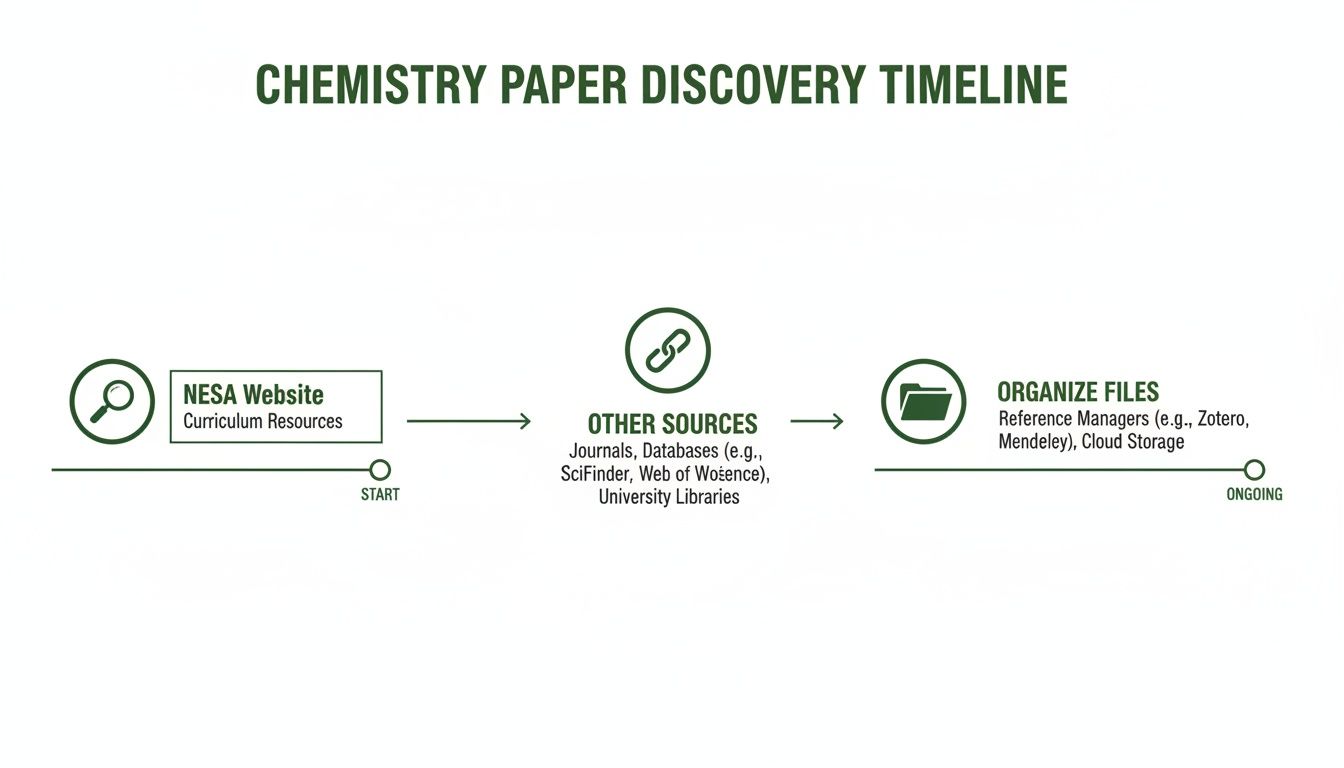
Starting with a structured approach, from grabbing official papers on the NESA site to organising your files logically, lays the groundwork for a killer study schedule.
Terms 1 & 2: Building a Foundation (Untimed and Open-Book)
Early in Year 12, your goal is to understand how questions are asked, not how fast you can answer them. This is your untimed, open-book phase.
As soon as your class finishes a key topic from Module 5, like Le Chatelier's Principle, your job is to hunt down 2-3 past paper questions that specifically target that syllabus dot point. A practical example would be finding a question asking how adding a catalyst affects equilibrium and working through it with your textbook open to see how the theory is applied.
Sit down with your notes and textbook open right next to you. Work through those questions slowly. The point isn't to test yourself; it's to build a bridge between the theory you learned in class and how NESA actually assesses it. You’re decoding the exam, one concept at a time.
This low-pressure approach completely demystifies the HSC exam. It shows you exactly what the markers are looking for from day one, which helps you write better study notes and tune into the most important details your teacher mentions in class.
Term 2 & Into Term 3: Gaining Momentum (Timed and Module-Focused)
Once you've covered more of the syllabus and your confidence is up, it's time to introduce some time pressure. Welcome to the timed, module-focused phase.
Finished Module 6: Acid/Base Reactions? Perfect. Block out a 45-minute session and tackle only the Module 6 questions from a single past paper. This simulates a chunky section of the real exam, training you to switch between different question styles—like calculations, theory, and practical skills—all within one topic area.
Here’s an actionable weekly schedule:
- Monday: Learn new content for the current module in class.
- Wednesday: Do a 45-minute timed practice session on questions from a module you've already completed.
- Friday: Mark Wednesday's practice paper and create an error log of your mistakes.
- Weekend: Catch up on homework and do general revision.
This rhythm keeps you on top of new material while consistently circling back to revise older topics. For more strategies on getting the most out of these sessions, check out our deep dive into how to study effectively for exams.
The Final Stretch: Peak Performance (Leading Up to Trials and the HSC)
In the final months before your major exams, everything shifts towards building stamina and locking in your overall strategy. This is the full mock exam phase. Now is the time to sit down and work through complete HSC Chemistry past papers from start to finish under strict exam conditions.
Try to complete one full, timed paper every week or fortnight. This is about so much more than just remembering content; it’s about physical and mental conditioning. You're training your brain to stay focused for the full three hours, manage your time effectively, and handle the pressure of the clock.
Actionable Mock Exam Tips:
- Be a Tyrant with Timing: Use a timer and be ruthless. When time’s up, it's pens down. It’s the only way to get a true feel for your pacing.
- Use Official Materials Only: Have nothing on your desk but the NESA-approved periodic table and data sheet. Your phone should be in another room.
- The Review is Everything: A completed paper you never mark is a completely wasted opportunity. Schedule a separate block of time to mark it properly and analyse every single mistake.
This phased approach transforms past papers from a passive folder of PDFs into an active, year-long training program. It builds your skills, confidence, and endurance methodically so you can walk into that exam hall ready to perform at your absolute best.
How to Nail Exam Conditions in Your Own Home
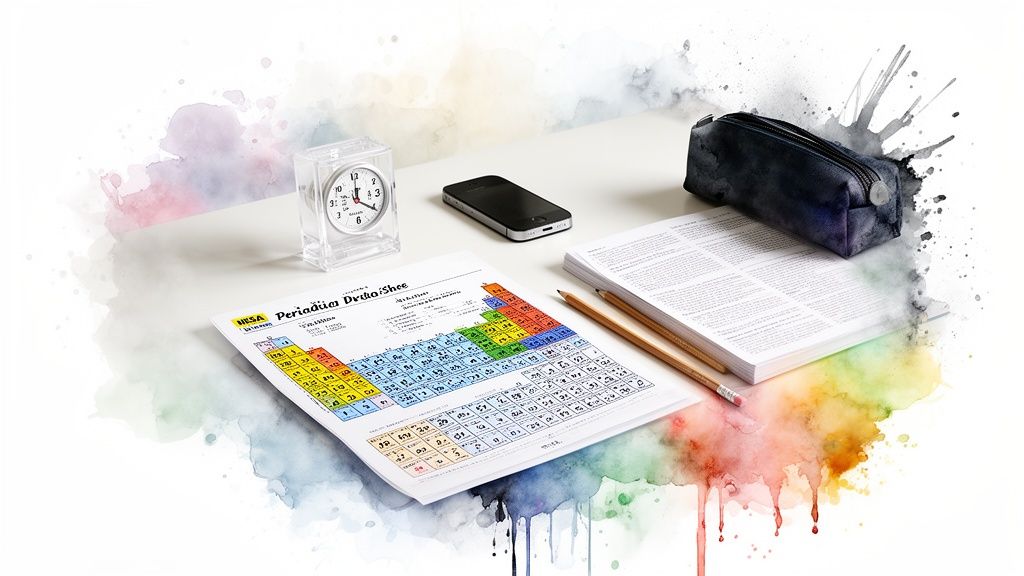
Your performance on exam day isn't just about what you know; it's about how you perform under real pressure. Doing chemistry past papers hsc at your desk with music on is fine for practice, but it's a completely different beast to the silent, high-stakes environment of the exam hall.
This is where you build the mental stamina to stay sharp from the first question to the last. Merely setting a timer is a good start, but it's not enough. To really get ahead, you need to be strict about recreating the official HSC exam environment in your own study space.
Set Up a Proper Exam Space
Your environment is everything when it comes to focus. Before you even think about starting the clock, you need to prepare your space to mirror the exact conditions of an exam room. This isn't just about tidying up; it's about systematically removing every single distraction.
Here are the non-negotiables for your exam setup:
- A Completely Clear Desk: The only things allowed on your desk are the exam paper, blank writing paper, pens, a calculator, and your official NESA resources.
- Official Resources Only: Go and print a fresh copy of the official HSC Chemistry data sheet and periodic table. Don't use your own versions with helpful notes scribbled in the margins.
- Zero Digital Distractions: Your phone needs to be off—or better yet, in another room entirely. If you're using a digital timer on your computer, close every other tab.
This physical setup does more than just remove distractions; it sends a powerful signal to your brain that it's game time, helping you drop into a state of deep focus much faster.
Enforce the Rules Like an Invigilator
Here’s where the real challenge—and the real benefit—comes in: self-discipline. The HSC Chemistry exam is three hours long, with an extra five minutes of reading time at the start. You have to honour this down to the second.
Set a timer for exactly three hours and five minutes. Use those first five minutes only for reading and planning. You cannot pick up your pen to write. Once those five minutes are up, start the exam and do not stop until that final alarm goes off. No snack breaks, no phone checks, and no peeking at your notes.
Treat every single practice exam like it's a dress rehearsal for the real thing. The moment you think, "It's just a past paper, I can go over time a little," you've lost the benefit. This is how you build both speed and resilience.
Train Your Mental Endurance and Focus
A three-hour exam is a test of mental stamina as much as it is a test of your chemistry knowledge. Research on cognitive fatigue shows that decision-making quality degrades over prolonged periods of intense focus. Simulating the full exam helps you train for this.
If you find your mind wandering, practice a simple reset technique. For example, if you feel your focus slipping, take ten seconds to close your eyes, take a single deep breath, and then get back to it. This tiny action can be surprisingly effective at clearing the mental fog and resetting your concentration.
Completing full chemistry past papers hsc in one timed session is the only way to build the endurance you need to perform at a high level for the entire exam. It ensures your last answer is just as sharp as your first. By pushing through that feeling of fatigue in practice, you'll be far more prepared to handle it when the real marks are on the line.
The Art of Marking Your Own Papers Like an Examiner
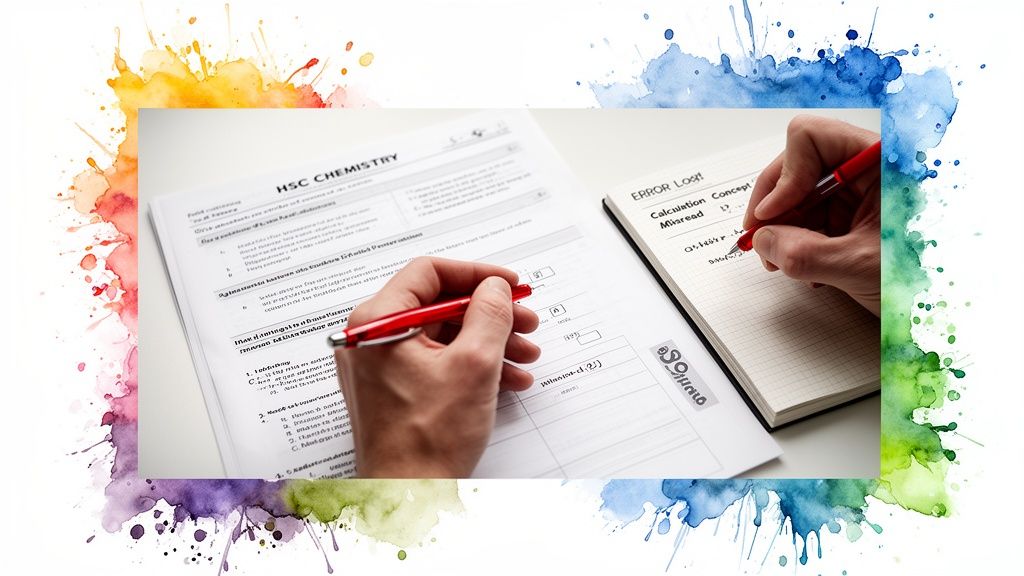
The real learning kicks in the moment you put your pen down. Simply grinding through chemistry past papers hsc is only half the battle; the other half is won in the ruthless, honest process of marking your own work. This is where you can turn your mistakes into your greatest strengths.
Adopting an examiner's mindset is a game-changer. It forces you to look at your answers with critical eyes, creating a powerful feedback loop that is one of the most effective ways to boost your results.
Decoding the NESA Marking Guidelines
Your most important tool here isn't a red pen—it's the official NESA marking guidelines. Think of this document as your Rosetta Stone for understanding exactly how marks are awarded. It’s what breaks down the difference between a one-mark answer and a three-mark showstopper.
When you're marking your own paper, don't just check if the final answer is right. Instead, ask yourself these actionable questions:
- Did I use the specific keywords the marking criteria asked for? For example, in an equilibrium question, did I use phrases like "rate of forward reaction" and "rate of reverse reaction"?
- For calculations, did I show every single step? That means the formula, the substitution of values, and the final answer with the correct units. Leaving one out is an easy way to drop marks.
- Is my answer structured logically? Did I address every part of the question exactly as the guidelines lay it out?
This critical self-assessment forces you to align your thinking with the examiners'. Before long, you start to internalise what a top-tier answer looks like, which naturally shapes how you approach every question.
Think of the marking guidelines as the exam's rulebook. By learning the rules inside and out, you learn how to play the game to win. You begin to write answers specifically designed to tick every box an examiner is looking for.
Introducing the Error Log: Your Personal Feedback System
A marked paper stuffed into a folder is a lost opportunity. To make real, lasting progress, you need to track your mistakes systematically. This is where an error log comes in—a simple but incredibly effective way to spot patterns in your mistakes.
Just create a simple table in a notebook or a spreadsheet with these headings: Question, My Mistake, Mistake Category, and How to Fix It. Every single time you lose a mark, log it. This practice quickly shines a light on the true source of your struggles. You might think you're just "bad at calculations," but your error log might reveal that the real problem is consistently forgetting to balance your equations first.
Common Mistake Categories for Your Log
Categorising your errors is what makes this system so powerful, because it lets you target your revision. Here are a few common categories you might want to start with:
- Calculation Error: A simple slip-up with the calculator or a misplaced decimal.
- Misunderstood Concept: You just didn't grasp the underlying chemistry theory.
- Misread Question: You answered what you thought the question was asking, not what it actually asked.
- Forgot Formula/Fact: A straightforward memory issue.
- Poor Expression: You knew the answer but didn't use the right scientific terminology to explain it clearly.
Official NESA data shows that each year, between 9,834 and 10,285 students sit the HSC Chemistry exam, all competing for the same pool of marks. An error log gives you a personal edge by directing your study time exactly where you need it most, helping you stand out. You can learn more about HSC Chemistry enrolment statistics on the NSW Government website.
After a few weeks of diligent logging, you'll have a clear, data-driven picture of your academic weaknesses. If "Misunderstood Concept" keeps popping up for Module 5, you know it's time to revisit your notes, hit the textbook, or even ask your teacher for help.
For students who find these conceptual gaps a real challenge, working with an online science tutor in Australia can provide the targeted support needed to bridge them. This feedback loop—practise, mark, analyse, and refine—is the engine that will drive your academic improvement.
Common Questions About HSC Chemistry Past Papers
When you start digging into HSC Chemistry past papers, a few questions always pop up. Getting straight, practical answers to these is the key to moving past uncertainty and making your study sessions count.
Here’s a rundown of common queries with no-nonsense, actionable advice.
How Many Past Papers Should I Actually Do?
This is a classic. The honest answer? It’s all about quality over quantity. Blasting through paper after paper might feel productive, but the real learning happens in the review.
Aim to properly complete and analyse between 8 to 12 full past papers before your final HSC exam. A deep dive into five papers—where you mark every question, log your mistakes, and actively revise your weak spots—is worth so much more than a shallow skim of fifteen.
Actionable Insight: Use the older papers (e.g., 2019-2021) for targeted practice on specific modules, and save the most recent ones (2022 onwards) for your final, full-scale mock exams closer to the real thing.
Are Papers From the Old Syllabus Still Useful?
Yes, but you have to be smart about how you use them. The HSC Chemistry syllabus was updated in 2019, so any paper from before then will have some different content and question styles. That doesn’t make them useless, though.
Think of them as a great resource for drilling core skills. These older papers are perfect for sharpening your fundamentals in areas that haven't really changed, like:
- Stoichiometry calculations
- Equilibrium principles
- Basic organic chemistry reactions
Just remember to stick exclusively to post-2019 papers for your full, timed mock exams. You need that experience to be as close to the real deal as possible.
What If I Get Completely Stuck On a Question?
First off, don't panic. It happens to everyone. Your strategy depends on whether you're doing casual practice or a timed mock exam.
During untimed practice: Give the question a solid 10–15 minute effort. If you’re still getting nowhere, go back to your notes or textbook to review the theory. Resist the urge to jump straight to the sample answers. The goal is to learn the process, not just find the solution.
During a timed mock: Don't let one killer question sink your whole exam. Make your best educated guess, circle the question number to come back to later, and move on. Bank the easy marks first. That circled question then becomes your number one priority for your post-exam review.
The most important part of getting stuck isn't the frustration—it's what you do afterwards. Dig deep to figure out why you struggled. Was it a concept you didn't know? A formula you forgot? Or did you just misread the question? That analysis is what turns a mistake into real learning.
Should I Bother With Other Schools' Trial Papers?
Absolutely. Using trial papers from different schools is a fantastic strategy to broaden your preparation. These papers are often written to be a little more challenging than the official HSC exam, which is brilliant for building your problem-solving muscle and resilience.
Working through a variety of trial papers exposes you to different interpretations of the syllabus and a wider range of question styles. It ensures you’re not just prepared for the questions you expect, but are also ready to handle any curveballs the examiners might throw at you on the day.
Navigating the HSC requires a solid strategy and often, a little extra support. At Evergreen Tutoring Services, our expert tutors can help you break down complex concepts, master your exam technique, and build the confidence to achieve your best. Find your perfect HSC Chemistry tutor with us today.