
Improving reading comprehension is about more than just recognising words on a page. It's an active process of engaging with the text to construct meaning. This involves a toolkit of targeted strategies—like questioning what you read, summarising key ideas, and building your vocabulary—not just passively turning more pages.
Why Just Reading More Isn't Enough
"To become a better reader, just read more." It’s common advice, but it misses a crucial piece of the puzzle. Reading more without actively engaging your brain is like driving for hours without paying attention to the road signs. You’ve covered the distance, but you haven't processed the journey.
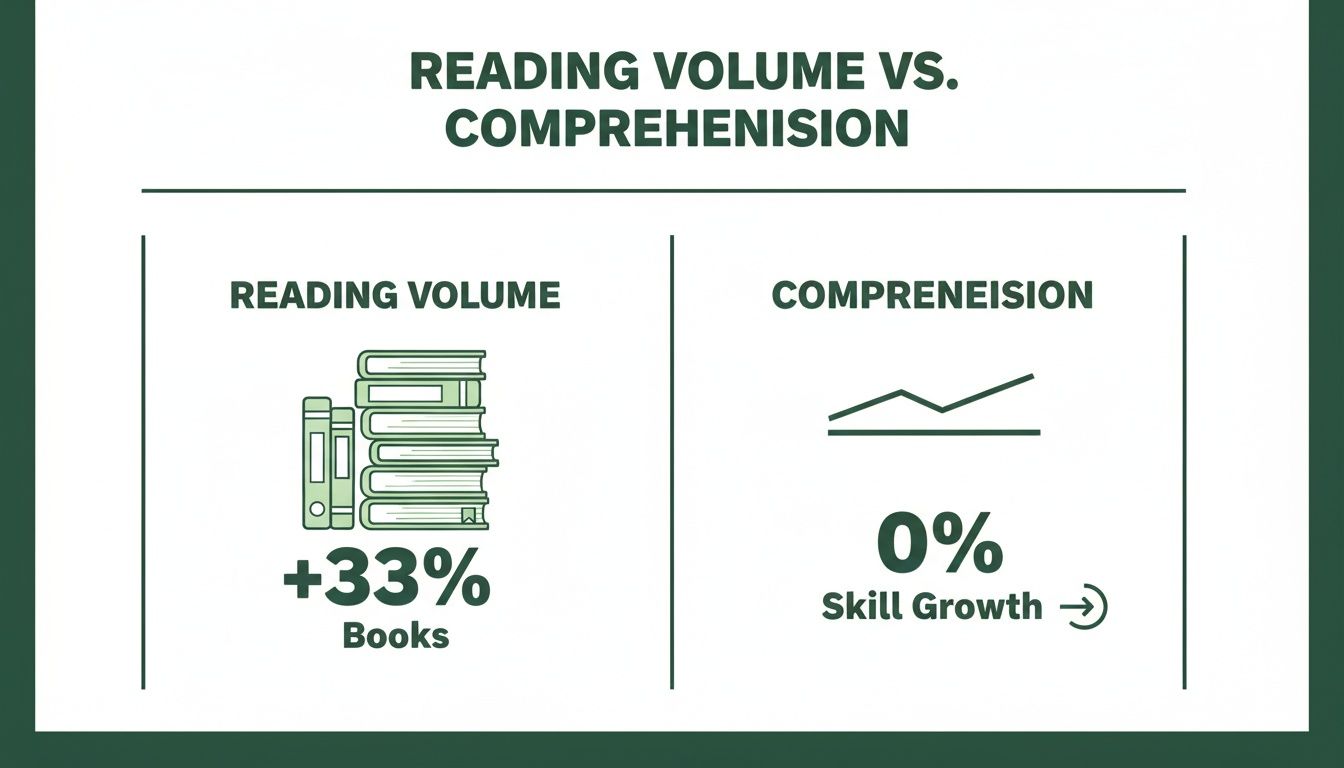
This gap between volume and skill is a significant challenge. For instance, a 2024 analysis of Australian students' reading habits found a 33% increase in reading volume. However, despite students reading an average of 17.6 books each, their comprehension scores remained static at 75%. You can explore the data in the Renaissance What Kids Are Reading Report.
This data highlights the critical difference between passive reading and active understanding.
This graphic visualises that surprising gap perfectly, showing how a huge jump in the number of books read led to zero growth in actual skill.
Ultimately, the data confirms it: true progress comes from how you read, not just how much. This guide will focus on those smarter, targeted skills that are the real key to unlocking meaning from any text you come across.
Decoding the Foundations of Comprehension
True reading comprehension isn't a single skill. It's a complex system where several abilities work together. If a key component is weak, understanding falters, much like a car won't run properly if the engine, wheels, or steering aren't working in sync.
To truly understand a text, a reader needs a solid foundation built on a few key pillars.
The Core Building Blocks
Based on established literacy research, effective reading comprehension relies on the interplay of four crucial elements:
- Decoding: The fundamental ability to sound out and recognise words accurately and fluently.
- Vocabulary: Knowing the meaning of individual words.
- Background Knowledge: Having context about the topic. For example, understanding a text about cricket is difficult without knowing what a "wicket" or an "over" is.
- Metacognition: The ability to "think about your thinking"—to monitor your own understanding and recognise when you've lost the thread.
When even one of these is weak, the entire process can break down. This is a widespread issue. A landmark report from the Grattan Institute revealed that about one-third of Australian students struggle with reading proficiency, often due to gaps in explicit instruction, not a lack of effort. You can explore their full findings on why Australia needs a reading revolution.
Pinpointing which of these foundational skills needs support is the first step toward building stronger, more confident readers. It shifts the focus from "I can't read" to "I need to practise this specific skill."
Once you understand which components need work, you can move from frustration to targeted, effective action. For more hands-on ideas, you might find these four ways to help teach primary students to read really helpful.
Actionable Strategies for Active Reading
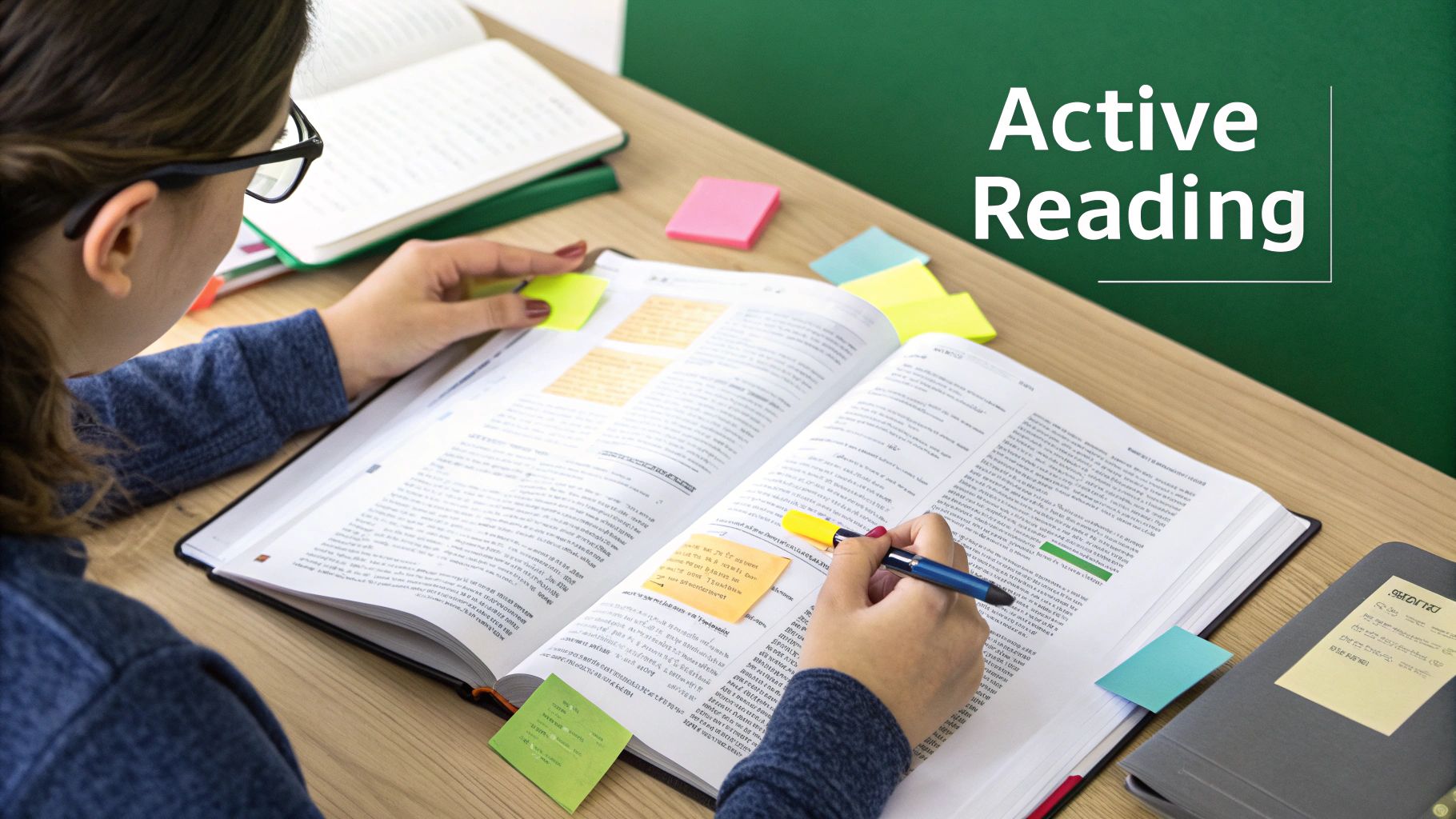
Effective reading means switching from being a passive spectator to an active participant. It's about turning reading into a dynamic conversation with the text, where you constantly engage your mind, ask questions, and build meaning as you go.
Forget aimless highlighting. Let's get into practical, structured strategies that actually boost your understanding.
Get Your Bearings Before You Dive In
Before reading the first paragraph, preview the material. Take just 60 seconds to scan headings, subheadings, images, and captions. This simple act creates a mental map, helping you anticipate the content and giving your brain a framework to hang new information on.
Practical Example: If you open a science chapter titled "The Water Cycle," scanning the subheadings "Evaporation," "Condensation," and "Precipitation" immediately tells you the key stages you're about to learn. This primes your brain to look for specific information.
Ask Questions to Guide Your Reading
An active reader is a curious one. Use the "5Ws and H" (Who, What, When, Where, Why, and How) to formulate questions before you read, hunt for the answers while you read, and reflect on them after.
Practical Example: For a history chapter on the Eureka Stockade, arm yourself with questions like:
- Who were the key figures leading the rebellion?
- What were the main grievances that sparked it?
- Why is this single event still seen as so significant in Australian history?
This shift turns reading from passive consumption into an active investigation. You’re no longer just reading; you’re on a mission to find answers.
By transforming reading into a focused inquiry, you give yourself a clear purpose. This small shift makes it easier to filter out less important details and lock onto the core message of the text.
Visualise and Summarise to Make It Stick
Your brain processes images far more effectively than abstract text. As you read, create a "mental movie." If a novel describes a character walking through a bustling marketplace, don’t just read the words—picture the sights, sounds, and smells. This visualising technique makes text concrete and more memorable.
On top of that, pause regularly to summarise what you've just read in your own words. A fantastic method for stories is the "Somebody-Wanted-But-So-Then" framework.
Practical Example: Using the story of Cinderella: "Cinderella (Somebody) wanted to go to the ball, but her stepmother forbade it, so her fairy godmother appeared, then she was able to attend." This simple check ensures you’ve grasped the main narrative points before moving on.
Active Reading Techniques at a Glance
This table breaks down some of the most effective strategies you can use to boost your engagement and understanding while you read.
| Technique | What to Do | Why It Works |
|---|---|---|
| Previewing | Scan headings, subheadings, and images before you start reading the main text. | Creates a mental map and primes your brain for the topic, making it easier to organise new information. |
| Questioning | Use the 5Ws and H (Who, What, When, Where, Why, How) to ask questions before, during, and after reading. | Turns reading from a passive activity into an active search for answers, which sharpens focus and improves retention. |
| Visualising | Create a mental movie of the descriptions in the text. Picture the scenes, characters, and actions. | Makes abstract concepts concrete and memorable by engaging your brain's visual processing centres. |
| Summarising | Pause every few paragraphs or at the end of a section to briefly explain the main points in your own words. | Forces you to process and synthesise the information, confirming that you've actually understood the core message. |
Treating these techniques as a toolkit, rather than a rigid checklist, is the key. Try one or two in your next reading session and you'll quickly notice the difference it makes.
Building Vocabulary and Background Knowledge
You can't construct meaning from a text if you don't recognise the words or understand the context. Building a strong vocabulary and solid background knowledge are cornerstones of improving reading comprehension, turning confusion into clarity.
Forget drilling flashcards. Real vocabulary growth happens when you learn words in their natural habitat—within the context of what you're reading.
Actionable Insight: When you encounter a new word, don't just look up its definition. First, try to infer its meaning from the surrounding sentences (context clues). Then, look it up to confirm. Finally, challenge yourself to use the new word in your own original sentence. This active use is what makes it stick.
Actively Expand Your Understanding
Similarly, building background knowledge doesn't have to feel like a chore. Before tackling a dense chapter on World War II, spend 15 minutes watching a reputable documentary clip or exploring a reliable website on the topic.
This small investment builds a mental framework, making the details, names, and events in the text far easier to connect with and remember. It's a proactive step that pays huge dividends. For a deeper dive into practical strategies, check out our guide on how to increase vocabulary.
Think of it this way: vocabulary provides the bricks, and background knowledge provides the architectural plans. You need both to build strong, lasting comprehension.
Overcoming Reading Hurdles and Staying Motivated
Even with the best strategies, sometimes the biggest hurdle is motivation. Reading anxiety, a lack of interest in assigned books, or simple fatigue are real barriers that can stop progress.
Reigniting the desire to read is essential. Motivation isn't just a nice-to-have; it's a critical component of building stronger reading skills.
Actionable Insight: Use the "10-minute rule." Commit to reading for just ten minutes. It's a small, achievable goal that removes the pressure of finishing a chapter. More often than not, those ten minutes will turn into twenty or thirty without you even noticing.
Find Your Reading Spark
The fastest way to stay motivated is to read something you actually enjoy. This doesn’t have to be a classic from the school curriculum.
- Graphic novels or comics
- Articles about a favourite sport or hobby
- Online forums or blogs about gaming
- Biographies of people you find inspiring
When reading is connected to a genuine interest, it stops feeling like a chore. Forcing a student through a "boring" book can do more harm than good, but finding the right material can be a game-changer. If focus is still an issue, it can be helpful to explore strategies for students struggling to concentrate.
This is backed by data from Australia Reads, which shows many secondary students skip reading for pleasure. Yet when schools dedicate time for independent reading, those same students read more frequently and build stronger comprehension. It's worth exploring their key statistics on reading to see the impact.
Your Top Questions, Answered
As you put these strategies into practice, a few common questions arise. Let's tackle them to keep you on the right track.
How Long Does It Take to See Improvement?
There's no magic number, as progress depends on the starting point and consistency. That said, with targeted effort on specific skills—like practising the summarising technique for 20-30 minutes, 3-4 times a week—most learners notice a real difference in their confidence and understanding within 4-6 weeks.
The key is consistency over intensity. Short, regular sessions are more effective for building skills than one long, infrequent effort.
Is It Better to Read Digital or Physical Books?
Both have their place, but some research suggests physical books may have a slight edge for deep comprehension. We tend to skim more on screens, and the tactile nature of a book can aid memory and focus.
However, the best format is always the one a reader will actually use. If a tablet loaded with graphic novels is what sparks their interest, that’s a fantastic start.
Ultimately, the goal is active engagement with the text. Whether it’s a paperback or an e-reader, what truly builds skill is applying strategies like visualising the story and connecting it to personal experiences.
What if My Child Hates Reading?
This is incredibly common. The solution is almost always to disconnect reading from academic pressure. First, find what genuinely interests them, even if it has nothing to do with a traditional book. This could be anything from video game lore and magazines about their favourite sport to online fan fiction.
Start with their passion and build a bridge to reading from there. The immediate goal is to rebuild a positive association with the act of reading; more structured skill-building can follow once that resistance fades.
If you're looking for personalised support to build these skills, Evergreen Tutoring Services offers one-on-one online lessons tailored to your child's specific needs and learning style. Discover how our expert tutors can help at https://www.evergreentutoringservices.com.au.


4 Responses
Very insightful
It is a helpful article
this reading techniques are really helpful keep posting such helpful blog
After reading this ,i have realized that I unconsciously follow almost all these tricks.