Staring at a blank page when a school essay is due can be a truly daunting feeling. If you’ve ever felt that mix of frustration and uncertainty when trying to put your thoughts into words, you are definitely not alone.
This feeling is becoming more and more common. Across Australia, many students and parents are worried about a growing gap in writing ability, from primary school reports right through to those critical VCE and HSC exams. The thing is, writing clearly isn’t just another academic chore; it’s the absolute foundation for effective communication in every single part of life.

Why Strong English Writing Skills Matter More Than Ever
Strong writing skills are directly tied to academic achievement. It’s as simple as that. They give students the power to articulate complex ideas, build persuasive arguments, and analyse information with real depth. When you can write well, you can think more clearly.
This guide is your roadmap to move from that feeling of uncertainty to genuine confidence. We'll break down practical, real-world strategies to build a solid foundation, master more advanced techniques, and develop a clear, compelling writing voice. These aren’t just abstract theories; they are actionable steps you can start using today.
The urgency here is backed by verifiable national trends. Research published by the Australian Education Research Organisation (AERO) confirms a significant decline in writing proficiency. One study revealed that by Year 9, only 54% of students were writing at the expected level. This issue is detailed further in news reports covering Australia's fixing Australia's writing crisis.
Good writing is about more than just grammar and spelling. It's about presenting your ideas in a way that is clear, logical, and persuasive. It is a skill that opens doors to better grades, higher exam scores, and future opportunities.
A Structured Path to Improvement
So, how do you actually improve your English writing skills in a way that sticks? The journey involves several key areas that all work together to build your overall competence. To give you a clear overview, this table breaks down the core pillars we’ll be covering.
Your Quick Guide to Better English Writing
| Focus Area | Key Action | Why It Matters |
|---|---|---|
| Foundation Building | Master grammar, vocabulary, and sentence structure. | These are the non-negotiable building blocks of clear and effective communication. |
| Habit Formation | Establish a consistent daily or weekly writing routine. | Regular practice turns theory into an instinctive, natural skill. |
| Genre Mastery | Learn specific strategies for essays and exams (VCE/HSC). | High-stakes writing requires targeted techniques to perform well under pressure. |
| Feedback & Revision | Actively seek and apply feedback to your work. | This is the fastest way to spot your blind spots and accelerate your growth. |
Each of these pillars is a crucial step on the path to becoming a confident and skilled writer. This structured approach ensures you’re not just memorising rules but are actively building the ability to express yourself with precision and impact. It’s about creating a system for improvement that really works.
Building Your Writing Foundation
Great writing isn't about memorising a dictionary or trying to sound clever with unnecessarily complex words. It’s all about clarity and precision—getting your ideas across in a way that’s easy for your reader to understand and follow.
Let's move beyond the dry, textbook rules and focus on what genuinely makes a difference in your school assignments and exams. These foundational skills are the tools you’ll use to build every single essay, report, and creative piece you write.
Master the Mechanics of Grammar
Grammar is the skeleton of your writing. It provides the structure that holds everything together. While it might feel a bit tedious, a solid grasp of grammar prevents confusion and makes your arguments far more powerful. You don't need to become a grammar expert overnight, but mastering a few common trouble spots can make a huge difference.
-
Comma Splices: This is one of the most frequent errors in student writing. It’s when you join two complete sentences with only a comma.
- Incorrect: The experiment was a success, the results were conclusive.
- Correct: The experiment was a success, and the results were conclusive. (Add a conjunction)
- Correct: The experiment was a success;* the results were conclusive.* (Use a semicolon)
-
Subject-Verb Agreement: Make sure your verb agrees with your subject. It sounds simple, but it's an easy mistake to make in a long sentence.
- Incorrect: The list of assignments are very long.
- Correct: The list of assignments is very long. (The subject here is "list," which is singular).
-
Apostrophe Use: These trip people up all the time. Use them for contractions (it's for it is) and to show possession (the student's book).
- Incorrect: The dog wagged it's tail.
- Correct: The dog wagged its tail. (Here, its is possessive).
An actionable insight is to use a tool like Grammarly. It catches mistakes as you type and explains the rules, helping you learn on the go.
Expand Your Vocabulary Strategically
A strong vocabulary isn't about dropping fancy words into sentences where they don't belong. It’s about being able to choose the right word to express your ideas with greater nuance and accuracy.
The single best way to build your vocabulary is to read widely and actively. When you stumble across a new word, don't just skip over it. Look it up, understand its meaning in that specific context, and then challenge yourself to use it.
Actionable Tip: Create a "word of the day" note on your phone. Write down the new word, its definition, and a sentence where you use it correctly.
A classic mistake is grabbing a thesaurus to swap a "boring" word for a more "interesting" one. This often backfires because synonyms can have slightly different meanings or connotations. A thesaurus is great for exploring options, but always double-check the new word’s precise meaning.
Let’s look at a practical example:
- Original: The character was sad.
- Awkward Thesaurus Swap: The character was lugubrious. (Technically correct, but it sounds unnatural and forced).
- Better: The character was melancholy, staring out the window as the rain fell. (More descriptive and fits a literary tone).
- Better: The character was dejected after hearing the bad news. (More specific to a situation of disappointment).
Vary Your Sentence Structures
Reading a paragraph where every sentence starts the same way and is the same length is just plain monotonous. Varying your sentence structure creates a more engaging rhythm for your reader and helps to put emphasis on your key points.
Think of it like music. A repetitive, constant beat gets boring pretty quickly. A dynamic rhythm with different tempos and notes is far more captivating.
Here are a few actionable ways to add variety:
- Mix short and long sentences. Use short, punchy sentences for impact and longer sentences to elaborate on more complex ideas.
- Start your sentences differently. Don’t always lead with the subject. Try starting with a prepositional phrase, an adverb, or a dependent clause.
- Use different sentence types. Weave together simple sentences, compound sentences (joined by a conjunction like 'and' or 'but'), and complex sentences.
Check out this practical "before and after":
- Before (Repetitive): The protagonist faced a difficult choice. He had to decide between his family and his duty. This decision would change his life forever. He felt a great deal of pressure.
- After (Varied): Faced with a difficult choice, the protagonist had to decide between his family and his duty. This single decision, which would change his life forever, placed an immense amount of pressure on him.
The second version is just so much more engaging to read.
Organise Your Thoughts with Simple Outlines
Clear writing always starts with clear thinking. Before you even think about drafting your first paragraph, take a few minutes to create a quick outline. This doesn't need to be a formal, multi-level document; often, a few bullet points mapping out your main ideas are all you need.
An outline acts as a roadmap. It keeps your writing focused and ensures your argument flows logically from one point to the next.
Practical Example: For an essay on Macbeth's ambition, your outline might be:
- Introduction: Thesis – ambition is his fatal flaw.
- Body 1: Initial ambition sparked by witches.
- Body 2: Ambition leads to murder of Duncan.
- Body 3: Ambition corrupts him completely (Banquo, Macduff's family).
- Conclusion: Restate thesis, summarise points.
For academic essays, a structured approach is even more vital. Frameworks like the TEEL method (Topic sentence, Evidence, Explanation, Link) provide a reliable structure for your body paragraphs. You can find a great breakdown of this in our guide to the TEEL method.
Developing a Consistent Writing Habit
Mastering the rules of grammar and building a strong vocabulary is a great start, but those skills stay theoretical until you put them into practice. The real secret to improving your English writing is turning that practice from a chore into a natural, consistent habit.
This isn't about forcing yourself to write a full essay every day. It’s about making small, low-pressure writing exercises a genuine part of your routine. This simple shift builds momentum, dials down the writing anxiety, and makes the act of putting words on a page feel far less intimidating.
Start Small with Low-Stakes Writing
The thought of writing daily can feel completely overwhelming, especially when you're juggling a busy study schedule. The trick is to begin with short activities that take just 15-20 minutes and, crucially, have no grades attached. This removes the pressure to be perfect.
Here are a few practical ideas to get you started:
- Keep a Journal: At the end of the day, just write a few sentences about what happened, what you learned, or how you felt. It's a private space to practise expressing your thoughts without any filter.
- Summarise an Article: Find a short news article or blog post, read it, and then try to boil down its main points into a single paragraph using your own words. This is a fantastic workout for both your comprehension and your ability to be concise.
- Try Creative Prompts: Look up a list of writing prompts online and spend 15 minutes just playing with one. It could be anything from "Describe a room from the perspective of a fly" to "Write a letter to your future self."
The goal here isn't to produce a masterpiece. It's to make writing a regular, comfortable activity, almost like stretching before you play a sport.
The diagram below shows how this consistent practice builds on your core skills, cementing a strong foundation for all your future writing.
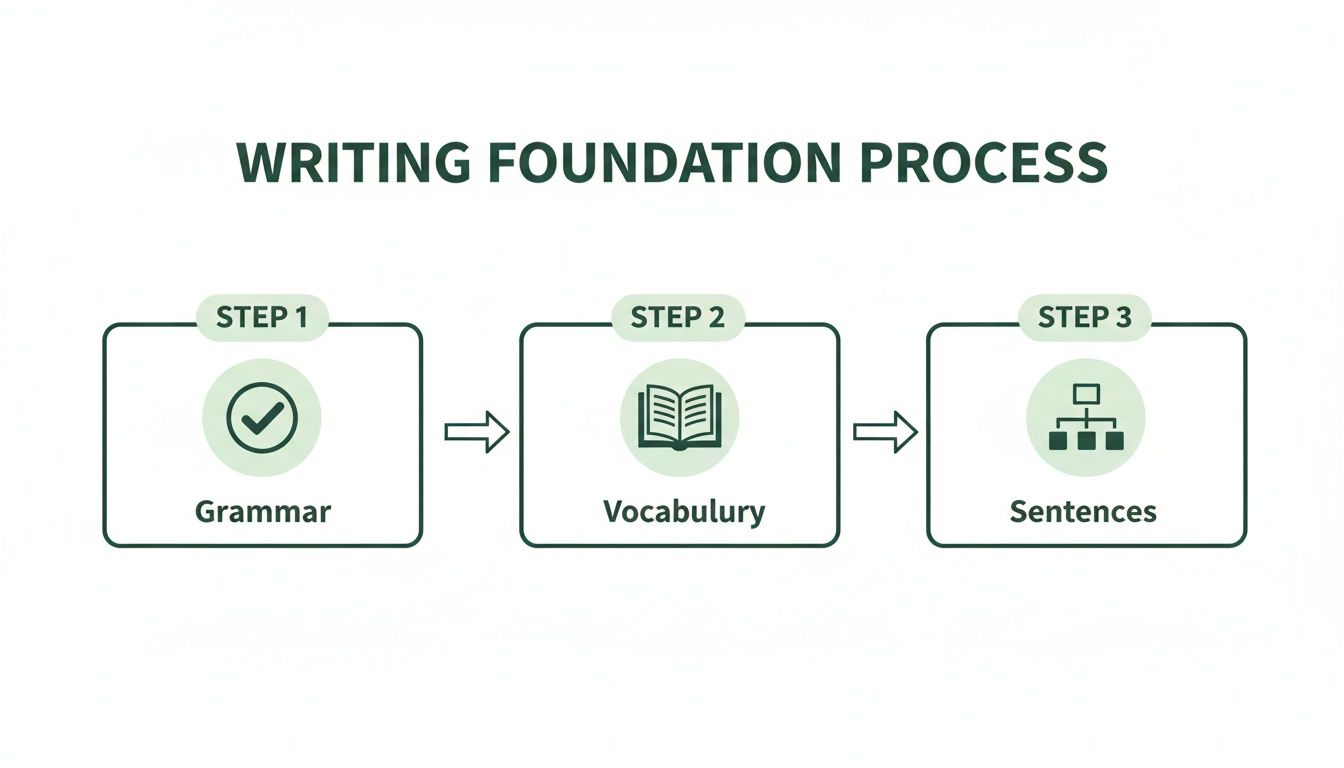
As you can see, mastering the individual elements—grammar, vocabulary, and sentence construction—is only the beginning. It's the consistent practice that truly integrates them into a powerful, cohesive skill.
Embrace the Power of Deliberate Practice
Simply writing every day isn't quite enough to guarantee rapid improvement. If you want to really fast-track your progress, you need to get into deliberate practice. This just means that instead of writing aimlessly, you focus on improving one specific, targeted skill at a time.
For instance, one week you might decide your entire focus is on using stronger, more descriptive verbs. The next week, you could concentrate on crafting clearer topic sentences for your paragraphs.
Actionable Insight: At the start of each week, identify one writing weakness from your last assignment's feedback. Make that your sole focus for all your practice sessions that week.
Deliberate practice is the difference between mindlessly jogging and training for a race with a specific plan. By isolating a single skill, you give your brain the focused repetition it needs to build lasting competence.
It’s a methodical approach that helps you turn your weaknesses into strengths, one by one. Over time, all these individual improvements start to compound, leading to a significant leap in the overall quality of your writing.
Create a Customisable Weekly Schedule
Building a new habit is always easier when you have a plan. A structured weekly schedule helps you slot these small writing exercises into your existing study routine. The key is to keep it flexible and realistic.
Here’s a sample schedule you can adapt to fit your own needs and learning style. Remember, the goal is consistency, not perfection. If you miss a day, just pick it up the next.
Sample Weekly Writing Practice Schedule
| Day | Activity (15-20 Minutes) | Skill Focus |
|---|---|---|
| Monday | Journal about your weekend. | Fluency: Writing freely without stopping to self-edit. |
| Tuesday | Read a news article and summarise it. | Conciseness: Expressing key ideas in fewer words. |
| Wednesday | Write a paragraph using a new vocabulary word five times. | Vocabulary: Deepening understanding of a new word. |
| Thursday | Describe a person or place in detail. | Descriptive Language: Using sensory details and strong verbs. |
| Friday | Take an old paragraph and rewrite it to vary sentence structure. | Sentence Variety: Improving flow and rhythm. |
| Saturday | Tackle a creative writing prompt. | Creativity: Exploring different writing styles and voices. |
| Sunday | Rest or review your week's writing. | Reflection: Identifying patterns and progress. |
A schedule like this turns the abstract goal of "improving my writing" into a series of concrete, manageable actions. Each short session is a small win that builds your confidence and reinforces the habit. Before you know it, writing will feel less like a hurdle and more like a powerful tool you have at your command.
Writing for High Marks in Essays and Exams
Moving from consistent practice to performing under pressure in an exam hall is a whole different ball game. Acing a VCE or HSC exam demands more than just solid grammar and a decent vocabulary. It’s all about strategy, speed, and giving the markers exactly what they’re looking for.
This is a massive hurdle for so many students. Research confirms the need for explicit instruction in writing. The Language Gap Report from Oxford University Press found that 84% of Australian teachers believe a significant vocabulary gap hinders their students' academic progress, directly impacting exam performance. This shows why you can’t just hope for the best. You need proven techniques.
Dissecting the Prompt
Before you write a single word, you have to become a detective. The number one reason students lose marks is simple: they don’t actually answer the question being asked. Rushing this first step is a surefire way to land a mediocre grade.
Start by hunting for the key directive words—the verbs telling you what to do. Are you being asked to analyse, compare, persuade, evaluate, or discuss? Each of these demands a completely different approach.
- Analyse: Break a topic down into its parts and show how they connect.
- Compare: Zero in on both the similarities and differences between two things.
- Persuade: Argue a specific point of view to convince your reader.
- Evaluate: Make a judgement on the value or merit of something, backing it up with solid evidence.
Actionable Tip: Literally circle the directive word and underline the key concepts in the exam question before you start outlining your response. This takes 10 seconds and keeps you on track.
Structuring for Success with PEEL
In a timed exam, clarity and logic are your best friends. Examiners read hundreds of essays, and a response with a clean, logical structure immediately stands out. One of the most effective frameworks for building powerful body paragraphs is the PEEL method.
The PEEL structure ensures every paragraph is focused, evidence-based, and tied directly to your main argument.
- Point: Kick off with a sharp topic sentence. This states the main point of the paragraph.
- Evidence: Back it up with specific proof. This could be a quote from a text, a statistic, or a historical fact.
- Explanation: This is the crucial part. Explain how your evidence proves your point.
- Link: Wrap up the paragraph by connecting your point back to your overall thesis or the main question.
Practical PEEL Example (for History):
- (P)oint: The Treaty of Versailles was a primary cause of future conflict due to its harsh punitive measures against Germany.
- (E)vidence: For instance, the "War Guilt Clause" (Article 231) forced Germany to accept sole responsibility for the war.
- (E)xplanation: This not only created deep resentment among the German populace but also provided fertile ground for nationalist movements that promised to restore national pride.
- (L)ink: Therefore, the treaty's terms, intended to secure peace, paradoxically sowed the seeds for World War II.
For a deeper dive into structuring your arguments, check out our collection of practical essay writing tips and tricks.
Adapting Your Style for Different Subjects
A very common mistake is using the exact same writing style for every subject. A top-scoring History essay looks completely different from a high-quality Science report. Getting a handle on these different conventions is a game-changer.
Here’s a quick breakdown of what markers are looking for in different subjects:
| Subject | Tone & Style | Key Elements |
|---|---|---|
| English | Analytical, persuasive, and nuanced. | Sophisticated vocabulary, textual evidence (quotes), analysis of literary devices, and a strong authorial voice. |
| History | Formal, objective, and evidence-based. | Chronological structure, use of primary and secondary sources, focus on cause and effect, and historical terminology. |
| Science | Concise, precise, and impersonal. | Passive voice (the solution was heated), technical language, data presentation (graphs/tables), and a structured lab report format (Aim, Method, etc.). |
Recognising these differences lets you tailor your writing to hit the specific marking criteria for each subject. Mastering this adaptability is what separates a good writer from a great one.
Using Feedback to Accelerate Your Progress
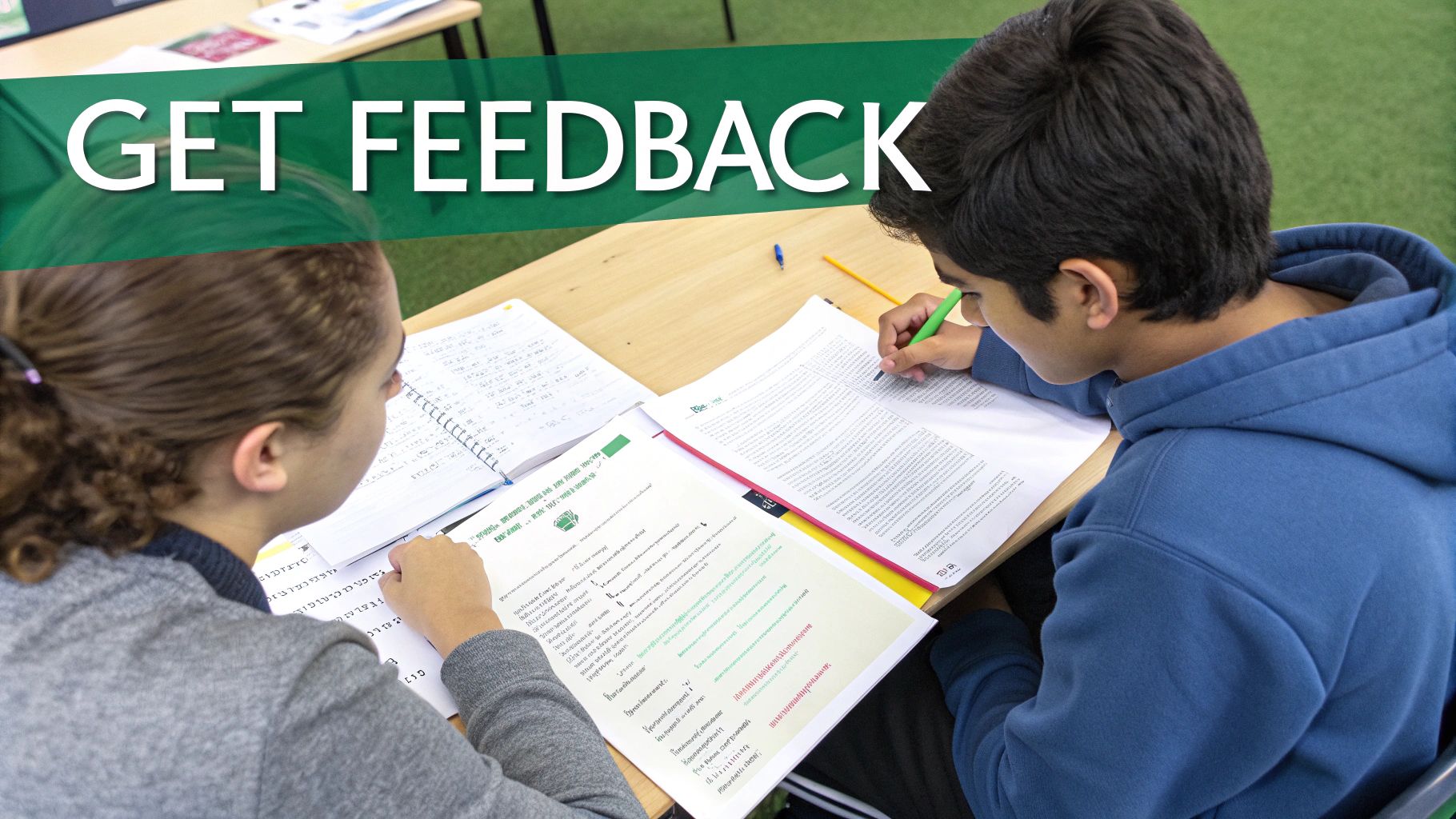
Writing in a vacuum is one of the slowest ways to improve. If you really want to pick up speed on your journey to becoming a better writer, you have to see your work through someone else's eyes. Actively seeking out and using constructive feedback is the single fastest way to spot your blind spots and accelerate your progress.
The process starts with you—learning to review your own work effectively—but its real power is unlocked when you invite others in. Whether it's a classmate, a teacher, or a dedicated tutor, an outside perspective is invaluable.
Practical Self-Revision Techniques
Before showing your writing to anyone else, the first round of feedback should always come from you. Effective self-revision is so much more than a quick spell-check; it's a deliberate process of looking at your work with a critical eye.
An actionable trick is to read your writing out loud. This forces you to slow down and helps you catch awkward phrasing, clunky sentences, and grammatical errors your eyes might otherwise skim over. If a sentence feels difficult to say, it’s probably difficult to read.
Another powerful technique is to change the format. Copy and paste your text into a different font or document style. This simple visual change tricks your brain into seeing it as a new piece of writing, making it easier to spot errors you previously overlooked.
The Value of Peer and Expert Review
While self-editing is a great start, you can only get so far on your own. This is where getting an outside opinion becomes an absolute game-changer for anyone serious about improving their English writing skills.
-
Peer Review: Swapping essays with a classmate can be incredibly helpful. Your peers are working on the same assignments and can offer a relatable perspective. To make these sessions productive, agree to focus on specific things, like the clarity of the main argument or the strength of the evidence used.
-
Expert Opinion: Getting feedback from a teacher or a dedicated tutor takes your improvement to a whole new level. An expert can pinpoint not just what is wrong, but why it's wrong and give you specific strategies to fix it. This is where personalised tutoring makes a dramatic difference.
Feedback is a gift. It’s the fastest way to understand how your writing is actually being received by a reader. Embracing it, rather than fearing it, is essential for rapid growth.
How Personalised Tutoring Makes the Difference
A personal tutor provides the kind of focused, one-on-one support that is simply not possible in a busy classroom. They act as your personal guide, offering tailored feedback that directly addresses your unique strengths and weaknesses. A tutor can take an essay from your schoolwork and break it down with you line by line, explaining complex concepts and showing you exactly how to apply them.
This creates a supportive, judgement-free environment where you can ask questions without feeling embarrassed. That direct interaction builds confidence in a way that written comments on an assignment never can. You can learn more about how tutoring helps with subject confidence in our detailed guide.
A tutor’s job is to pinpoint recurring patterns in your writing—whether it’s a tendency to use run-on sentences or a struggle with structuring arguments—and provide targeted exercises to help you master those skills. This focused support is especially critical for preparing for high-stakes exams like the VCE or HSC. It’s the most direct path to turning weaknesses into strengths.
As you start putting these strategies into action, a few common questions always seem to pop up. It's totally normal. Getting some straight answers can clear things up and keep you moving in the right direction. Let's tackle some of the most frequent queries I hear from students and parents.
How Long Does It Take to See Real Improvement?
This is always the first question, and the honest answer is: it depends on consistency.
If you can commit to just 15-20 minutes of focused practice every single day, you’ll likely start to feel more confident and see your writing become clearer within a few weeks. Seriously, that small daily habit makes a huge difference.
However, mastering bigger skills—like structuring a persuasive VCE essay or finding your unique writing voice—takes more time. The key is to aim for small, consistent wins rather than expecting an overnight miracle. Progress isn't always a straight line, but every practice session builds on the last one.
Is It Better to Read Fiction or Non-Fiction?
Both are incredibly important, but they help you in slightly different ways. You really need a mix of both.
- Fiction is basically a masterclass in storytelling. Reading novels and short stories will fill your head with evocative words and show you how to create rhythm and flow in your sentences. It teaches you how to make an emotional impact.
- Non-fiction, like articles, essays, and reports, is where you learn to build a logical argument. It shows you how to structure your thoughts, present evidence clearly, and write with precision.
The best approach? A balanced reading diet. For every novel you read for pleasure, try reading a long-form journalistic article on a topic that interests you.
Think of it this way: fiction teaches you how to paint with words, while non-fiction teaches you how to build a solid structure. You need both to create something truly impressive.
Can Technology Really Help Me Improve?
Absolutely, but with one big condition: you have to treat it as a tool, not a crutch. Technology can be a fantastic assistant for anyone working on their English writing skills.
Editing tools like Grammarly are great for catching grammar mistakes and suggesting clearer phrasing on the fly. You learn as you go. Online resources and writing prompts also offer an endless supply of practice opportunities.
But here’s what technology can’t do: it can't replace the critical thinking and creative spark needed to form your own ideas and build a compelling argument. Use tech to polish your work, not to write it for you. The goal is to strengthen your own abilities, and technology is just a great helper in that process.
Ready to get the personalised feedback and expert guidance that truly accelerates progress? At Evergreen Tutoring Services, our dedicated tutors provide the one-on-one support you need to build confidence and master the skills for academic success. Discover how our tailored approach can transform your writing by visiting https://www.evergreentutoringservices.com.au.