To write a truly persuasive essay, you need more than just an opinion. It’s a process of building a logical, evidence-backed argument designed to convince your reader to see things your way. It all starts with a clear plan, gets held together by a strong structure, and is brought to life with powerful, convincing language.
This guide is your practical toolkit for mastering every step, filled with actionable insights to help you build a compelling case.
Why Persuasive Writing Is a Critical Skill

Learning how to write a persuasive essay goes way beyond just ticking a box for a school assignment; it's a fundamental life skill. For senior students in Australia gearing up for high-stakes exams like the HSC or VCE, it’s absolutely essential. The ability to construct a compelling, evidence-backed case is what truly sets successful students apart.
Unfortunately, national assessments have shown a concerning trend. An analysis of NAPLAN persuasive writing data between 2011 and 2018, published by the Australian Education Research Organisation, revealed an overall slide in average scores. The gap becomes really noticeable in high school, where over one-third (38%) of Year 9 students struggled with engaging their audience—a vital element in swaying anyone's opinion. You can discover more insights about these educational trends in the full research.
This guide is designed to give you a clear path forward, helping you move beyond basic arguments to craft a narrative that genuinely connects with and convinces your reader.
More Than Just an Exam Hurdle
Persuasion is at the heart of effective communication in almost every field imaginable. Nailing this skill now will serve you well into university and your future career. Think of it as a mental workout that strengthens your ability to think logically and express your ideas with clarity and impact.
This process is about so much more than just stating what you think; it teaches you to:
- Analyse complex issues from multiple different angles.
- Gather and evaluate evidence to make your claims bulletproof.
- Anticipate and address what the other side might argue.
- Structure your thoughts in a clear, logical sequence.
A great persuasive essay doesn’t just tell the reader what to think—it guides them through a logical journey, making your conclusion feel like the only reasonable outcome. This is where you transform a simple argument into a powerful, convincing piece of writing.
Ultimately, a well-crafted persuasive essay is a demonstration of sharp thinking. It proves you can do more than just recall information; you can synthesise it, analyse it, and present it in a way that influences others. Developing these abilities is a key part of our guide on how to develop critical thinking.
Planning Your Essay Before You Write a Word
A powerful essay is built long before you type the first sentence. Too many students dive straight into writing, thinking they can figure it out as they go, only to end up with a jumbled argument that wanders off track.
Think of the pre-writing phase as your strategic advantage. It’s where you transform a vague idea into a focused, compelling argument. This isn't just about a quick brainstorm; it’s about creating a solid foundation with a clear roadmap that will guide you from your introduction to your final, killer conclusion.
Deconstruct the Essay Question First
Before you can dream of forming an opinion, you have to know exactly what you’re being asked. Essay questions, especially in exams, are precision-engineered. Every word is there for a reason, and rushing this step is the easiest way to write a brilliant essay that completely misses the point.
To avoid this all-too-common trap, break down the prompt and identify its core components:
- Instructional Verbs: Look for words like 'discuss', 'evaluate', 'analyse', 'argue', or 'to what extent'. These verbs are your direct orders. Actionable Insight: 'Discuss' asks for a balanced exploration of both sides, while 'argue' demands you pick a side and defend it fiercely.
- Key Concepts: Circle the main ideas and any limiting factors. Are you being asked about a specific time period, a particular group of people, or a certain geographical location? These define the boundaries of your argument.
- The Real Question: Now, rephrase the entire prompt in your own words. What’s the core tension or debate it’s pushing you to engage with?
Practical Example: For the question, "To what extent should social media platforms be held responsible for moderating user-generated content?", the phrase 'to what extent' is a massive clue. It signals that a simple yes/no answer is not enough. The question demands a nuanced evaluation of the degree of responsibility, considering arguments for and against heavy-handed oversight.
Brainstorm Arguments and Gather Evidence
Once you’ve got a firm grip on the question, it's time to let the ideas fly. A fantastic way to start is with a simple T-chart, listing arguments 'For' your potential stance on one side and 'Against' on the other. This gives you a bird's-eye view of the entire debate.
This process naturally flows into the next crucial step: finding proof. An argument without evidence is just an opinion, and opinions don’t win arguments or score high marks. You need to back up every claim with solid, credible evidence.
Your goal is to build a case so strong that it’s hard to refute. This isn't achieved with emotional pleas, but with a logical progression of ideas supported by credible evidence. A 2017 study from Stanford University confirmed that data-driven arguments are consistently found to be more persuasive than those based on anecdotes alone.
Aim for a healthy mix of evidence to make your essay more robust:
- Statistics and Data: Numbers add a powerful sense of authority. Citing a verifiable statistic like "According to the Australian Institute, 78% of Australians are concerned about fake news on the internet" gives your point undeniable weight.
- Expert Opinions: Quoting a recognised authority—a university researcher, a legal scholar, an industry leader—lends credibility to your claims.
- Real-World Examples: Case studies or well-chosen historical events make abstract ideas tangible. They help your reader connect with your argument.
Crafting a Strong Thesis Statement
All this planning and research culminates in one single, critical sentence: your thesis statement. This is the anchor for your entire essay. It's a clear, concise, and debatable declaration of your main argument, usually sitting right at the end of your introduction.
A weak thesis is often just a statement of fact or a vague announcement. A strong thesis is assertive and takes a firm position.
Let's look at the difference for our topic:
- Weak: "There are many different views on content moderation for social media." (This is a fact, not an argument).
- Strong: "While freedom of speech is paramount, social media platforms must be held legally accountable for moderating harmful content to protect public safety and democratic integrity."
The second one is miles better. It acknowledges the counterargument (freedom of speech), states a crystal-clear position (they must be held accountable), and even outlines the key reasons why (public safety, democratic integrity). This one sentence gives both you and your reader a perfect roadmap for the entire essay.
Building a Structure That Supports Your Argument
A brilliant argument can fall flat without a solid framework to hold it up. Your essay's structure is the backbone that holds everything together, guiding your reader logically from your opening hook to your final, convincing point. It’s how you build momentum and make sure every piece of evidence serves a clear purpose.
While there's room for creativity, the classic three-part structure—introduction, body, and conclusion—is a time-tested model for a reason. It creates a clear path for your reader, making your argument easier to follow and much more persuasive.
This visual shows a simple yet effective flow for planning your essay's core components before you even start thinking about the full structure.
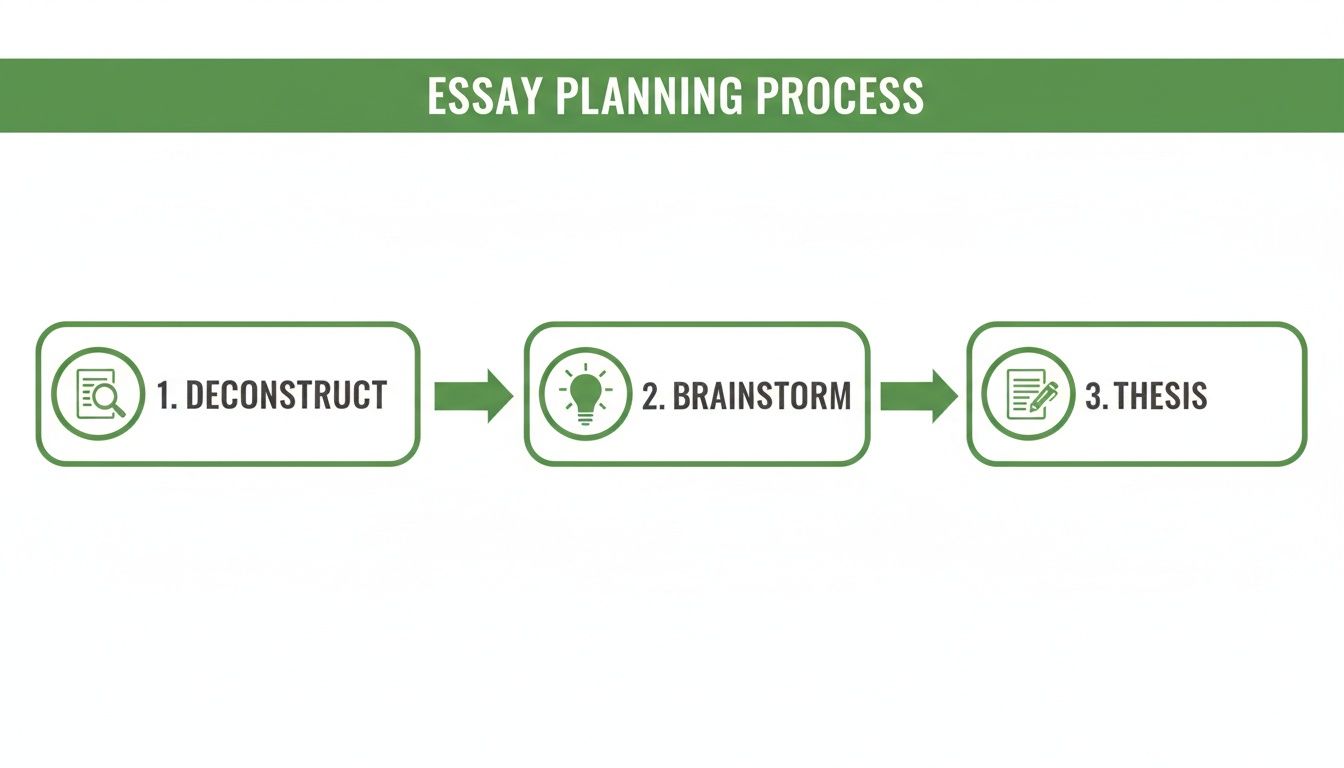
This process highlights how deconstructing the prompt, brainstorming ideas, and locking in a thesis are the foundational steps that directly inform how you'll build out your essay.
To give you a bird's-eye view, here's a quick breakdown of what each part of the essay needs to achieve.
A Blueprint for Persuasive Essay Structure
| Essay Section | Primary Goal | Key Elements to Include |
|---|---|---|
| Introduction | Grab the reader's attention and state your position clearly. | Hook, brief background context, and a strong thesis statement. |
| Body Paragraphs | Prove your thesis with evidence and logical reasoning. | Topic sentence, evidence, explanation, and rebuttal of counterarguments. |
| Conclusion | Reinforce your argument and leave a lasting impression. | Rephrased thesis, summary of key points, and a final powerful thought. |
This table acts as a simple checklist to keep you on track as you move from one section to the next.
Crafting an Unforgettable Introduction
Your introduction is your first—and sometimes only—chance to grab your reader's attention. A weak opening can lose them before you've even had a chance to present your main argument. Its job is to set the stage, introduce the topic, and clearly state where you stand.
A powerful introduction usually has three key parts:
- The Hook: Kick things off with a compelling sentence that makes the reader want to know more. This could be a surprising statistic, a provocative question, or a short, punchy anecdote.
- Background Context: Briefly give the reader just enough information to understand the debate. Keep it concise; you're just setting the scene, not giving away all your evidence.
- The Thesis Statement: This is the most critical sentence in your entire essay. It’s your main argument, or contention, presented clearly and confidently right at the end of the intro. For a deeper look, our guide on how to write a contention offers more detailed strategies.
Practical Example: Essay on Fast Fashion
"Every year, Australians discard approximately 500,000 tonnes of textiles, a staggering figure from the Australian Bureau of Statistics that reveals a hidden environmental crisis. This culture of 'fast fashion'—cheap, trendy clothing produced at lightning speed—has reshaped our wardrobes but at a significant ethical and ecological cost. Therefore, the Australian government must implement stricter regulations on textile waste and hold major fashion retailers accountable for their environmental impact."
This intro works because it hooks the reader with a shocking, verifiable number, gives just enough context on 'fast fashion', and finishes with a strong, debatable thesis.
Building Strong Body Paragraphs
The body of your essay is where you do the heavy lifting to prove your thesis. Each paragraph should work like a mini-essay, focused on a single, distinct idea that supports your overall argument. It's crucial that your paragraphs build on each other in a logical sequence, creating a clear and compelling line of reasoning.
While models like TEEL (Topic sentence, Evidence, Explanation, Link) are useful starting points, truly effective persuasive writing goes a step further. It shows you’ve thought about the other side of the coin by anticipating and dismantling opposing viewpoints, which demonstrates a much higher level of critical thinking.
Weaving in Evidence and Rebuttals
A well-structured body paragraph presents a clear claim, backs it up with solid evidence, and then explains exactly why that evidence matters.
Actionable Insight: Structure your paragraphs this way:
- Topic Sentence: Start with a sentence that clearly states the main point of the paragraph and links it back to your thesis.
- Introduce Evidence: Don’t just drop a quote or statistic out of nowhere. Use a signal phrase like, "According to research from the Australia Institute…"
- State and Explain Evidence: Provide your data, example, or expert opinion. Then, crucially, explain how this evidence proves your topic sentence.
- Acknowledge and Refute (The Rebuttal): This is where you really show your marker you've thought deeply about the issue. Acknowledge a potential counterargument and then explain why your position is stronger.
Here’s what that looks like in action, continuing with our fast fashion essay:
"One of the most compelling reasons for government intervention is the immense water consumption of the fast fashion industry. For instance, the UN Environment Programme reports that producing a single cotton t-shirt requires up to 2,700 litres of water—enough for one person to drink for 900 days. This unsustainable use of a precious resource places an enormous strain on ecosystems, particularly in drought-prone manufacturing regions. While some might argue that consumer choice and boycotts are more effective than regulation, this view overlooks the systemic nature of the problem. Individual actions are commendable but insufficient to challenge an industry worth billions, making government-led regulation the only viable solution for large-scale change."
This paragraph doesn't just state a fact; it explains its significance and tackles a common counterargument head-on, making the overall case that much stronger.
Writing a Conclusion That Leaves an Impact
Your conclusion is the last thing your reader will see, so it needs to be powerful and memorable. This is your final opportunity to drive your point home and leave a lasting impression. Avoid simply repeating your introduction; instead, you want to create a sense of finality and importance.
A strong conclusion should get three things done:
- Restate Your Thesis: Rephrase your main argument in a new, compelling way. Use different wording to show that you've explored the topic fully.
- Summarise Your Key Points: Briefly pull together the main arguments from your body paragraphs. This reinforces the logical flow of your essay.
- Provide a Final Thought or Call to Action: End with a powerful statement. This could be a prediction, a recommendation, or a broader reflection on the issue's significance. It's your "mic drop" moment.
Practical Example: Conclusion on Fast Fashion
"In conclusion, the environmental toll of fast fashion is no longer a problem Australia can afford to ignore. By re-evaluating the true cost of a five-dollar t-shirt—measured not in cents but in thousands of litres of water and tonnes of landfill—it becomes clear that government regulation is not just an option, but a necessity. Without decisive action to enforce corporate responsibility, we are simply outsourcing our environmental conscience, leaving a legacy of waste for future generations to inherit."
This conclusion neatly summarises the argument and ends with a powerful, thought-provoking statement that resonates with the reader long after they’ve finished reading.
Using Language That Truly Persuades
With a solid structure mapped out, it’s time to zoom in on the words themselves. This is where your essay shifts from being merely informative to genuinely persuasive. It isn't about throwing in fancy, complicated words; it’s about making strategic language choices that actually influence how your reader thinks and feels.
The most powerful essays masterfully blend the three rhetorical appeals. These were first described by the philosopher Aristotle thousands of years ago, and they are timeless tools for building a convincing argument.
The Three Pillars of Persuasion
Understanding ethos, pathos, and logos is the key to crafting an essay that truly connects. Think of them as the three legs of a stool—if one is missing, your entire argument can wobble and fall over.
-
Ethos (Credibility): Establish yourself as a trustworthy source. Actionable Insight: Build ethos by using balanced language, acknowledging counterarguments, and citing reputable, verifiable sources (e.g., academic journals, government reports). This shows your marker you’ve done your homework.
-
Pathos (Emotion): Appeal to the reader's values and emotions. A carefully chosen anecdote or vivid, emotive language can make your argument more relatable. Practical Example: Instead of saying "pollution is bad," describe "choking smog that blankets our cities and harms our children." The key is subtlety; too much emotion undermines your credibility.
-
Logos (Logic): This is the foundation of your argument—the clear reasoning backed by hard evidence like facts and statistics. Every body paragraph should be a masterclass in logos, proving your claims with undeniable proof. A data-driven case is incredibly difficult to argue against.
A great persuasive essay never relies on just one of these. It skilfully weaves them together, using logic as its backbone, credibility as its voice, and just the right touch of emotion to make the message stick.
Choosing Words with Precision and Power
Your diction, or word choice, has a massive impact on the tone and power of your essay. Swapping out vague, generic terms for precise, impactful language can make your writing far more convincing.
Practical Example:
- General: "The new policy is bad for the community."
- Precise: "The new policy imposes an unfair financial burden on low-income families in the community."
The second sentence is instantly more persuasive because it’s specific. It tells the reader how and for whom the policy is bad.
Actionable Insight: Don't just use a thesaurus to find a longer word; use it to find the most accurate one. The best word choice feels natural yet adds a new layer of meaning and impact to your argument.
Varying your sentence structure is another simple but incredibly effective technique. Mixing short, punchy sentences with longer, more complex ones creates a rhythm that keeps your reader engaged. A long string of complex sentences can get confusing, while too many short ones in a row can sound choppy and simplistic.
Creating a Seamless Flow with Transitions
Think of transitions as the signposts of your essay. They are the words and phrases that guide your reader smoothly from one idea to the next, clearly showing the logical relationship between your paragraphs and sentences. Without them, your essay can feel like a jumble of disconnected points.
Transitions are the glue holding your argument together. They create a logical bridge, ensuring your reader can follow your train of thought without ever getting lost.
Here is a practical toolkit of transitional phrases you can pull from to improve the flow of your writing.
A Toolkit for Transitional Phrases
| Function | Example Phrases |
|---|---|
| To Add an Idea | Furthermore, Moreover, Additionally, In addition |
| To Show Contrast | However, On the other hand, Nevertheless, Conversely |
| To Provide an Example | For instance, For example, To illustrate, Specifically |
| To Emphasise a Point | Indeed, In fact, Crucially, Most importantly |
| To Show Cause/Effect | Consequently, As a result, Therefore, Thus |
| To Conclude | In conclusion, Ultimately, To summarise, In the final analysis |
By mastering these persuasive language techniques, you move beyond simply stating your case. You start crafting an argument that is not only logical and well-supported but also engaging and compelling.
How to Revise and Edit Your Draft Like a Pro

Hitting ‘save’ on your first draft is a great feeling, but the job isn’t done yet. The revision and editing stages are where a decent essay truly becomes a persuasive one. It’s a critical step where many students stumble.
Decades of NAPLAN data show a worrying trend: the gap between high and low-achieving writers widens in high school. Analysis from the Grattan Institute found that, in some cases, the gap in writing ability between the strongest and weakest Year 9 students is equivalent to more than seven years of schooling. This highlights the need for a structured approach to polishing your work.
To make this process feel less overwhelming, split it into two distinct jobs. First, focus on revision—the big-picture stuff. Then, and only then, zoom in on editing the sentence-level details.
The Revision Phase: Focus on the Big Picture
Before you even think about commas or spelling, you need to step back and look at your essay as a whole. Revision is all about checking the structural integrity and logical power of your argument. You’re essentially asking one simple question: does my argument actually work?
Ask yourself these critical questions:
- Is My Thesis Clear? Can a reader find your main contention easily? Does every single paragraph directly support it, or have you wandered off-topic?
- Is the Logic Sound? Do your paragraphs flow in a logical order? Each point needs to build on the last.
- Is the Evidence Strong Enough? Is every claim backed by credible, relevant evidence? Be honest—are there any weak spots that need a better example or a stronger, verifiable source?
- Did I Address Counterarguments? Have you acknowledged and effectively refuted opposing views? This is what makes your own position so much stronger.
Actionable Insight: This is the stage for big changes. Don't be afraid to rewrite a paragraph, scrap weak evidence, or reorder your arguments for better flow. It’s all about making sure the skeleton of your essay is rock-solid.
Taking the time to develop these skills is vital, and our dedicated guide offers more advice on how to improve writing skills for long-term success.
The Editing Phase: Zoom in on the Details
Once you’re confident in your argument’s structure, it’s time to get out the magnifying glass and polish your writing at the sentence level. This is the editing phase, where you sweat the small stuff to make sure your essay is clear, professional, and easy to read.
Here, you're hunting for all the little errors that can distract your reader and undermine your credibility.
An Actionable Editing Checklist
Work through your essay with a fine-tooth comb, but don’t try to fix everything at once. Focus on one issue at a time.
- Read It Aloud: This is the single best trick in the book. It forces you to slow down and helps you catch awkward phrasing and clunky sentences. If it sounds weird when you say it, it will read weird on the page.
- Check for Clarity and Conciseness: Hunt down and eliminate any unnecessary words or repetitive phrases. Practical Example: Change "due to the fact that" to "because." Be ruthless.
- Correct Grammar and Punctuation: Look for common mistakes like run-on sentences, comma splices, and incorrect apostrophe use.
- Proofread for Spelling: Don't just rely on spell-check! It won’t catch correctly spelled but misused words (like ‘their’, ‘there’, and ‘they're’).
- Ensure Consistent Tone: Make sure your tone is consistently academic and authoritative. Cut out any language that’s too informal or overly emotional.
Your Top Persuasive Essay Questions, Answered
Even with the best plan, it’s normal for a few questions to pop up. Let's tackle the most common uncertainties students have about writing persuasive essays.
One of the big ones is always about personal opinions. Are they okay to use? The short answer is yes, but it’s how you present them that counts. Your entire essay is essentially your reasoned opinion, but you must frame it as a logical argument backed by solid proof, not just a gut feeling.
Actionable Insight: Ditch phrases like "I feel" or "I believe." Instead, state your claims with confidence and let your evidence do the heavy lifting. For example, instead of "I believe the law is unfair," write "The law is unfair because…" and then provide your evidence.
Another classic query is about the ideal length. While your teacher or exam will often set a specific word count, the standard five-paragraph essay is a reliable starting point. This structure gives you an intro, three distinct body paragraphs (each hammering home a unique point), and a powerful conclusion.
How Much Evidence Is Enough?
There's no magic number. The real goal is quality over quantity.
A single, powerful statistic from a reputable source that you unpack and explain properly is far more convincing than a long list of facts thrown in without analysis.
Actionable Insight: The strength of your argument doesn’t come from how many sources you list. It comes from how well you use that evidence to prove your point. For every piece of evidence, you must explain why it supports your argument.
And, of course, make sure every piece of evidence is directly relevant to the specific point you’re making in that paragraph.
What’s the Difference Between Persuasive and Argumentative Essays?
This is a fantastic question because the terms are often used interchangeably, but there's a subtle and important distinction.
- Persuasive Essays: These often appeal to both logic and emotion (logos and pathos). The main goal is to get the reader to agree with you, and sometimes that means using more emotive or passionate language.
- Argumentative Essays: These lean almost entirely on logic and evidence (logos). They demand that you acknowledge and systematically refute counterarguments to prove your position is the most valid one.
For most senior school tasks in Australia, you'll be writing what is essentially a formal argumentative essay. This requires a balanced, evidence-based approach. Research consistently highlights how crucial these skills are, showing significant performance gaps in persuasive writing abilities among students. You can discover more insights about these educational trends to see why it's such a focus.
Ultimately, understanding these finer points will help you write with more clarity and confidence. The real skill is turning an opinion into a compelling, well-defended case that leaves no room for doubt.
Mastering the art of persuasion takes practice, but you don't have to do it alone. Evergreen Tutoring Services offers personalised online tutoring to help you build the skills and confidence needed to excel in your essays and exams. Find out how our expert tutors can support your academic journey today.