When preparing for your final exam, one tool stands above the rest: official VCE Chemistry past papers. These aren't just practice questions; they are your best resource for understanding what examiners expect and how to earn top marks.
Why Past Papers Are Your Strongest Study Tool
Many students save past papers for a last-minute check, which is a missed opportunity. High-achieving students use them strategically to get inside the minds of the people who write and mark the exams. Working through official VCAA materials helps you see the specific language, key terms, and depth of explanation that assessors are looking for. It turns guesswork into a methodical process.
Spot Recurring Question Patterns
One of the biggest advantages of working through past papers is that patterns emerge. You'll notice certain topics and question styles appear year after year. Questions on stoichiometry, organic reaction pathways, and interpreting spectroscopic data are staples of the VCE Chemistry exam.
Identifying these recurring themes allows you to focus your study time where it will have the most impact. Instead of memorising every detail, you can double down on high-yield topics that consistently deliver the most marks.
By analysing several years of VCE Chemistry past papers, you'll anticipate the types of questions you'll face. This familiarity reduces exam-day anxiety and builds confidence.
Learn from Common Mistakes
This is where the real gold is. Using past papers alongside their official examiner reports provides direct insight into common errors that cost students marks. These reports are honest, highlighting where previous year groups went wrong.
You might discover that:
-
Students struggle with complex redox equations in basic solutions.
-
Marks are lost for not showing clear working in calculations.
-
Answers about equilibrium often lack the precise terminology for full credit.
Understanding these common trip-ups helps you work on your own weaknesses. You learn to avoid simple, costly mistakes, ensuring your final answers are sharp and precise.
Finding and Organising Your Exam Resources
A messy downloads folder adds unnecessary stress. Before you start, get all your materials in one place, beginning with authentic VCE Chemistry past papers. Source these directly from the official source to ensure they match the current study design. Avoid third-party copies, which can be outdated or contain errors.
Your one-stop shop is the Victorian Curriculum and Assessment Authority (VCAA) website. It’s the official home for every past exam and the useful examiner reports.
Here's what the official VCAA page looks like, where you'll find all the VCE Chemistry past exams and reports.
Each year includes the exam paper, the examination report, and sometimes a sample paper, giving you a complete toolkit for your revision.
Building Your Digital Study Library
Once you have these resources, set up a simple digital filing system. This isn’t just about being neat; it’s about creating a structured library that saves time and helps track your progress.
Here’s a practical folder structure:
-
VCE Chemistry Past Papers (Main folder)
-
2023 (Subfolder for each year)
-
2023_Chem_Exam.pdf
-
2023_Chem_Report.pdf
-
-
2022
-
2202_Chem_Exam.pdf
-
2022_Chem_Report.pdf
-
-
…and so on for every year.
-
This layout helps you find any paper or report in seconds. The VCAA provides a full archive of VCE Chemistry past papers from 2017 to 2023, offering a solid range of materials.
An organised system removes mental clutter. Knowing where everything is lets you dive straight into studying, making your revision time more productive.
How to Simulate Real Exam Conditions
Flicking through a VCE Chemistry past paper is one thing; performing under the pressure of a ticking clock is another. To truly prepare, you must replicate the official exam environment. This builds the mental stamina and time management skills you'll need on the day.
The non-negotiables are simple: set a strict timer for reading and writing time, find a silent, distraction-free space, and put your phone away. Work only with your approved VCAA data booklet and scientific calculator. Learning to navigate the data booklet quickly is a skill built under pressure.
A Phased Approach to Mock Exams
Jumping into a full, timed exam can be overwhelming. A smarter strategy is to build up to it gradually.
-
Phase 1: Open-Book Practice. Start by attempting a paper with your notes and textbook. The goal is accuracy and learning to find information.
-
Phase 2: Timed Sections. Next, complete individual sections under the clock, like the multiple-choice questions, to get a feel for the required pace.
-
Phase 3: The Full Mock Exam. Once confident, attempt a full, timed, closed-book mock exam from start to finish.
This infographic shows the types of questions you'll juggle under timed conditions.
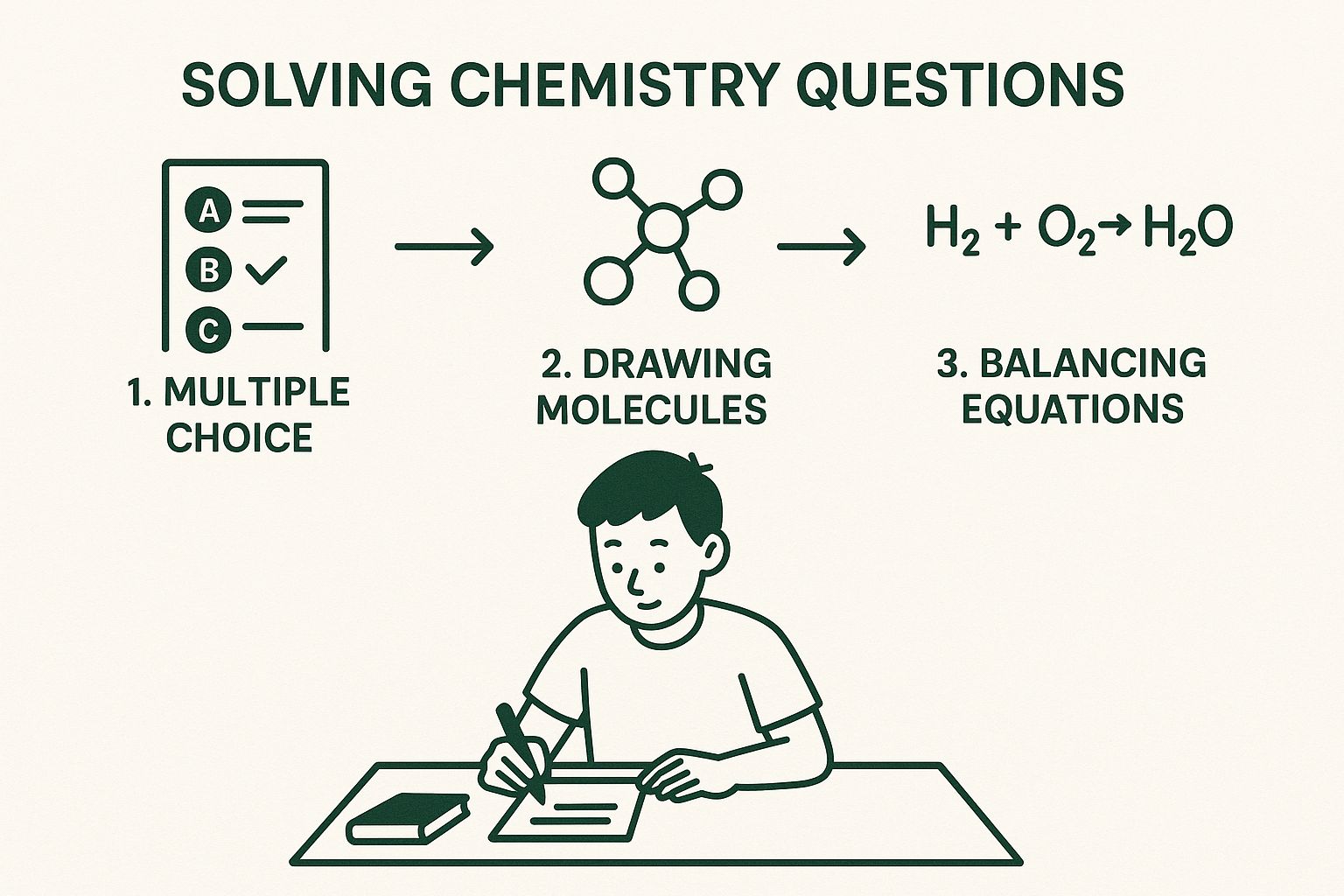
You need to switch between different cognitive gears quickly—from recall to complex problem-solving—all while the clock is ticking.
Simulating exam conditions trains your brain for the event itself. It builds resilience, sharpens timing, and reduces the chance of panicking on exam day.
Making mock exams feel real desensitises you to the pressure. For more strategies, check our guide on essential exam study tips. This approach ensures the real exam hall feels familiar.
Learning From Your Mistakes with Examiner Reports
Finishing a VCE Chemistry past paper is only half the battle. The most important learning happens when you start the marking process. This is when you turn practice into powerful, targeted revision. The real game-changer is pairing your marked paper with the official VCAA Examiner Report for that year. These reports are a goldmine, showing why marks were awarded or denied for every question.
Decoding Examiner Comments
Examiner reports are your direct line into an assessor's brain. They spell out the specific keywords, phrasing, and calculation steps that separate a decent answer from a full-mark response. For example, a report might reveal that students lost marks on an equilibrium question for not using the phrase "rate of the forward reaction".
You’ll see patterns—the common traps that trip students up year after year. This analysis is crucial. VCAA often allocates marks to topics where students have historically struggled.
The goal isn't just to see what you got wrong, but to understand why. Was it a calculation error, a misread question, or a gap in your knowledge?
Creating an Error Log
To make this process stick, create an 'error log' using a notebook or spreadsheet. For every mistake, diagnose the root cause. This turns each past paper into a diagnostic tool.
Categorise each mistake:
-
Conceptual Error: You didn't understand the core principle.
-
Calculation Error: The method was right, but the numbers were wrong.
-
Misread Question: Your answer was good, but for the wrong question.
-
Keyword Missing: You missed the precise scientific term.
Common VCE Chemistry Exam Feedback
The VCAA Examiner Reports highlight the same issues year after year. Familiarising yourself with them gives you a huge advantage.
|
Area of Feedback |
Common Student Error |
Examiner’s Advice |
|---|---|---|
|
Significant Figures |
Using inconsistent or incorrect significant figures. |
Match the sig figs in your answer to the least precise data value in the question. |
|
Stoichiometry |
Forgetting to use mole ratios from the balanced equation. |
Double-check that you’ve correctly applied the stoichiometric ratio. |
|
Equilibrium |
Making vague statements like “the equilibrium shifts” without justification. |
State why the equilibrium shifts by referring to Le Chatelier’s principle and reaction rates. |
|
Organic Chemistry |
Naming compounds incorrectly or drawing flawed structures. |
Practice IUPAC nomenclature. Ensure every atom satisfies its bonding capacity. |
|
Redox |
Incorrectly identifying the oxidant and reductant. |
Remember OIL RIG (Oxidation Is Loss, Reduction Is Gain) to identify electron transfer. |
Tracking these patterns in your error log helps you pinpoint weaknesses and focus your study time. If you constantly make errors in electrochemistry, that’s a clear sign to review that topic. For students struggling to bridge these gaps, tutoring services for VCE exam preparation can provide targeted support.
Focusing on High-Yield Topics and Calculations
After working through a couple of VCE Chemistry past papers, you’ll realise not all topics are equal. A smart study plan focuses on high-yield areas that consistently carry the most marks. Past papers point directly to the concepts VCAA examiners favour, allowing you to pour revision time where it will make a difference.
Identifying the Heavy Hitters
As you sift through exams, some topics will appear with regularity. These are your non-negotiables. Keep a running tally of these patterns.
You'll almost certainly see a heavy emphasis on:
-
Stoichiometry: The bedrock of VCE Chem calculations.
-
Redox and Electrochemistry: Balancing equations and analysing cells are exam staples.
-
Organic Reaction Pathways: Questions mapping out molecule synthesis are a classic.
Prioritising these areas aligns your study with the exam, making revision more efficient.
Mastering Quantitative Problem-Solving
The VCE Chemistry exam focuses more on problem-solving than rote learning. Past papers show that roughly 40-50% of questions involve quantitative reasoning. About a third of the marks are for understanding chemical processes, not just theory.
This means mastering calculations is essential for a top score.
Don't just drill calculations from a textbook. Use past papers to see how they're presented in multi-step problems that weave together concepts like molarity, stoichiometry, and limiting reagents.
To nail these, deconstruct the question. Break it into smaller chunks. Pinpoint what you know and what you need to find. Write a balanced equation. Map out your calculation pathway before picking up the calculator. This methodical approach is your best defence against silly mistakes like forgetting mole ratios or using the wrong units.
Common Questions About VCE Chemistry Past Papers
As you incorporate VCE Chemistry past papers into your study routine, some common questions may arise. Let's address them to sharpen your strategy.
How Many Past Papers Should I Actually Do?
This is a quality vs. quantity debate. The real gains come from deep analysis, not just ploughing through more papers.
Aim to complete, mark, and thoroughly review 5-7 full past papers under exam conditions in the final weeks. Before then, use older papers for targeted practice on tricky topics.
The secret is what you learn from each paper. Deeply analysing three papers and fixing weaknesses is more valuable than speeding through ten without reflection. Save the most recent papers for your final mock exams.
My Scores on Practice Papers Are Not Improving. What Now?
Hitting a plateau is normal. It’s a sign to change your approach, not just work harder. Get forensic with your error analysis. Are mistakes coming from one area?
-
Is it a specific concept, like equilibrium?
-
Are you making calculation errors?
-
Are you misreading questions under pressure?
Start a detailed error log to spot patterns. Go back to your textbook for topics you keep getting wrong. Try practising one question type across multiple papers, such as doing only the redox questions from five different exams.
Are Old Past Papers from a Different Study Design Still Useful?
Yes, but use them smartly. Prioritise papers from the current VCE Chemistry study design for full mock exams.
However, older papers are a goldmine for practising fundamental skills. Core chemistry concepts don't change much.
Use them for targeted drills:
-
Stoichiometry: Mole calculation principles are timeless.
-
Equilibrium: Le Chatelier's principle has been a staple for decades.
-
Organic Chemistry: Basic reactions and nomenclature are perfect for practice.
Have the current study design document open when using an old paper to check if a topic is still relevant. Never use an out-of-date paper for a full, timed mock exam.
Feeling stuck on these complex topics or hitting a study plateau? Evergreen Tutoring Services provides personalised, one-on-one online tutoring to help you master VCE Chemistry. Our expert tutors can help you analyse your past paper performance, target your weaknesses, and build the confidence you need to excel in your final exams. Learn more at https://www.evergreentutoringservices.com.au.