At its core, writing a contention is all about crafting a single, arguable sentence that puts your main argument on the table. This one sentence becomes the backbone of your entire essay, giving your reader a crystal-clear roadmap of what you're setting out to prove.
What a Winning Contention Actually Is
Before you can nail how to write one, you need to understand what it really is. Think of it as the heart of your argument—the central, debatable claim your whole essay is built to defend. It's so much more than just a topic sentence or a simple statement of fact.
A powerful contention makes a promise to your reader. It sets the stage, defines what’s at stake, and lays out a clear path for the logic they're about to follow. It’s what takes your writing from a vague idea to a sharp, focused argument.
The Difference Between a Fact and a Contention
One of the most common mistakes I see is students mixing up a factual statement with a contention. It's an easy trap to fall into. A fact is indisputable and leaves no room for debate, while a contention practically begs for discussion and demands proof.
Let's break it down with an example:
-
Fact: "Climate change is leading to rising sea levels."
-
Contention: "Australia’s current federal policies are insufficient to mitigate the long-term economic damage caused by rising sea levels."
The first statement is a scientifically established fact; you can't really argue with it. The second, however, is an arguable claim. It can be backed up with evidence about specific policies, economic models, and scientific forecasts. Getting this distinction right is absolutely vital for writing a compelling essay.
Your contention is your central pillar. If it's a simple fact, your essay has nowhere to go. If it’s a debatable claim, you’ve given yourself a purpose to write and your reader a reason to engage.
The ability to write strong, arguable statements is a key skill measured right across Australian schools. Take the National Assessment Program – Literacy and Numeracy (NAPLAN), which tests student writing in Years 3, 5, 7, and 9. As of 2023, NAPLAN's reporting even shifted from numerical bands to four proficiency levels, showing a renewed focus on these core literacy skills. You can actually see how these national standards are evolving by reviewing the latest NAPLAN results.
The Three Pillars of a Strong Contention
A powerful contention doesn't just appear out of thin air; it’s carefully built on three core pillars. When you're figuring out how to write a contention, the goal is always to make it arguable, specific, and defensible. Nail these three, and you'll see your essays transform from a simple summary of facts into a genuinely compelling argument.
An effective contention absolutely must have these foundations. This little summary box gets right to the heart of what makes a great thesis statement.
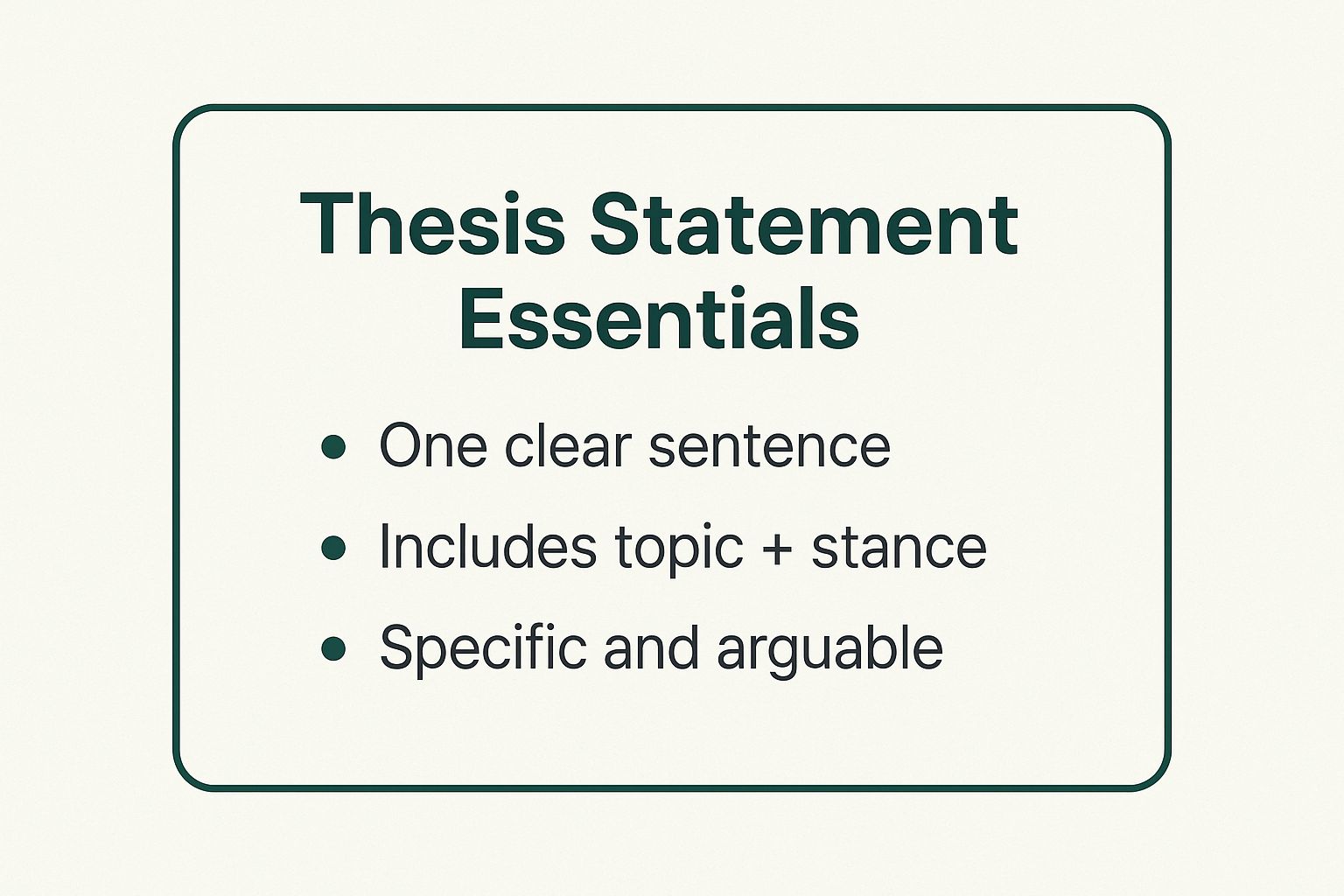
As you can see, clarity, a firm stance, and arguable specificity are the key ingredients. Without them, your argument just doesn't have the direction or purpose it needs to succeed.
It Must Be Arguable
First things first: your contention cannot be a simple statement of fact. It has to be a claim that a reasonable person could disagree with. You're trying to spark a debate, not get a simple nod of agreement. Think of it as picking a side on an issue that has more than one legitimate viewpoint.
For instance, saying "Shakespeare wrote many plays" is a fact. There’s nothing to argue there.
An arguable contention, on the other hand, would be something like, "Shakespeare's portrayal of female characters in his tragedies reinforces harmful societal stereotypes." Now that's a statement that takes a stance and needs evidence to back it up—which is exactly what an essay is for.
It Must Be Specific
A broad, sweeping statement is a nightmare to defend. Specificity is your best friend here; it narrows your focus, making your argument feel more manageable and far more persuasive. Vague claims only ever lead to generic, unconvincing essays.
Imagine trying to argue that "technology is bad for society." The topic is just too massive. Where would you even begin?
A specific, and therefore much stronger, contention would be: "The unchecked rise of social media algorithms has directly contributed to political polarisation in Australia by creating echo chambers." See the difference? This gives you a clear, focused path for your research and writing.
A great contention acts like a magnifying glass, focusing your argument on a precise point instead of trying to view the entire landscape at once. It’s about depth, not breadth.
It Must Be Defensible
Finally, your claim needs to be backed up by credible evidence. Without support, a contention is just an opinion. You need to shore it up with logical reasoning, facts, statistics, and expert analysis. Before you lock in your statement, always ask yourself: "Can I actually find enough reliable evidence to support this?"
If your entire argument is built on personal feelings or assumptions you can't prove, it’s not defensible. A defensible contention is one where you can confidently find and present evidence to build a logical case that proves your point to the reader.
To see this in action, let's look at how we can beef up a weak statement.
Transforming a Weak Statement into a Strong Contention
|
Characteristic |
Weak Contention Example |
Strong Contention Example |
|---|---|---|
|
Arguable |
It’s just a fact. No one can disagree with it. |
It presents a clear, debatable position. |
|
Specific |
It’s too broad and covers too much ground. |
It’s focused on a single, clear idea. |
|
Defensible |
It’s hard to find evidence for such a vague claim. |
You can support it with targeted research and facts. |
This table really highlights the journey from a flimsy idea to a rock-solid argument ready for an essay.
Developing Your Contention from Scratch
Crafting a sharp contention is rarely a bolt-from-the-blue moment. It’s a hands-on process that starts with broad ideas and slowly gets chiselled down into a precise, arguable statement. You have to be willing to explore your topic, do a bit of digging with some initial research, and challenge your own assumptions until a solid argument takes shape.
Think of it less like finding the perfect sentence and more like sculpting one from a block of raw material. You’ll start with a messy brainstorm, then shape a flexible "working contention" before polishing it into its final form.
Uncovering Your Angle Through Brainstorming
The first real step in knowing how to write a contention is just exploring every possible angle of your topic. Don't filter yourself at this point; just get every thought out of your head and onto the page. A simple mind map or even a messy bulleted list can be surprisingly powerful for seeing new connections and uncovering interesting perspectives you hadn't considered.
Say your topic is 'the impact of social media on teenagers'. Your first thoughts might be a jumble of everything from mental health and body image to cyberbullying and the value of online communities. It's in this creative mess that you'll often find the seeds of a truly unique and compelling argument.
A working contention is your starting point, not your destination. It's a flexible draft of your main argument that you fully expect to change and refine as you research and write.
This flexibility is your best friend. It gives you the freedom to adapt as you learn more. Your first idea might be that social media is purely damaging, but your research could uncover nuances that lead to a far more sophisticated and defensible contention.
Refining Your Argument with Critical Questions
Once you’ve got a working contention, it's time to put it to the test. The best way to do this is by asking tough questions that force you to challenge your own assumptions. This kind of self-interrogation is what turns a simple claim into a well-reasoned argument that can withstand scrutiny.
Try hitting your idea with these questions:
-
So what? Why does this argument actually matter? Who does this issue affect, and what are the real-world consequences?
-
Is it truly arguable? Could a reasonable person hold an opposing view? If the answer is no, you’re probably just stating a fact, not making a contention.
-
Can I back this up? Is there enough credible evidence out there to support this specific claim?
This critical reflection ensures your final contention is not only interesting but also sturdy enough to be properly defended. It's a core skill for academic success, though attainment levels can differ. In Australia, the national Year 12 Certification rate reached 76.3% in 2022, but disparities exist, often linked to socio-economic factors that can affect access to quality writing instruction. You can explore more about these educational attainment statistics in Australia.
Common Mistakes That Weaken Your Argument
Knowing what to do is half the battle; knowing what not to do is just as crucial. Even a well-researched essay can fall flat if its core argument is built on a shaky foundation. Sidestepping a few common traps is the key to making sure your point is strong, clear, and persuasive right from the first sentence.
One of the biggest pitfalls is making your claim far too broad. A contention like "environmental pollution is a global problem" is impossible to defend in a standard essay. It’s just too vast. You’ll end up with a shallow argument that’s all over the place, lacking any real focus or depth.
Another frequent error is presenting a simple fact as if it’s an arguable point. Stating "The Australian government provides subsidies for renewable energy," for example, is a fact, not a contention. This leaves no room for debate, essentially ending your essay before it even gets a chance to begin. You can explore how to craft more genuinely persuasive arguments in our guide on Section C argument and persuasive language.
Vague Language and Unclear Claims
Ambiguity is the enemy of a strong argument. When you use vague or imprecise language, you just confuse your reader and seriously weaken your position. Your goal should be to make it unmistakably clear what you intend to prove.
Take this weak contention: "Social media has some negative effects on teenagers." The words "some" and "negative effects" are too wishy-washy. What kind of effects? How significant are they?
A strong contention is sharp and specific. It doesn't hedge with vague terms; it makes a clear, confident claim that you can rigorously defend with evidence.
This need for clarity is more critical than ever. Over the last decade, Australian students’ writing skills have noticeably declined. A 2025 analysis revealed that most Year 9 students write at a level equivalent to a Year 4 student, which really underscores the urgent need for explicit instruction in building complex arguments. Learning how some schools are defying this national writing decline shows what's possible. Your ability to write a contention that avoids these common mistakes directly tackles this skill gap.
Weaving Your Contention Throughout Your Essay
A powerful contention isn’t something you just state in your introduction and then forget about. It needs to be the golden thread that runs through your entire essay, connecting every point and giving your writing a clear sense of purpose. Think of it as the compass that keeps every paragraph pointing in the right direction.
When you learn how to write a contention, the final piece of the puzzle is weaving it into the very fabric of your essay. This means every single body paragraph has to directly support and prove your central argument, creating a cohesive and convincing piece of writing.
Using Your Contention as a Guide
Each body paragraph should kick off with a topic sentence that works like a mini-claim. This sentence puts forward a specific point that directly backs up your main contention. You're essentially breaking down your big argument into smaller, bite-sized pieces that you prove one by one.
For instance, let's say your contention is: “Australia’s current federal policies are insufficient to mitigate long-term economic damage caused by rising sea levels.”
A strong topic sentence for a body paragraph might be: “The government’s reliance on short-term coastal defence projects fails to address the inevitable economic disruption to key agricultural regions.” See how this mini-claim clearly links back to, and helps to prove, the main argument?
Your contention isn't just a statement; it's the lens through which you analyse all your evidence. Every piece of data or quote you include must be explicitly linked back to this central claim to reinforce its relevance.
Reinforcing Your Argument in the Conclusion
Your conclusion is your last chance to really drive your argument home. This isn't the time to just repeat what you've already said. Instead, you need to revisit your contention, rephrasing it to show the reader how you’ve proven it throughout your essay.
Pull together the main points from your body paragraphs to show their combined strength in supporting your position. This reinforces the validity of your argument and leaves your reader with a powerful, lasting impression.
For more great advice, have a look at these helpful essay writing tips and tricks that can take your writing to the next level.
Your Top Questions About Contentions, Answered
As you get the hang of writing a solid contention, a few common questions tend to pop up. Let's tackle some of the most frequent ones we hear from students to clear up any confusion and help you sharpen your arguments.
How Long Should a Contention Be?
Keep it short and punchy. Your contention should almost always be a single, concise sentence. Its role is to state your main argument with absolute clarity, not to lay out your entire essay. If you try to pack too much in, you'll end up with a clunky, confusing statement that muddies the waters right from the start.
Aim for one powerful sentence that names your topic, declares your position, and hints at the core reason behind it. This approach forces you to be precise and sets a strong, clear direction for the rest of your piece.
Simplicity is your greatest asset. A single, well-crafted sentence is far more powerful than a paragraph trying to do the same job. A clear contention shows a clear thinker.
Can My Contention Change While I Write?
Absolutely! In fact, we encourage it. It’s often a sign that you're thinking deeply about your topic. It’s best to start with a working contention—think of it as a draft argument that guides your initial research and planning.
As you dig into your evidence and start building your points, you might discover a stronger angle or realise your initial stance needs a bit of a tweak. This is a completely normal and healthy part of the writing process. Don’t hesitate to revise your contention so it perfectly reflects the argument you can now support most effectively.
Ready to transform your essays from good to great? The expert tutors at Evergreen Tutoring Services provide personalised, one-on-one support to help you master skills like writing a powerful contention. Strengthen your writing and boost your grades with us today!