That blank page staring back at you for your VCE Psychology investigation can feel pretty daunting. But honestly, a strong start makes all the difference. Nailing your psychology study design for VCE comes down to having a crystal-clear, testable research question and a solid hypothesis from the get-go. This first step is everything—it takes a big, vague topic and turns it into a focused investigation, setting you up for success.
Crafting a Rock-Solid VCE Psychology Study

Your VCE Psychology journey doesn't start with collecting data; it starts with an idea. Every great study is built on the foundation of a sharp, focused research question. It's the 'why' that drives your entire project, guiding everything from your methodology to who you'll include in your study and how you'll analyse the results. Without it, you're just wandering in the dark.
From Broad Topic to Focused Question
So many students begin with a huge area of interest, like "memory" or "sleep." These are fantastic starting points, but they aren't research questions. The real trick is to narrow your focus down to something you can actually investigate within the scope of a VCE project.
Let's run with the "sleep" topic. It’s too broad on its own. You need to ask a specific question you can find an answer to.
Think along these lines:
- Does the amount of sleep a student gets affect their test scores?
- How does using a phone right before bed influence sleep quality?
- Do energy drinks actually make it harder for a teenager to fall asleep?
See the difference? Each of these is more focused and, most importantly, testable. A good research question for a VCE study has to be specific, measurable, and realistic. You need to be able to pull it off with the resources you have—which is usually your classmates and the school environment.
For example, trying to measure how a new prescription drug affects sleep is just not going to happen. But investigating the link between an hour of TikTok before bed and self-reported sleep quality? That's totally manageable.
Developing a Testable Hypothesis
Once you've locked in your research question, the next move is to propose an answer. This is your research hypothesis. It's a clear, predictive statement about what you think will happen between the variables you're studying. And you must write it before you touch any data.
A good hypothesis is:
- A statement, not a question: It declares your prediction.
- Testable and falsifiable: You have to be able to gather evidence that could either support it or prove it wrong.
- Specific: It clearly names the population, the variables, and what you expect the outcome to be.
A crucial part of your VCE psychology study design is making sure your hypothesis is more than just a wild guess. It needs to be a specific prediction based on psychological theory or past research. It has to state the direction of the effect you're expecting.
Let's go back to our research question: "Do energy drinks impact a teenager's ability to fall asleep?" A solid research hypothesis might look something like this:
"It is hypothesised that VCE students who consume one 250ml energy drink two hours before bedtime will take significantly longer to fall asleep, as measured in minutes, compared to VCE students who drink 250ml of water two hours before bedtime."
This is super precise. It identifies the population (VCE students), the variables (what they drink and the time it takes to fall asleep), and the predicted outcome (it will take longer to fall asleep).
The Role of the Null Hypothesis
For every research hypothesis, there has to be a null hypothesis (often written as H₀). This is a statement that basically says there will be no difference or relationship between your variables. It’s the default assumption that any result you find is just due to random chance.
For our energy drink example, the null hypothesis would be:
"There will be no statistically significant difference in the time taken to fall asleep, measured in minutes, between VCE students who consume one 250ml energy drink two hours before bedtime and those who drink 250ml of water."
In science, we don't actually try to "prove" our own hypothesis. Instead, our goal is to gather enough evidence to be able to reject the null hypothesis. If you can confidently say your results aren't just a fluke, then you provide support for your research hypothesis (also called the alternative hypothesis, or H₁). This whole process is the backbone of proper scientific investigation and a massive part of what you're assessed on in VCE.
Defining and Measuring Your Variables
Alright, you've got a solid hypothesis. Now it's time to get down to the nuts and bolts of your investigation—the 'what' and the 'how'. This is where you have to be incredibly precise about what you're changing and what you're measuring. Honestly, every good psychology study is built on a crystal-clear understanding of its variables.
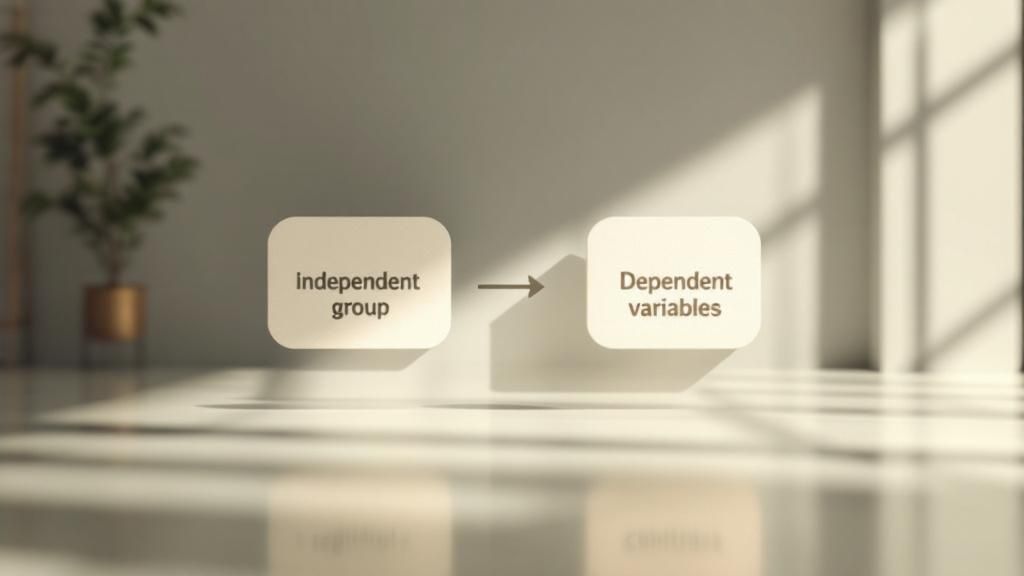
At the core of any experiment, you'll find the Independent Variable (IV) and the Dependent Variable (DV). The IV is the thing you, as the researcher, intentionally manipulate or change to see if it has an effect. The DV is the outcome you measure to find out if the IV actually did anything. It's a simple cause-and-effect relationship: you tweak the IV (the cause) to see if there's a change in the DV (the effect).
The Art of Operationalisation
This is probably one of the most critical skills you'll need for your psychology study design VCE assessment. Operationalisation sounds complex, but it's just the process of turning abstract ideas into something concrete and measurable. You can't just "measure stress"—you need to decide exactly how you're going to put a number on it.
Let's stick with the "stress" example. It's far too vague on its own. To operationalise it, you could define it as:
- A participant's self-reported score on the Perceived Stress Scale (PSS).
- The participant's average heart rate in beats per minute during a specific, timed task.
- The level of cortisol (a key stress hormone) found in a saliva sample.
See how each of these is specific and measurable? This level of precision is non-negotiable. It’s what makes your results objective and allows other researchers to replicate your study down the track.
Here's a key takeaway for your VCE study: if you can't measure it, you can't study it scientifically. Operationalisation is the bridge between your cool idea and the actual data you'll collect.
Identifying and Controlling Extraneous Variables
In a perfect world, only your IV would affect your DV. But we don't live in a perfect world. In reality, countless other factors, which we call extraneous variables (EVs), can creep in and mess with your results. Think of them as "noise" that can make it tough to see the real impact of your IV.
Some common EVs you'll encounter in VCE-level studies are:
- Participant differences: Things like age, mood, intelligence, motivation levels, or even what they ate for breakfast.
- Situational variables: The time of day, the temperature of the room, or distracting noises from outside.
- Experimenter effects: When the researcher unintentionally gives clues or treats the experimental and control groups differently.
Your job is to spot these potential EVs and control them as much as possible. If you don't, and an EV systematically affects your DV, it becomes a confounding variable. A confounding variable is a disaster for your experiment because you can no longer be sure if the changes you saw were caused by your IV or by this other unwanted factor.
Real-World Application in Your Study
Let's imagine you're investigating whether listening to classical music (your IV) helps improve memory test performance (your DV). A pretty obvious EV is that some of your participants might already love classical music, while others can't stand it. If, just by random chance, all the classical music fans end up in your experimental group, their personal preference becomes a confounding variable. You'd have no idea if their higher scores were because of the music's cognitive benefits or just because they were happier and more relaxed.
Choosing the right measurement tools is also a huge part of this. Using psychological tests and measures is a highly professional skill. A 2021-22 survey of 821 Australian psychologists found that those in fields like neuropsychology and educational psychology had more positive views on testing. This just goes to show that how well a measure works depends on professional skill and context, which is why you need to choose your tools carefully. You can learn more about the nuances of psychological testing in Australia and how pros view different methods.
To help bring these concepts to life, here’s a table showing how you can operationalise a few common VCE topics.
Operationalising Common VCE Psychology Concepts
This table breaks down how you can turn broad psychological ideas into the specific, testable variables you'll need for your study design.
| Abstract Concept | Operationalised Independent Variable (IV) | Operationalised Dependent Variable (DV) |
|---|---|---|
| Sleep Deprivation | Participants get either 4 hours of sleep or 8 hours of sleep in a controlled environment. | The number of errors made on a 15-minute logical reasoning task. |
| Exercise | Participants engage in 20 minutes of moderate-intensity jogging or 20 minutes of quiet sitting. | Scores on the Depression Anxiety Stress Scales (DASS-21) administered after the activity. |
| Caffeine Intake | Participants consume a 200mg caffeine pill or an identical-looking placebo pill. | Reaction time in milliseconds to a visual stimulus presented on a computer screen. |
Getting this right from the start is crucial. By carefully defining your IV and DV and being proactive about controlling for EVs, you're setting yourself up to run a methodologically sound study that can produce valid and reliable results.
Alright, you’ve operationalised your variables. Now for the next big decision in your psychology study design for VCE: how are you actually going to structure the experiment? How you arrange your participant groups is a fundamental choice that shapes everything from data collection to the conclusions you can ultimately draw.
Hand-in-hand with this decision is figuring out who you'll study and how you'll select them. These two pieces—experimental design and participant sampling—are completely intertwined and absolutely crucial for the validity of your research.
Comparing Experimental Designs
For VCE Psychology, you’ll need to get your head around three core experimental designs. Each has its own strengths and weaknesses, and picking the right one comes down to your research question, what resources you have, and which pesky extraneous variables you need to control.
Here are the three main players:
- Independent Groups Design: This is often the most straightforward way to go. You randomly allocate participants into two or more separate groups, and each group only experiences one condition of the Independent Variable (IV). Think of it this way: one group gets the real caffeine pill, and a completely different group gets the placebo. Simple.
- Repeated Measures Design: With this design, every single participant experiences all conditions of the IV. Using our caffeine example, each participant would take the caffeine pill on one day and the placebo pill on another, with their performance measured both times.
- Matched Participants Design: This one is a bit of a clever hybrid. You find pairs of participants who are as similar as possible on key characteristics that could affect the study (like IQ, age, or pre-existing anxiety levels). Then, you split the pair up—one person goes into the control group, and the other goes into the experimental group.
Managing Strengths and Weaknesses
The Independent Groups design is beautifully simple and completely avoids order effects – issues like participants getting better with practice or getting tired, which can happen when they do a task more than once. The major downside, though, is individual participant differences. There’s always the chance that, just by random luck, one group is naturally smarter, faster, or more motivated than the other, which could seriously skew your results.
A Repeated Measures design brilliantly solves that problem. Because you’re comparing each participant against themselves, individual differences are no longer a confounding variable. The catch? You now have to worry about order effects. Participants might get better at a task the second time around (a practice effect) or get bored and perform worse (a fatigue effect).
The classic fix for order effects in a Repeated measures design is counterbalancing. You simply split your participants in two. Group A does the experimental condition then the control, while Group B does the control condition first, then the experimental. This neat trick helps to balance out any potential order effects across your whole sample.
The Matched Participants design tries to give you the best of both worlds. It minimises individual differences but avoids creating order effects. The biggest hurdle, especially for a VCE study, is the sheer effort involved. It’s incredibly time-consuming and often difficult to pre-test everyone and find accurate matches.
From Population to Sample
Once you've settled on your experimental structure, you need people to participate in it. The population is the entire group you're interested in (e.g., all VCE students in Victoria). Of course, you can't test everyone, so you select a smaller group from them, which we call a sample. The whole point is to choose a sample that is representative of that broader population.
This infographic shows the basic flow of how you'd select a representative sample.
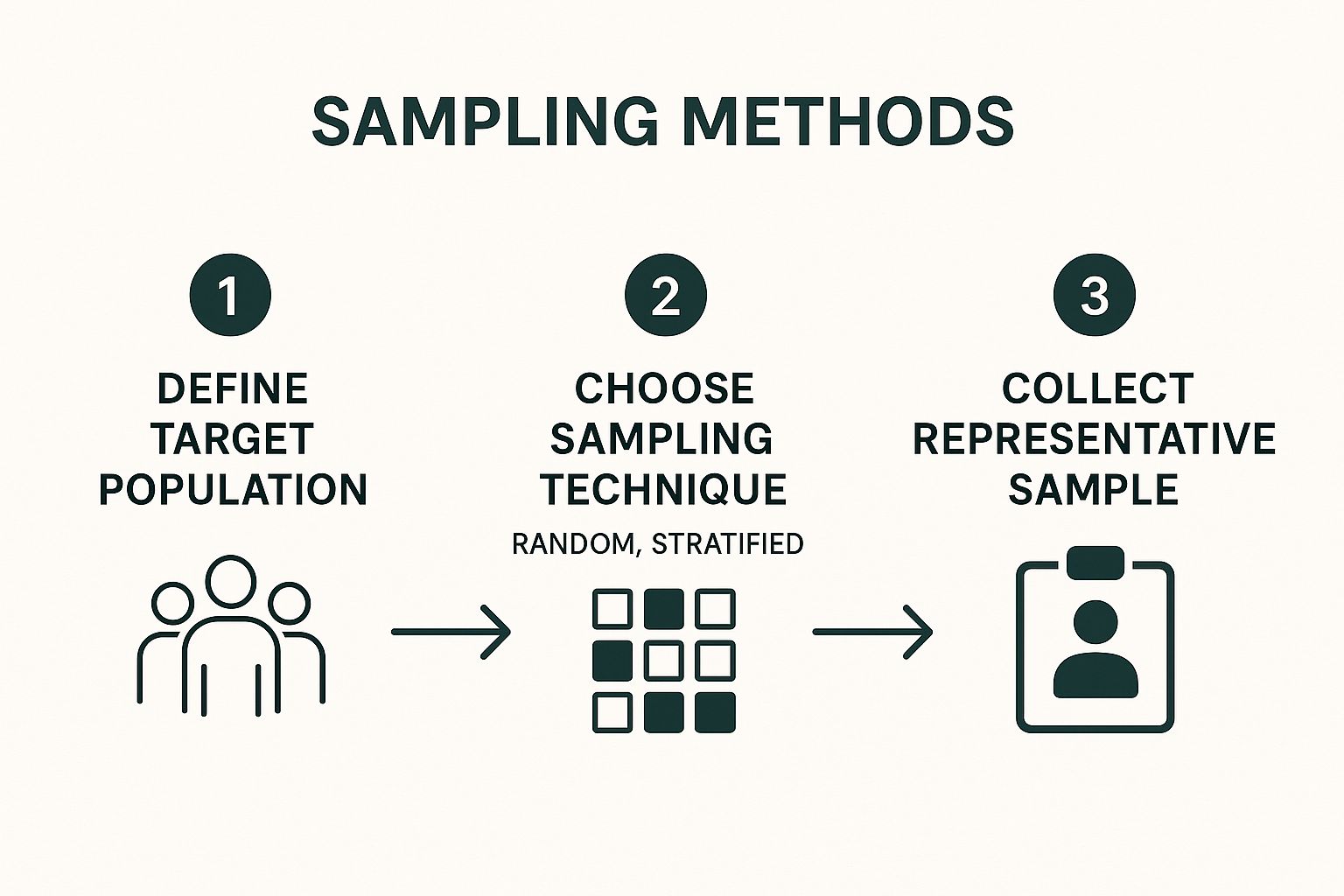
It always starts with clearly defining your target group before you can even think about using a sampling technique to pick out individuals for your study.
How you select this sample is vital for generalisability—that is, the extent to which your findings can be applied back to the wider population. You'll come across three main sampling methods in VCE.
- Convenience Sampling: Just like it sounds, this involves picking participants who are easy to get, like your friends or classmates. It’s quick and painless but almost always leads to a biased sample that doesn't truly represent the wider population.
- Random Sampling: This is the gold standard. Every single member of the population has an equal chance of being selected for the study. You could literally pull names out of a hat. This method gives you a much more representative sample, but it can be really hard to get a complete list of an entire population to draw from.
- Stratified Sampling: This is the most sophisticated approach. First, you break the population down into important subgroups, or 'strata' (e.g., Year 11 and Year 12 students). Then, you make sure your sample has the same proportions of these subgroups as the actual population. So, if your school is 60% Year 12s and 40% Year 11s, your sample must reflect that same ratio.
While convenience sampling is almost always what students use for VCE projects due to practical limits, it's so important to acknowledge its limitations in your final report. Pointing this out shows your markers that you genuinely understand the principles of good psychology study design.
Navigating Ethical Responsibilities in Your Research

When you're putting together a psychology study design for VCE, ethics aren't just a box-ticking exercise. They are the absolute bedrock of your entire investigation. Getting this part right is non-negotiable and something your assessors will look at very closely.
At its core, ethical research is about treating your participants with respect, dignity, and care. Your number one job as a researcher is to protect them from harm. This means thinking through every potential risk—whether it's psychological, like causing stress or embarrassment, or anything physical—and having a solid plan to minimise it.
The Four Pillars of Ethical Conduct
Every single decision you make in your study design needs to be seen through an ethical lens. For your VCE project, there are four key principles that are absolutely paramount: informed consent, voluntary participation, confidentiality, and withdrawal rights.
It’s not enough to just memorise the definitions. You need to show you can apply them in a real-world context.
Let’s break down what each of these looks like on the ground:
-
Informed Consent: Your participants need to know exactly what they're signing up for before they agree to anything. This means explaining the purpose of your study, what they’ll be asked to do, and any potential risks involved. A vague "this is for a psych experiment" just won't fly.
-
Voluntary Participation: Nobody should ever feel pressured or guilt-tripped into taking part in your study. This also means you can't offer over-the-top incentives that might make someone feel like they can't say no.
-
Confidentiality: This is all about protecting your participants' privacy. You must keep their personal information secure and de-identify their results. This means ensuring no one can link the data back to a specific person.
-
Withdrawal Rights: This is a big one. You have to make it crystal clear that participants can leave the study at any time, for any reason, without facing any kind of penalty. They also have the right to ask for their data to be removed after the fact.
These aren't just friendly suggestions; they are hard and fast rules. A strong VCE psychology study design demonstrates a deep, practical understanding of how to implement these principles to protect the very people who make your research possible.
To help you keep track, here's a quick checklist to guide your planning.
VCE Psychology Ethical Principles Checklist
| Ethical Principle | Core Meaning | Actionable Step in Your Study |
|---|---|---|
| Informed Consent | Participants must fully understand the study before agreeing to join. | Create a clear, jargon-free consent form outlining the study's purpose, procedures, and any potential risks. Get it signed before you start. |
| Voluntary Participation | Participation must be completely free from coercion or pressure. | State clearly in your recruitment materials and consent form that participation is 100% voluntary and there are no negative consequences for declining. |
| Confidentiality | Participant data and identity must be kept private. | Use participant codes instead of names, store data securely (e.g., password-protected files), and report findings in an aggregated, anonymous way. |
| Withdrawal Rights | Participants can leave the study at any time without penalty. | Explicitly state in the consent form and at the beginning of the experiment that participants are free to withdraw at any stage and can have their data removed. |
Putting these principles into practice is what separates a good study from a great one.
From Principle to Practice
So, how do you translate these ideas into action? Your first major task is to draft a comprehensive informed consent form. This document needs to be written in plain, simple English, detailing every aspect of what the participant can expect.
Once your data collection is done, your ethical duties aren't over. You must conduct a debriefing. This is where you thank your participants, properly explain the study’s true purpose, and give them a chance to ask questions. A good debriefing ensures people leave your study feeling informed and respected.
What About Deception?
You might be wondering about studies where researchers don't tell participants the true aim upfront. This is known as deception, and it involves intentionally misleading participants about the nature of the research.
For VCE studies, you should avoid deception wherever possible.
In professional research, it's only allowed under very strict conditions—usually when the potential findings are hugely significant and knowing the study's real purpose would completely invalidate the results. If deception were ever used, the debriefing becomes even more critical. You'd have to explain why you used it and give participants the explicit right to withdraw their data. The ethical bar for using deception is incredibly high, and for your VCE investigation, it's a path best avoided.
Building a strong ethical framework is a key skill, just like understanding the nuances of VCE assessments and knowing how to succeed even in a non-scored VCE environment.
Making Sense of Your Data and Findings
You’ve done the hard yards. You've meticulously planned your investigation, navigated the ethical maze, and gathered all your data. Now comes the exciting part of your psychology study design for VCE—actually figuring out what it all means. This is where your raw numbers start to tell a story, and you finally get to see if your hypothesis was on the mark.
This isn’t just about plugging figures into a calculator. It’s about understanding the narrative behind the numbers. The skills you build here are fundamental, not just for your SAC but for any kind of scientific thinking you'll do in the future.
Starting with Descriptive Statistics
The first port of call in any analysis is to simply describe the data you've collected. That's exactly what descriptive statistics are for. They don’t draw massive conclusions; they just give a clear, straightforward summary of what you found. For VCE Psychology, you’ll focus on two key types.
First up are measures of central tendency, which give you an idea of the 'typical' score in your data set.
- Mean: This is simply the average of all your scores. You add everything up and divide by the number of scores you have. The mean is a solid go-to, but be warned: it can be easily thrown off by unusually high or low scores (outliers).
- Median: This is the middle score when you line up all your data from smallest to largest. Because it sits right in the middle, it’s not really affected by outliers, which can make it a more reliable snapshot.
- Mode: This one's the easiest—it's just the score that pops up most frequently in your data.
Next are measures of variability, which tell you how spread out your scores are. A common one at the VCE level is the range, which you find by subtracting the lowest score from the highest. A big range suggests your scores are all over the place, while a small range means they’re bunched up closely.
The Leap to Inferential Statistics
Descriptive stats are brilliant for summarising your sample, but they can't tell you if your results mean anything for the wider population. To do that, you need to make the leap to inferential statistics. These are the tools that let you make an educated guess (an inference) about whether the effect you observed is a real thing or if it just happened by chance.
You won't be doing complex calculations for VCE, but you absolutely need to grasp the concept. Inferential statistics help you work out if your findings are statistically significant. If a result is deemed significant, it means it's highly unlikely to have occurred randomly. This gives you the confidence to reject your null hypothesis and lend support to your research hypothesis.
Statistical significance is your green light to say, "Hey, it looks like my independent variable really did have an effect on the dependent variable." Without it, your results are just an interesting observation with no real scientific weight.
These analytical skills are at the very heart of psychology. Australian universities drill down on these competencies, with courses like PSYC2012 at the University of Sydney offering comprehensive training in research methods and stats. These programs ensure future psychologists can design robust studies and interpret data correctly, which is vital for professional accreditation.
Drawing a Powerful Conclusion
Your conclusion is where you pull it all together. It needs to speak directly to your original hypothesis. State clearly and without fluff whether your results support it or not.
A strong conclusion does more than just repeat the numbers. You need to interpret what the descriptive statistics (like the mean scores for your experimental and control groups) and the statistical significance actually mean in the context of your research question.
For example, you might write: "The mean time to fall asleep for the energy drink group was 38.4 minutes, compared to 14.2 minutes for the water group. As the results were found to be statistically significant, the null hypothesis was rejected. The findings therefore support the research hypothesis that consuming an energy drink would increase the time taken for VCE students to fall asleep."
Critically Evaluating Your Study
Finally, a crucial part of your discussion involves reflecting on your study's limitations. No study is perfect, especially one you run for a VCE assessment. Being able to spot the weaknesses in your own psychology study design for VCE is a sign of sophisticated critical thinking.
Think about what might have gone wrong:
- Could any extraneous variables have crept in and become confounding variables?
- Was your sample too small or not very representative (e.g., you just used your mates from one class)?
- Were there any hiccups with your measurement tools or how you ran the procedure?
After you’ve identified a few limitations, suggest specific, practical ways you could improve the study next time. This shows you're thinking like a real scientist—always looking for ways to make the next experiment even better. Acing this critical evaluation is a key part of your assessment, and getting some dedicated support can make all the difference when you're preparing for your VCE School-Assessed Coursework.
Common Questions About VCE Study Design
As you get deeper into your psychology study design for VCE, a few questions are bound to come up. It's totally normal. Some of the concepts can feel a bit tricky at first, and it’s always smart to get things straight before you lock in your method.
This section tackles some of the most common hurdles students face, giving you direct answers so you can move forward with confidence. Think of it as your go-to guide for those moments you feel a bit stuck. Getting these details right can make a massive difference to the quality of your final report.
Extraneous vs. Confounding Variables
One of the biggest points of confusion is the difference between an extraneous and a confounding variable. They sound similar, but their impact on your study couldn't be more different.
An extraneous variable is any variable, apart from your Independent Variable (IV), that could potentially mess with your Dependent Variable (DV). Think of them as possible interferences you need to anticipate and control. For instance, in a study on memory, a participant’s mood on the day of testing is a classic extraneous variable.
A confounding variable is what happens when you don't manage to control an extraneous variable, and it actually does affect your DV. It’s a research-wrecker. Why? Because it makes it impossible to know if the changes you saw were caused by your IV or by that uncontrolled variable. If one group in your memory study was tested in a dead-silent library and the other next to a noisy construction site, then noise has just become a confounding variable.
The easiest way to remember this is that extraneous variables are potential problems, while confounding variables are actual problems that have ruined your experiment's validity. Your goal is to spot the potential EVs and stop them from ever becoming CVs.
Choosing the Best Experimental Design
So, how do you pick between an Independent Groups, Repeated Measures, or Matched Participants design? The best choice really hinges on your specific research question, the resources you have, and what you’re trying to control.
- An Independent Groups design is usually the most practical choice for VCE investigations. It's straightforward to set up and you don't have to worry about order effects. Its main weakness? The potential for individual participant differences to skew your results.
- A Repeated Measures design is powerful because it completely eliminates participant differences as an issue. The trade-off is that you must manage order effects (like practice or fatigue) by using counterbalancing, which adds another layer of complexity to your procedure.
- Matched Participants is a fantastic middle ground, but the pre-testing and matching process is often far too time-consuming and difficult to pull off effectively at a VCE level.
For most students, an Independent Groups design is the most manageable and defensible choice.
Can I Use Deception in My VCE Experiment?
The short answer here is that you should steer clear of deception in your VCE study. In professional research, deception is only ever used as a last resort—when knowing the study's true aim would change how participants behave, the research is incredibly significant, and there's simply no other way to test the hypothesis.
Even then, a thorough debriefing is mandatory. Researchers must explain the real purpose, clarify why deception was necessary, and give participants the absolute right to withdraw their data after finding out the truth. For your SAC, prioritising ethical clarity and getting your teacher’s approval is always the correct path. It highlights why students need clear guidance and preparation for all major assessments; you can see how crucial structured support is by learning about expert tips for NAPLAN preparation.
Is a Convenience Sample Ever a Good Choice?
Look, we all know that random and stratified sampling produce much more generalisable results. But let's be realistic—they are often completely impractical for a single student to organise.
This is why a convenience sample, which involves using participants who are easy to get (like your classmates), is often seen as acceptable for VCE-level projects. The constraints are just part of the reality of school-based research.
The most important step isn't just using this method, but acknowledging it as a key limitation in your discussion section. You must clearly explain that your findings may not apply to the wider population because your sample wasn't representative. This shows a mature understanding of methodological rigour, and that’s what assessors want to see.
Designing a sound psychological study requires careful thought and planning. At Evergreen Tutoring Services, our expert tutors can guide you through every step of your VCE Psychology SAC, from refining your hypothesis to analysing your data. Visit us at https://www.evergreentutoringservices.com.au to see how our personalised support can help you excel.