

Welcome to your go-to resource for mastering Year 7 algebra! We know that moving into secondary school mathematics can feel like a big leap. Suddenly, letters are mixing with numbers, and concepts like 'x' and 'y' become central to your work. Algebra is simply a powerful new tool for solving problems, and like any tool, practice is the key to using it effectively. This guide is specifically designed to provide a comprehensive set of algebra questions for Year 7, broken down into the core topics you'll encounter.
This article isn't just a list of problems; it’s a structured practice resource. We will cover eight essential areas, including solving equations, simplifying expressions, and forming expressions from word problems. For each topic, you will find targeted questions, detailed step-by-step solutions, and practical tips to help you understand the 'why' behind the 'how'.
Whether you're aiming to get ahead, solidify what you've learned in class, or need extra support with homework, this curated collection will build both your skills and your confidence. By working through these examples, you'll be well-prepared to tackle any algebraic challenge that comes your way. Let's dive in and start solving.
1. Solving Linear Equations with One Variable
Solving linear equations with one variable is a cornerstone of algebra and a critical skill for Year 7 students. These equations involve finding the value of a single unknown, usually represented by a letter like x. The goal is to isolate this variable on one side of the equals sign by using inverse operations, a process that is much like solving a puzzle.
For example, if you encounter an equation like 3x + 5 = 14, you must systematically undo the operations. This skill is not just for the classroom; it's used to calculate missing measurements in design and construction or to scale ingredients in a recipe. Mastering this topic lays the groundwork for more complex mathematical concepts you'll encounter later on.
How to Isolate the Variable
The fundamental principle is to keep the equation balanced. Whatever you do to one side, you must also do to the other.
-
Undo Addition/Subtraction First: Always start by moving any constants (the numbers without a variable) to the opposite side.
-
Then, Undo Multiplication/Division: Once the variable term is by itself, you can isolate the variable completely by undoing the multiplication or division.
-
Check Your Work: Substitute your final answer back into the original equation to ensure it holds true.
This process-flow infographic outlines the key steps to follow when solving a one-variable linear equation.
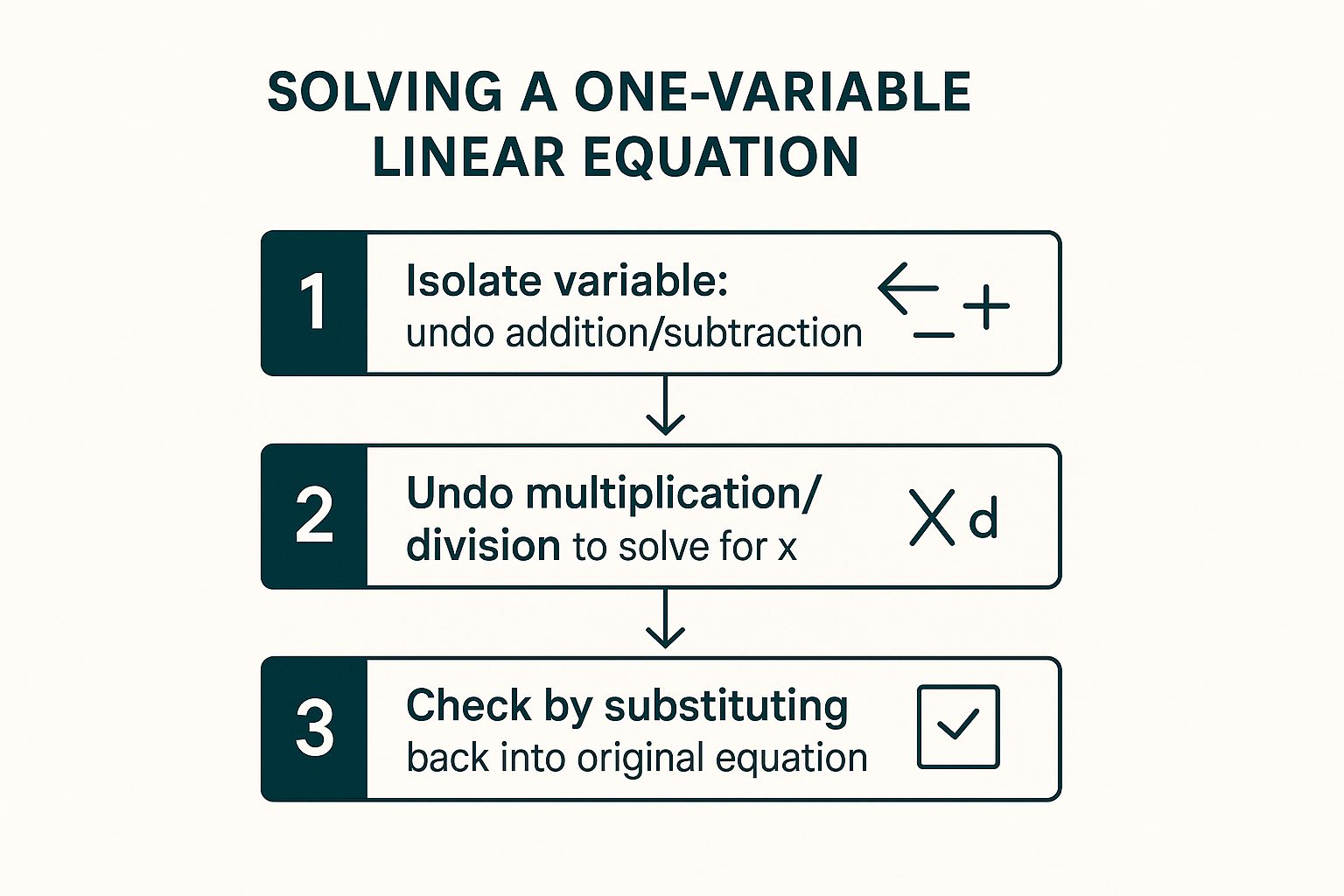
Following this sequence ensures you untangle the equation systematically, reducing the chance of errors. For many of the algebra questions Year 7 students face, this structured approach is key.
As students progress, these foundational skills become essential for tackling more advanced problems. You can explore how these basics are applied by reviewing the Mathematics Advanced syllabus.
2. Expanding Single Brackets (Distributive Property)
Expanding single brackets, also known as applying the distributive property, is a fundamental skill in algebra. It involves multiplying a term outside the brackets by every single term inside the brackets. This process allows you to remove the brackets and rewrite the expression in a simplified, expanded form, which is essential for solving more complex equations.

For instance, when faced with an expression like 4(x + 2), you distribute the 4 to both the x and the 2. This skill isn't just an abstract rule; it’s used for practical calculations like determining the total area of compound shapes or calculating costs when buying multiple items that have the same additional fee. Mastering this concept is crucial for tackling many algebra questions Year 7 students will encounter.
How to Apply the Distributive Property
The key to expanding brackets is to be systematic and ensure you multiply the outer term by every inner term. A common mistake is only multiplying it by the first term inside the bracket.
-
Draw Arrows: A great visual aid is to draw arrows from the term outside the brackets to each term inside. This serves as a checklist.
-
Watch the Signs: Be extremely careful with negative signs. When you multiply a negative term outside the brackets, it changes the sign of each term inside. For example,
-3(y - 5)becomes-3y + 15. -
Practice with Numbers: Before moving to variables, practise with numerical examples like
5(10 + 3)to build confidence and see that5(13)is the same as50 + 15.
This methodical approach helps prevent errors and builds a strong foundation for future algebraic manipulation, such as expanding double brackets. You can see how these foundational skills are built upon in the Mathematics Standard syllabus.
3. Collecting Like Terms and Simplifying Expressions
Collecting like terms and simplifying expressions is a foundational skill in algebra that involves tidying up mathematical statements. Students learn to identify and combine terms that have the exact same variable part, reducing long, complex expressions into their simplest, most manageable form. This process is crucial for all future algebraic manipulation and problem-solving.
This skill has practical applications outside of the classroom. It's like organising an inventory by grouping similar items, combining similar categories in a budget for financial planning, or grouping identical measurements together when analysing scientific data. Mastering this helps students recognise patterns and structure within mathematics.
How to Collect and Simplify
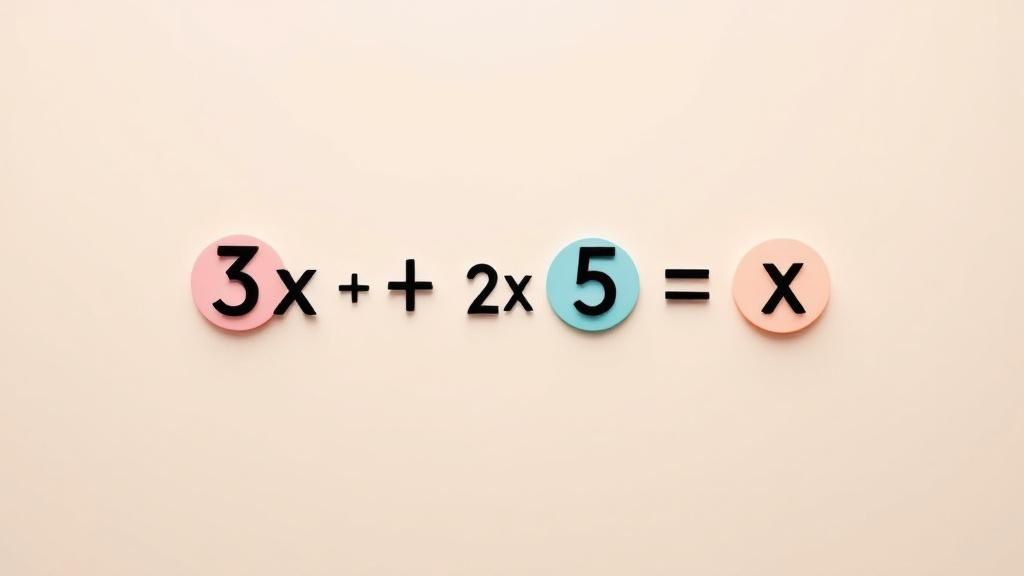
The core idea is that you can only add or subtract terms that are of the same "type." For example, you can add apples to apples, but not apples to bananas. In algebra, 3x and 5x are like terms, but 3x and 5y are not.
-
Identify Like Terms: Scan the expression and find all terms with the identical variable and exponent. Using different colours or shapes to circle them can be very helpful.
-
Combine the Coefficients: Add or subtract the coefficients (the numbers in front of the variables) of the like terms you identified. The variable part remains unchanged.
-
Write the Simplified Expression: Write down the new, simplified expression, usually ordering the terms from the highest power to the lowest, with constants at the end.
-
Double-Check: Quickly review your work to ensure you haven't missed any terms or made a simple calculation error.
This systematic approach makes dealing with the types of algebra questions Year 7 students encounter much simpler and less prone to mistakes.
By becoming proficient at simplifying, students build a strong foundation for solving more complicated equations. This skill is a prerequisite for topics explored in later years, such as those covered in the Year 8 Maths syllabus.
4. Substitution into Algebraic Expressions
Substitution into algebraic expressions is the process of replacing variables (letters) with specific numerical values to calculate a final result. This skill is crucial as it bridges the gap between abstract algebra and concrete numbers, showing students how formulas work in practical situations. It is the engine that drives many real-world calculations, from science to finance.
For instance, if a formula calculates the cost of hiring a bike as C = 10 + 5h, where h is the number of hours, substitution allows you to find the exact cost for a 3-hour hire. This concept is fundamental for using formulas in physics, like Distance = Speed × Time, or for calculating the area of a shape given its dimensions. Among the algebra questions Year 7 students encounter, this skill is vital for applying algebraic thinking to real-world problems.
How to Substitute Correctly
The key to successful substitution is careful and methodical calculation, ensuring you follow the established rules of mathematics.
-
Use Parentheses: When you replace a variable with a number, enclose the number in parentheses. This is especially important for negative numbers or when multiplication is involved, as it helps prevent errors. For example,
4abecomes4(3). -
Follow the Order of Operations (BODMAS/BIMDAS): After substituting the values, you must simplify the expression using the correct order: Brackets, Orders (indices/powers), Division and Multiplication (from left to right), and Addition and Subtraction (from left to right).
-
Calculate Carefully: Double-check your arithmetic, using a calculator for more complex computations if permitted. This minimises simple mistakes that can lead to an incorrect final answer.
This structured process ensures accuracy and reinforces the importance of the order of operations, a core mathematical principle. When tackling algebra questions Year 7 students are given, mastering substitution is a non-negotiable step towards building confidence and competence.
5. Forming Expressions from Word Problems
Forming expressions from word problems is a crucial skill that bridges the gap between abstract algebra and the real world. This process involves translating everyday language and scenarios into mathematical expressions, which is a foundational aspect of mathematical modelling. For Year 7 students, this demonstrates the practical power of algebra beyond the classroom.
For instance, you might model the cost of a phone plan based on data usage, express the relationship between the ages of family members, or describe geometric measurements in a construction project. Mastering this skill involves identifying unknown quantities, assigning variables, and recognising the mathematical relationships described in the text. This is a common type of algebra question Year 7 students encounter, teaching them to think logically and structurally.
How to Translate Words into Algebra
The key is to break down the problem into smaller, manageable parts. A systematic approach helps demystify what can seem like a complex task.
-
Define Your Variables: Always start by clearly stating what your variable (like x or n) represents. For example, "Let c be the total cost."
-
Look for Key Words: Identify words that signal mathematical operations. "More than" suggests addition, "less than" implies subtraction, "of" can mean multiplication, and "per" often indicates division or a rate.
-
Draw Diagrams: For problems involving shapes or physical arrangements, a quick sketch can make the relationships between quantities much clearer.
-
Check the Context: Once you have an expression, read it back to yourself to ensure it makes logical sense within the context of the original problem.
Following these steps helps you to methodically translate a real-world scenario into a concise algebraic expression, ready for solving.
This structured thinking is at the heart of many effective math problem-solving strategies, helping students build confidence in tackling unfamiliar challenges.
6. Introduction to Inequalities
Moving beyond the certainty of an equals sign, inequalities introduce Year 7 students to a new way of thinking in algebra. Instead of solving for a single value, inequalities like x > 5 or y ≤ 10 deal with a range of possible solutions. This concept expands algebraic reasoning by asking "what range of numbers makes this statement true?" rather than "what single number works?".
This skill is crucial for understanding real-world constraints and possibilities. For instance, inequalities are used to define speed limits on roads (speed ≤ 60), to manage budget constraints in financial planning (spending ≤ $50), or to determine capacity limitations for an event venue (guests < 200). Learning to work with them is a key step in applying mathematics to practical problems.
How to Work with Inequalities
The process for solving simple inequalities is very similar to solving equations, with one critical difference. You still aim to isolate the variable, but you must pay close attention to the inequality symbol.
-
Treat it like an equation: Use inverse operations (addition, subtraction, multiplication, division) to isolate the variable, just as you would with a linear equation.
-
The Golden Rule: If you multiply or divide both sides of an inequality by a negative number, you must flip the direction of the inequality sign. For example, > becomes <.
-
Visualise on a Number Line: Representing your solution on a number line is a great way to understand the range of values. Use an open circle for < and > (to show the number is not included) and a closed circle for ≤ and ≥ (to show it is included).
-
Test Your Solution: Pick a number from your solution set and substitute it back into the original inequality to check if it holds true. This is a vital step in many algebra questions Year 7 students will encounter.
Mastering inequalities is not just about getting the right answer; it's about developing flexible problem-solving skills. These concepts are foundational for more advanced topics in senior mathematics, including functions and graphing, as outlined in syllabuses like the Mathematics Standard syllabus.
7. Simple Ratio and Proportion Problems
Simple ratio and proportion problems introduce Year 7 students to the concept of proportional relationships, where two quantities change at the same rate. These problems require students to find an unknown value by understanding how ratios work, often using algebraic thinking to set up and solve equations. The ability to solve these is fundamental for real-world applications like scaling recipes, interpreting map distances, or calculating currency conversions.
For example, if a recipe for 4 people requires 200g of flour, a proportion problem would ask how much flour is needed for 6 people. By setting up the ratio 4 people : 200g, students can find the equivalent ratio for 6 people. This type of thinking is a practical application of algebra that demonstrates its relevance outside the classroom, making it a key component of the algebra questions Year 7 students encounter.
How to Solve with Ratios
The key to solving proportion problems is consistency. Ensure you set up your ratios correctly and use a systematic method to find the unknown value.
-
Set Up Ratios Consistently: Always place the same units in the same positions. For example, if you set up
people/grams, the second ratio must also bepeople/grams. -
Use Cross-Multiplication: For a proportion like
a/b = c/d, you can solve it by cross-multiplying:a × d = b × c. This creates a simple linear equation to solve for the unknown variable. -
Label Units Clearly: Keep track of your units (e.g., grams, dollars, kilometres) throughout the calculation to avoid confusion and ensure the final answer makes sense.
-
Check for Practical Sense: After finding an answer, quickly check if it seems reasonable. For instance, if you're scaling a recipe up, the ingredient amounts should increase.
This methodical approach helps to structure the problem, turning a word problem into a manageable algebraic equation.
Mastering ratios and proportions is essential for more advanced topics in mathematics and science. You can see how these foundational skills are built upon by exploring the Mathematics Standard syllabus.
8. Basic Functions and Input-Output Tables
Understanding basic functions and input-output tables is a pivotal step in algebra, introducing Year 7 students to the concept of relationships between variables. This topic explores how one quantity (the output) changes in response to another (the input), laying the groundwork for more advanced mathematical modelling. The core idea is that for every input, there is a specific, predictable output determined by a rule or function.
For example, the relationship between the number of hours you work and your total pay is a function. If you earn $15 per hour, the input is the hours worked, and the output is your earnings. This concept, popularised by mathematicians like Leonhard Euler, is fundamental to everything from coding simple programs to analysing scientific data. Mastering it helps students see maths as a tool for describing the world around them.
How to Work with Functions and Tables
The key is to identify the pattern or rule that connects the input and output values. This rule is the function.
-
Start with Concrete Relationships: Begin with familiar scenarios, like the connection between the number of items bought and the total cost, to make the abstract concept of a function more tangible.
-
Use Consistent Input Values: When creating a table, use sequential or evenly spaced inputs (e.g., 0, 1, 2, 3) to make it easier to spot the pattern in the output values.
-
Look for the Pattern: Analyse how the output changes as the input increases. Does it go up by a constant amount each time? This will help you determine the rule.
-
Connect to Real-World Meaning: Always relate the numbers in your table back to the original problem. What does an input of 5 and an output of 25 actually mean in the context of the question?
This systematic process helps demystify one of the more abstract algebra questions Year 7 students encounter, turning it into a logical puzzle.
Building this foundational knowledge early on is crucial for long-term success and confidence in mathematics. You can find strategies for encouraging children to engage with maths through tutoring to further support their learning journey.
8 Key Algebra Topics Comparison
|
Topic |
Implementation Complexity |
Resource Requirements |
Expected Outcomes |
Ideal Use Cases |
Key Advantages |
|---|---|---|---|---|---|
|
Solving Linear Equations with One Variable |
Low to Moderate |
Basic arithmetic skills needed |
Clear, definitive solutions to unknowns |
Simple problem solving, foundational algebra |
Builds foundation, logical reasoning |
|
Expanding Single Brackets (Distributive Property) |
Moderate |
Understanding of multiplication |
Ability to manipulate expressions |
Algebraic expansion, preparing for factoring |
Strengthens multiplication properties |
|
Collecting Like Terms and Simplifying Expressions |
Low to Moderate |
Attention to detail |
Simplified expressions, reduced errors |
Expression manipulation, preparation for factoring |
Develops algebraic fluency |
|
Substitution into Algebraic Expressions |
Low |
Basic substitution and arithmetic |
Concrete numerical results from algebraic expressions |
Verifying solutions, applying formulas |
Connects abstract algebra to numbers |
|
Forming Expressions from Word Problems |
Moderate |
Reading comprehension |
Accurate translation of problems to math |
Modeling real-world scenarios |
Enhances problem-solving and critical thinking |
|
Introduction to Inequalities |
Moderate |
Understanding inequality rules |
Solution sets representing ranges |
Constraints, optimization problems |
Expands algebraic thinking |
|
Simple Ratio and Proportion Problems |
Moderate |
Familiarity with fractions |
Correct proportional relationships |
Scaling, conversions, real-world proportionality |
Connects algebra to practical math |
|
Basic Functions and Input-Output Tables |
Moderate to High |
Understanding function notation |
Grasp of variable relationships |
Modeling variable dependence, preparing for graphing |
Introduces fundamental math concepts |
Making Algebra Stick: Your Next Steps to Success
Navigating through this collection of algebra questions year 7 has given you a solid foundation in the core concepts that define this crucial area of mathematics. You have moved beyond just theory and have actively engaged with practical problems, from solving for x in linear equations to translating complex word problems into tidy algebraic expressions. This hands-on practice is the most effective strategy for building not just competence, but genuine confidence.
The journey through algebra is a marathon, not a sprint. The topics covered in this article, such as simplifying expressions, substitution, and understanding inequalities, are not isolated skills. They are interconnected building blocks that will support more advanced mathematical studies in Year 8 and beyond, including quadratic equations and graphing functions. Mastering them now is an investment in your future academic success.
Key Takeaways for Lasting Understanding
To ensure these skills are retained, it's vital to consolidate your learning. Reflect on the questions you attempted and identify which types felt intuitive and which were more challenging.
-
Review and Reinforce: Don't just check the answers for the questions you got wrong. Take the time to understand the process of the worked solution. Can you explain each step in your own words? Try re-doing a similar question without looking at the guide.
-
Connect to the Real World: Remember the section on forming expressions from word problems? Actively look for opportunities to see algebra in the world around you. This could be as simple as calculating discounts while shopping or figuring out the best value mobile phone plan. This practice makes algebra less abstract and more practical.
-
Embrace Consistent Practice: Dedicate short, regular blocks of time to algebra practice rather than cramming for hours. Consistency is far more effective for long-term memory and skill development. Just 15-20 minutes a few times a week can make a significant difference.
Your Path Forward in Algebra
By consistently applying these principles, you are not just learning to follow rules; you are developing powerful problem-solving and logical reasoning abilities. These skills are invaluable, extending far beyond the mathematics classroom into science, technology, finance, and everyday decision-making. You are learning to think systematically, to identify patterns, and to approach challenges with a structured, logical mindset.
As you continue your studies, remember that every complex algebraic problem is simply a series of smaller, manageable steps. The confidence you've built working through these foundational algebra questions year 7 is your greatest asset. Keep practising, stay curious, and don't hesitate to seek clarification when you need it. You are now well-equipped to tackle the next stage of your mathematical journey with skill and self-assurance.
If you're looking for dedicated, one-on-one support to turn algebraic challenges into achievements, Evergreen Tutoring Services can help. Our expert tutors specialise in creating personalised learning plans that target your specific needs, building a strong and confident understanding of Year 7 algebra. Visit Evergreen Tutoring Services to learn how we can help you excel.





One Response
Great practice material for Year 7 students—these questions provide the right mix of challenge and support for building strong algebra foundations.