

Staring at a stack of past papers can feel overwhelming. Many students fall into the trap of simply completing papers, checking answers, and moving on. This approach, however, barely scratches the surface of what these resources can offer. The real advantage lies not in passive repetition, but in the strategic application of proven learning methods. Past exams aren't just a test of what you know; they are a diagnostic tool, a training ground, and a powerful way to refine your exam technique.
This guide moves beyond the obvious, presenting eight sophisticated methods to transform your study routine. By integrating these strategies, you can turn your collection of methods past exams into a dynamic system for deep learning, identifying weaknesses, and building unshakable confidence. We will explore how to actively engage with the material, manage your time effectively, and structure your revision for maximum retention. Our goal is to ensure you walk into your next exam fully prepared and in control, equipped with techniques that go far beyond rote memorisation. You will learn how to deconstruct questions, manage time under pressure, and actively recall information, transforming practice papers from a simple revision task into a cornerstone of your academic success.
1. Active Recall Practice
Active recall is a powerful study technique that involves deliberately retrieving information from your memory. Instead of passively rereading your notes or textbooks, you actively quiz yourself. This process of pulling information from your brain, even if you struggle, strengthens the neural pathways associated with that memory, making it easier to recall during an actual exam. It is one of the most effective methods past exams can be used for, transforming them from simple revision tools into active learning instruments.
This method directly counters the "illusion of competence" that comes from simply rereading material. When you reread, the text feels familiar, and you might mistake that familiarity for genuine understanding. Active recall forces you to confront what you truly know versus what you only recognise.
How to Implement Active Recall with Past Exams
Using this technique is straightforward. Take a past exam paper, cover your notes and the solutions, and attempt to answer the questions under exam-like conditions. The goal isn't necessarily to get a perfect score initially, but to engage in the mental effort of retrieval.
- For problem-based subjects (Maths, Physics): Work through a problem from start to finish without looking at the formula sheet or worked examples.
- For content-heavy subjects (History, Biology): Use a question from a past paper as a prompt. Write down everything you can remember about that topic in bullet points or a short paragraph before checking your notes for accuracy and detail.
- For language learning: Use past translation or grammar exercises to test your vocabulary and sentence structure recall without a dictionary.
Key Insight: The real learning happens during the struggle to remember, not in the passive review afterwards. This "desirable difficulty" is what makes active recall so effective for long-term retention.
By integrating this into your study routine, you are essentially simulating exam conditions repeatedly. This practice not only solidifies your knowledge but also builds your confidence and reduces exam-day anxiety, as the format and pressure will feel familiar. Combining active recall with spaced repetition (revisiting the questions at increasing intervals) will further enhance your memory and mastery of the material.
2. Spaced Repetition System (SRS)
A Spaced Repetition System (SRS) is a learning technique that leverages the psychological spacing effect to combat the natural process of forgetting. Instead of cramming information in one go, you review it at increasing intervals over time. Each successful review pushes the next one further into the future, optimising your study schedule for long-term retention. This is one of the most efficient methods past exams can be incorporated into, as it turns old questions into a powerful, scheduled review system.
This approach is fundamentally about working smarter, not harder. It focuses your attention on the material you are most likely to forget, while spending less time on concepts you have already mastered. By systematically scheduling reviews, you interrupt the "forgetting curve" at the most effective moments, embedding knowledge deep into your long-term memory.
How to Implement SRS with Past Exams
Integrating past exam questions into an SRS can be done manually or with digital tools. The core principle is to review questions you answered incorrectly, or found difficult, at specific, increasing time gaps. This ensures you consistently reinforce your weakest areas until they become strengths.
- For technical subjects (Chemistry, Engineering): After attempting a past paper, enter any questions you got wrong into an SRS app like Anki. Create a digital flashcard with the question on one side and the detailed, worked-out solution on the other.
- For humanities (Legal Studies, Modern History): Use past essay prompts as your review items. Schedule reviews where you outline the key arguments, evidence, and structure for that essay prompt without looking at your notes.
- For medical and science courses (Medicine, Anatomy): Create flashcards from past exam questions that test specific terminology or processes. Use images or diagrams on your cards to create stronger memory associations.
Key Insight: Spaced repetition automates the process of prioritising what to study. It forces you to focus on difficult material until it’s mastered, making your study time incredibly efficient.
The following infographic illustrates the basic cycle of a spaced repetition schedule.
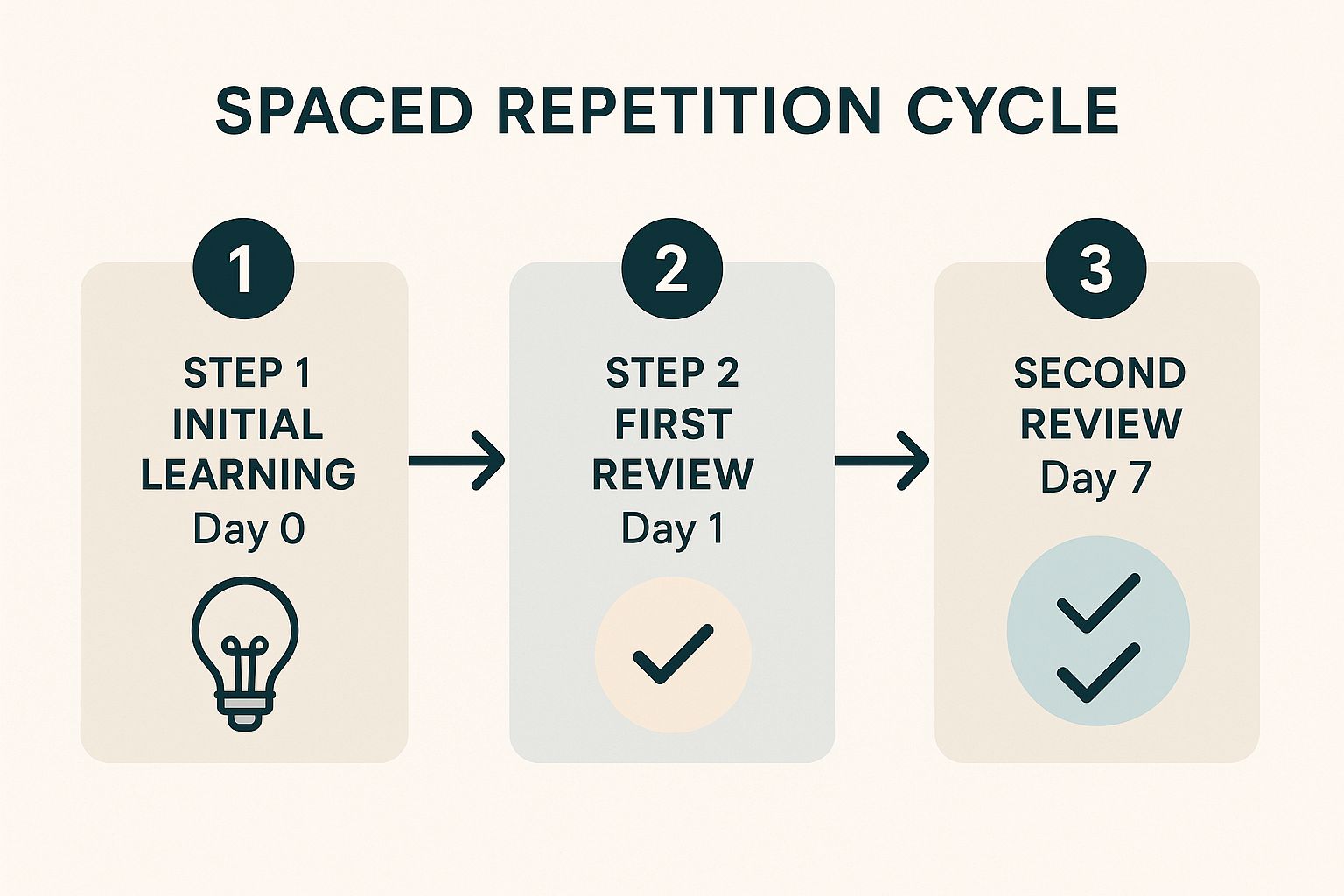
This process shows how the interval between reviews expands with each correct recall, strengthening the memory trace over time. By applying this structured approach, you build a robust and reliable foundation of knowledge that stands up to the pressure of final exams.
3. Past Paper Analysis and Practice
Past paper analysis is a systematic approach where you don't just complete exams, but deconstruct them to understand the mind of the examiner. This involves identifying recurring question types, understanding the marking scheme, and recognising what topics are frequently tested. By doing so, you move beyond rote learning and start thinking strategically about how to score maximum marks. This is one of the most structured methods past exams can be used for, turning them into a predictable map of what to expect.
This method helps you anticipate the exam's focus, allocate your study time more effectively, and understand the precise language and keywords that markers are looking for. It is a critical step often popularised by test preparation companies and academic coaching services to give students a competitive edge.

How to Implement Past Paper Analysis and Practice
The key is a two-phase approach: practice first, then analyse. Begin by completing papers under timed conditions to simulate the real exam environment. Once done, shift your focus from your score to a deep analysis of your performance and the paper itself. The analysis phase is where you develop crucial insights that inform your future study.
- For A-Level or HSC Chemistry: Solve a full paper, then create a spreadsheet logging each question by topic (e.g., Organic, Stoichiometry, Equilibrium). This reveals high-frequency topics.
- For CPA or Accounting Exams: After attempting a practice exam, categorise your incorrect answers. Did you make calculation errors, misinterpret the question, or have a knowledge gap in a specific accounting standard?
- For Medical Licensing Exams: Use question banks to do blocks of questions by system (e.g., Cardiovascular, Neurological). Analyse the patterns in how clinical vignettes are presented and what information is critical versus distracting.
Key Insight: Understanding why an answer is correct according to the marking scheme is more valuable than just knowing the correct answer. This helps you develop the critical thinking needed to structure high-scoring responses.
This analytical process builds a feedback loop that sharpens your exam technique. You learn to spot trick questions, manage your time across different sections, and tailor your answers to meet the exact requirements of the marking guide. It transforms your revision from a passive review into an active, strategic preparation for success. You can learn more about how to develop critical thinking to improve your analytical skills.
4. Pomodoro Technique for Exam Study
The Pomodoro Technique is a time management method that uses a timer to break down work into focused intervals, traditionally 25 minutes in length, separated by short breaks. While not exclusively for revision, it is one of the most effective methods past exams can be tackled with, as it promotes intense focus and prevents burnout. This structured approach helps you maintain high concentration levels, making your study sessions more productive and less intimidating.
By breaking a large task, like completing an entire past paper, into manageable chunks, the technique combats procrastination and mental fatigue. Instead of facing a daunting three-hour exam paper, you only need to concentrate for a 25-minute burst, which feels far more achievable.

How to Implement the Pomodoro Technique with Past Exams
Integrating this method is simple. You need a timer and a clear plan for what you will accomplish in each focused session. Decide on a set number of questions or one specific section of a past exam to complete within a 25-minute "Pomodoro."
- Plan your Pomodoros: Before starting, decide which questions or topics from the past exam you'll work on. For instance, one Pomodoro for multiple-choice questions, and another for a short-answer question.
- Focus for 25 minutes: Set your timer and work on the chosen task without any interruptions. This means putting your phone on airplane mode and closing irrelevant tabs.
- Take a short break: Once the timer rings, take a 5-minute break. Step away from your desk, stretch, or get a glass of water. After four Pomodoros, take a longer break of 15-30 minutes.
Key Insight: The power of the Pomodoro Technique lies in its strict work-break cycle. The forced breaks are not a sign of weakness; they are a strategic tool to reset your focus and prevent the diminishing returns of prolonged, unfocused study.
This disciplined approach helps you build study stamina and provides a clear structure for your revision schedule. It’s an excellent way to organise your time, ensuring you cover different sections of past exams without feeling overwhelmed. For more guidance on structuring your study time, you can learn more about how to study effectively for exams.
5. Mind Mapping and Visual Learning
Mind mapping is a visual representation method that organises information in a hierarchical, radial structure with the main topic at the centre and related concepts branching outward. It leverages the brain’s preference for visual and spatial processing, turning past exam content into interconnected diagrams that reveal patterns and gaps in knowledge. This approach is one of the most engaging methods past exams can be used for, enabling students to see the “big picture” at a glance.
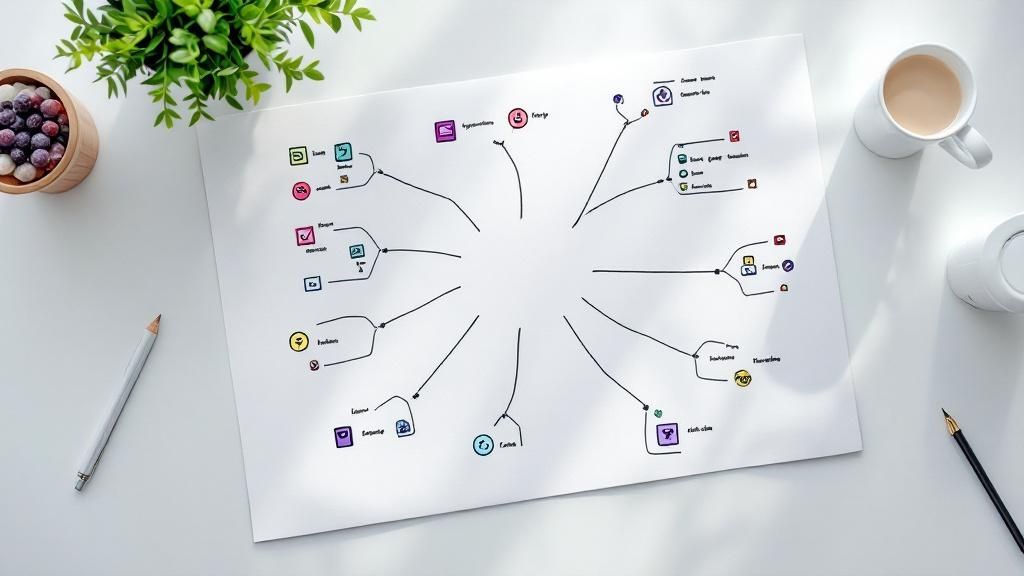
This method transforms past exam questions into visual maps that highlight relationships between ideas. History students can map the causes of World War I around a central “Alliance Systems” node, biology students illustrate cellular processes with colour-coded branches, and business students organise marketing strategy concepts by linking customer segments, channels and performance metrics. It is particularly useful for essay-based subjects and project planning.
Use mind mapping when you need to:
- Clarify complex subjects quickly
- Identify missing links between concepts
- Engage both left and right brain channels
- Structure essay outlines or extended responses
How to Implement Mind Mapping with Past Exams
- Start at the centre: Write the exam topic in a bold circle.
- Branch out: Create major themes (dates, theories, formulas) as primary branches.
- Colour-code themes: Assign a distinct colour to each branch for instant recognition.
- Add symbols and images: Enhance recall with simple icons or drawings.
- Keep it simple: Limit each branch to one key idea to avoid clutter.
Key Insight: Mind mapping converts passive review into an active, creative process, improving both retention and exam recall by visually linking concepts.
Combining mind mapping with past exam papers helps students simulate exam-style thinking visually. Digital tools like MindMeister and XMind streamline map creation, enabling easy edits and sharing. As a dynamic study aid, this method reduces cognitive load, encourages holistic understanding and boosts confidence on exam day.
6. Feynman Technique
The Feynman Technique is a powerful mental model for learning that revolves around explaining a concept in simple, plain language, as if you were teaching it to a complete novice. Named after Nobel laureate physicist Richard Feynman, this method forces you to move beyond surface-level memorisation and truly understand a topic from its core principles. It is one of the more profound methods past exams can facilitate, turning a complex exam question into a test of your own teaching ability.
This technique is exceptionally effective at exposing your knowledge gaps. If you stumble, use jargon, or can't simplify an idea, you've pinpointed exactly where your understanding is weak. It moves you from passively recognising information to actively deconstructing and reconstructing it in your own words, ensuring a much deeper and more permanent level of comprehension.
How to Implement the Feynman Technique with Past Exams
Applying this method involves using a past exam question as a starting point for your "lesson." The goal is to articulate the answer so clearly that even someone unfamiliar with the subject could grasp the basics.
- For abstract or theoretical subjects (Physics, Economics): Take a question about a complex theory, like quantum mechanics or supply and demand. Pretend you are explaining the answer to a high school student. Use analogies and simple terms to break it down.
- For process-oriented subjects (Computer Science, Chemistry): Select a question that requires explaining a process, like an algorithm or a chemical reaction. Write or speak out each step logically, justifying why each one follows the last.
- For essay-based subjects (History, Literature): Choose an essay prompt and outline your argument. Then, explain the core concepts and evidence you would use to a friend or family member, ensuring your logic is clear and persuasive without relying on academic jargon.
Key Insight: True understanding is demonstrated not by using complex vocabulary, but by the ability to explain a difficult idea in simple, accessible terms. If you can't teach it, you don't fully know it.
Incorporating this technique transforms past papers from a mere test of knowledge into a powerful diagnostic tool. You can practice by writing out your "lessons," recording yourself explaining a concept, or even teaching a study partner. This process not only cements the information in your mind but also builds a flexible, robust understanding that is far more valuable than rote learning. For a deeper dive into this and other strategies, you can learn more about effective study techniques on Evergreen Tutoring Services.
7. Interleaving Practice
Interleaving is a study strategy where you mix different topics or problem types within a single study session, rather than studying one topic exhaustively before moving to the next (known as blocked practice). This approach forces your brain to constantly switch gears, improving its ability to differentiate between concepts and choose the correct solution strategy. It is one of the more advanced methods past exams can be utilised for, promoting a deeper and more flexible understanding of the material.
This technique is highly effective because it mimics the unpredictability of a real exam, where questions from various topics are presented in a mixed order. By practising this way, you train your brain to identify the underlying principles of a problem rather than just robotically applying a recently memorised formula. This cognitive flexibility is crucial for high-level performance and long-term retention.
How to Implement Interleaving Practice with Past Exams
Instead of completing all the algebra questions before moving on to all the geometry questions, you should mix them up. This forces you to actively decide which method or knowledge is required for each specific question, a skill essential for exam success.
- For problem-based subjects (Maths, Chemistry): Take questions from different topics covered in past papers, for instance, one from calculus, then one from trigonometry, then one from algebra. Create a mixed-topic worksheet for yourself.
- For content-heavy subjects (History, Economics): Alternate between writing short-answer responses for different historical periods or economic theories. For example, answer a question on World War I, then one on the Cold War, then another on Federation.
- For language learning: Combine vocabulary drills from one unit, grammar exercises from another, and a short translation task from a third within the same study block, using questions drawn from various past exams.
Key Insight: Interleaving feels harder and less productive in the short term than blocked practice, but this "desirable difficulty" leads to more robust, long-lasting learning and better performance under pressure.
By adopting this strategy, you move beyond simple memorisation and develop true mastery. You learn not just what to do, but also when and why to do it. This ability to discriminate between problem types and apply appropriate knowledge is what separates high-achieving students from those who only know how to solve problems in isolation.
8. SQ3R Reading Method
The SQ3R method is a systematic reading comprehension technique designed to transform passive reading into an active, analytical process. Standing for Survey, Question, Read, Recite, and Review, it provides a structured framework for deconstructing complex academic texts and exam questions. This structured approach ensures you engage deeply with the material, which is crucial when analysing the dense information often found in past exams. Using this technique is one of the more analytical methods past exams can be incorporated into, helping you understand the 'why' behind the questions, not just the 'what'.
This method combats the common pitfall of simply reading through a past paper or textbook chapter without retaining the core concepts. It forces you to interact with the content at multiple levels, from getting a high-level overview to articulating the key ideas in your own words, ensuring a far deeper level of understanding and retention.
How to Implement the SQ3R Method with Past Exams
Applying SQ3R to past papers helps you dissect questions and understand the underlying curriculum requirements. Instead of just answering, you analyse the source material or question itself.
- Survey: Quickly scan the entire past exam paper. Look at the structure, question types, mark allocation, and any recurring themes or topics. This gives you a strategic overview.
- Question: Turn the headings of sections or the core components of a long-response question into direct questions. For a history essay prompt, ask: "What key events are being referenced?" or "What historical interpretation is expected?"
- Read: Actively read the question and any provided source material with your questions in mind. Highlight keywords, command terms (e.g., "analyse," "compare," "evaluate"), and the specific constraints of the question.
- Recite: Look away from the paper and try to summarise the question's core requirements in your own words. Explain what you are being asked to do and what knowledge you need to draw upon to answer it effectively.
- Review: Go back to the paper and check if your recited summary aligns with the question's demands. This final check ensures you haven't misinterpreted the prompt before you begin planning or writing your answer.
Key Insight: The SQ3R method forces you to slow down and deconstruct a question before you even attempt to answer it. This deliberate process prevents misinterpretation and helps you craft a more focused and relevant response.
This disciplined approach is particularly valuable for humanities, social sciences, and any subject with long-form or source-based questions. It builds your analytical skills, making you more adept at understanding precisely what examiners are looking for, which is a critical skill for achieving a high ATAR.
8 Methods for Past Exam Preparation Compared
| Study Method | Implementation Complexity | Resource Requirements | Expected Outcomes | Ideal Use Cases | Key Advantages |
|---|---|---|---|---|---|
| Active Recall Practice | Moderate: requires self-discipline | Minimal: flashcards, questions | Strong long-term retention, gap identification | Memorization-heavy subjects, exam prep | Efficient retention, confidence building |
| Spaced Repetition System | High: needs setup and daily commitment | Software/apps for scheduling | Maximized retention with minimal time | Large volume learning, language vocab | Efficient, adaptive review timing |
| Past Paper Analysis | Moderate: requires timed practice | Previous exam papers | Familiarity with exam format, time management | Exam-focused preparation | Realistic practice, performance insight |
| Pomodoro Technique | Low: easy to implement | Timer or app | Improved focus, reduced burnout | Any study requiring sustained concentration | Maintains concentration, prevents fatigue |
| Mind Mapping and Visual Learning | Moderate: time to create maps | Paper, pens, or software | Enhanced concept understanding and creativity | Subjects with complex concepts | Visualizes relationships, aids creativity |
| Feynman Technique | Moderate to high: needs explanation | Writing tools or teaching partners | Deep conceptual understanding | Complex subjects needing deep grasp | Deep learning, identifies gaps |
| Interleaving Practice | Moderate: requires planning | Mixed materials | Improved problem discrimination and transfer | Multi-topic learning, flexible problem solving | Enhances adaptability, reflects exam mix |
| SQ3R Reading Method | High: multi-step disciplined process | Textbooks, notes | Improved comprehension and active learning | Dense academic texts | Structured approach, boosts comprehension |
Integrating Your Strategy for Peak Performance
As we've explored, mastering your exam preparation journey isn't about finding a single magic bullet. It’s about building a robust, personalised system by strategically combining powerful techniques. The true potential of using methods past exams effectively is unlocked when you layer these strategies, creating a study routine that is both efficient and deeply effective for long-term retention.
Think of it not as a checklist to be completed, but as a toolkit. Each method we've covered, from Active Recall to the SQ3R Reading Method, is a specialised instrument. Your task is to become a skilled craftsperson, selecting the right tool for the right job and combining them for a superior result.
From Individual Tactics to a Cohesive System
The real power emerges when these methods are not used in isolation but are woven together into a seamless study workflow. The key is to experiment and find what combination gives you the most clarity and confidence.
For instance, a highly effective study cycle might look like this:
- Foundation: Use the SQ3R method to initially survey and understand a new chapter or topic from your textbook or notes. This gives you a solid base of comprehension before you tackle any questions.
- Application: Schedule a focused session using the Pomodoro Technique to attempt a relevant section from a past paper. This ensures you are working with intense concentration in manageable bursts.
- Analysis & Deconstruction: Immediately after the practice session, use the Feynman Technique on any questions you answered incorrectly or found confusing. Explain the concepts out loud, in your own simple terms, to identify precisely where your understanding breaks down.
- Organisation: Capture these complex ideas and their connections using a Mind Map. This visual representation helps to synthesise the information and see the bigger picture, transforming difficult topics into organised, understandable frameworks.
- Reinforcement: Convert your key takeaways, corrected mistakes, and difficult concepts into flashcards for your Spaced Repetition System (SRS). This ensures that the knowledge you've worked so hard to gain is not forgotten, but is instead moved into your long-term memory through scientifically-backed, timed reviews.
Key Insight: Your goal is to create a feedback loop. Past exams reveal your weaknesses. Analysis methods like the Feynman Technique help you understand them. Organisation tools like Mind Maps structure the new knowledge, and reinforcement systems like SRS ensure you never forget it.
By integrating these methods past exams, you move beyond simply doing practice papers. You transform them into a dynamic, diagnostic tool that actively builds your knowledge, sharpens your skills, and builds unshakeable confidence. This systematic approach reduces exam anxiety because you’re not just hoping you’ve covered everything; you have a process that proves you have. Your final weeks of study become less about frantic cramming and more about targeted refinement, leading you towards peak performance when it matters most.
Ready to build a personalised study system that gets results? The expert tutors at Evergreen Tutoring Services specialise in helping students implement and combine effective study strategies for their specific subjects and learning styles. We can help you analyse your approach to methods past exams and create a customised plan to turn your weaknesses into strengths, ensuring you achieve your academic goals.


