To really think critically, you have to move past just accepting information at face value. It's about actively questioning, analysing, and evaluating what you see and hear. It’s a mindset, really—one built on curiosity and healthy scepticism that lets you pick apart arguments, spot biases, and arrive at your own well-reasoned conclusions.
Why Critical Thinking Is Your Most Important Skill

In a world overflowing with viral news, social media noise, and AI-generated content, knowing how to think critically isn't just an academic exercise anymore. It's a fundamental life skill. It’s that little voice that makes you pause and ask, "Is this really true?" before you share a shocking post, or helps you see the real motive behind a flashy advertisement.
This skill isn't about being the smartest person in the room; it's about being discerning. It gives you the power to navigate tricky situations with a clear head, whether you're tackling a complex school project, deciding on a major purchase, or making sense of a local political debate.
From Schoolwork to the Real World
At its heart, critical thinking shifts you from being a passive sponge for facts to an active participant in your own learning. Instead of just memorising dates for a history exam, you start asking why things happened the way they did. You begin to analyse the different perspectives of historical figures, question the reliability of your sources, and form your own informed opinions.
This way of thinking is what separates good students from great ones. It's also exactly what future employers are looking for. As workplaces grapple with complex global challenges and the tsunami of misinformation, the demand for sharp analytical minds is only getting stronger.
In fact, a global survey of over 1,000 employers found that critical thinking was the single most desirable skill they look for. Here in Australia, with our increasingly data-driven society, the ability to properly analyse information is a massive advantage. Yet, there’s a growing worry that this skill isn't being taught effectively, which has experts rethinking how we can better prepare students. You can read more about how educators are tackling this in this article from the University of Melbourne.
Critical thinking isn’t about finding fault. It's a neutral and detached way of thinking that helps you see all sides of an issue, free from personal bias, so you can make decisions based on solid evidence.
What Critical Thinking Looks Like in Action
Let’s get practical. Imagine you're scrolling through your social media feed and a headline about a "miracle" health product catches your eye. Without critical thinking, you might just believe it. But with critical thinking, a series of questions automatically pops into your head:
- Who’s behind this? Is it a reputable scientific organisation or just a company trying to sell me something?
- What’s the evidence? Are there actual studies, data, or expert opinions to back this up?
- Could there be another explanation? Maybe the "amazing results" are just a placebo effect or pure coincidence.
- What are they not telling me? Is there conflicting evidence or are they conveniently ignoring potential side effects?
This simple, internal conversation is the engine of critical thought. When you practise it consistently, you build a mental filter that helps you sift through the noise, protect yourself from misinformation, and make smarter decisions in every part of your life—from the classroom to your personal well-being.
Building the Core Habits of a Critical Thinker
Developing strong critical thinking skills doesn’t happen overnight, and it certainly doesn’t start with memorising complex theories. It begins with small, practical habits you can build into your everyday routine. The goal is to shift your mindset from passively receiving information to actively engaging with it.
This change starts with a few simple, intentional practices.
From Passive Learning to Active Thinking
One of the easiest yet most powerful habits is to keep a curiosity journal. This isn't for deep diary entries or life reflections. Its only job is to be a place where you jot down all the questions that pop into your head during the day.
You might ask yourself, "Why is that particular ad so persuasive?" "What's the real reason behind this new school rule?" or "How does my 'For You' page actually decide what to show me?"
Writing these questions down gives them value and creates a log of interesting things to investigate later. This simple act trains your brain to stay inquisitive and see the world around you as a source of discovery. Over time, asking these questions becomes second nature—a true cornerstone of critical thinking.
Another fantastic habit is to consciously pause before you accept new information as fact. Whether it's a news headline, something a friend tells you, or even a statement made in class, teach yourself to take a mental breath. That brief pause is where the magic happens; it creates just enough space for your analytical mind to kick in and stop you from just nodding along.
This image highlights some of the key benefits that come from building these active thinking habits.
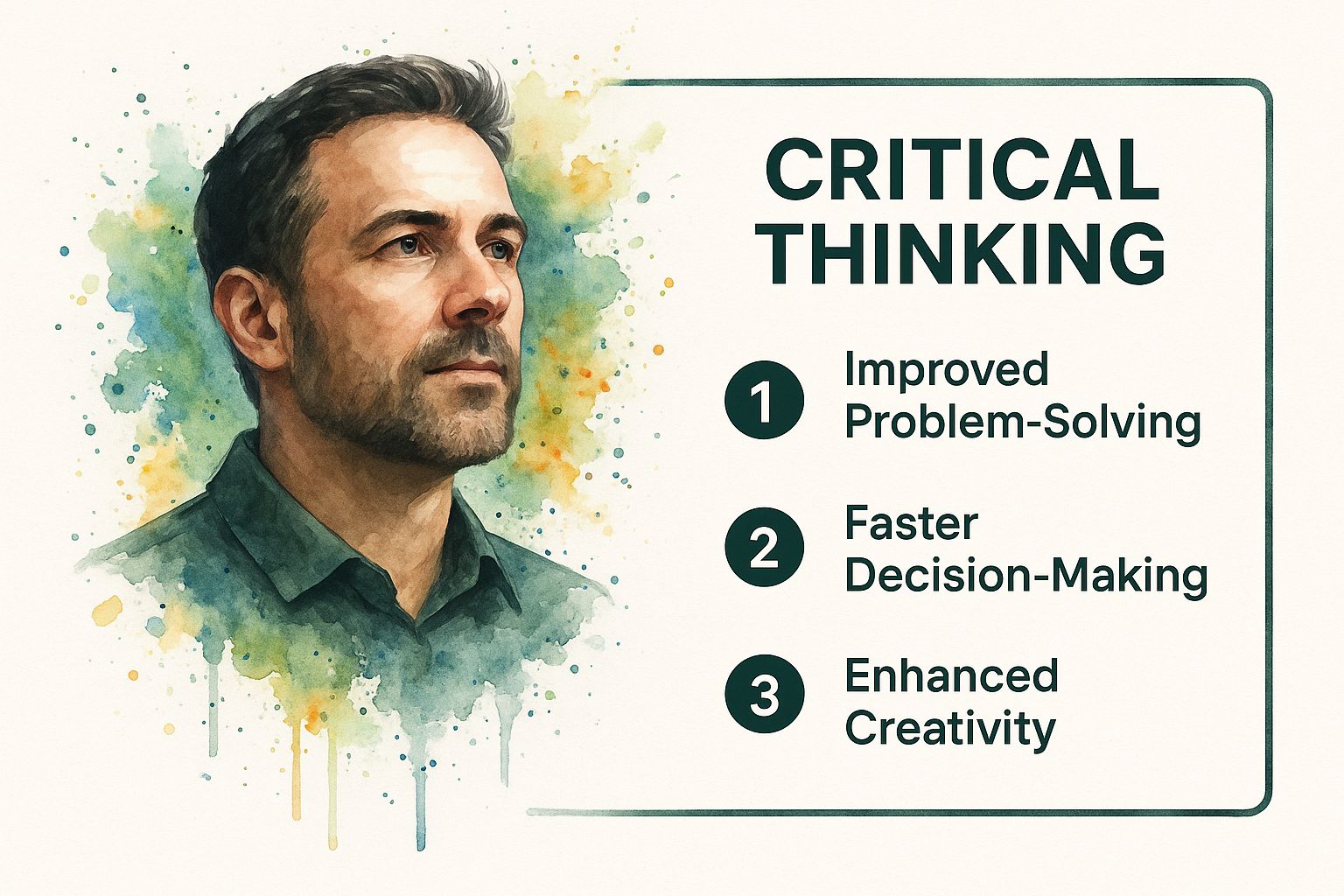
As you can see, these small habits directly lead to better problem-solving skills, faster decision-making, and a real boost in creativity. These are skills that will serve you well, not just at school, but for the rest of your life.
Key takeaway: Critical thinking isn’t a special mode you turn on for an exam. It’s a continuous process. The aim is to make questioning and analysing your default setting.
To make this idea even more practical, let's look at a simple technique for tackling everyday challenges: the Five Whys. When you're facing a problem, like procrastinating on a big assignment, don’t just accept the surface-level issue. Ask "why?" five times to dig down to what's really going on.
It looks something like this:
- Problem: I keep putting off my history essay.
- Why? Because I don't know where to start.
- Why? Because the topic feels huge and overwhelming.
- Why? Because I haven't broken it down into smaller, manageable chunks.
- Why? Because I’m not sure which parts of the topic are the most important.
- Why? Because I haven’t gone back over my notes to identify the main themes.
And just like that, the problem transforms. It’s no longer a vague, scary feeling of being overwhelmed. It’s a clear, actionable task: review your notes. This method turns fuzzy problems into a series of solvable steps. Many of these foundational skills are also explored in our guide on student engagement strategies, which can provide more ideas for building an active learning mindset.
Shifting Your Mindset From Passive Learner to Active Thinker
The difference between a passive learner and an active thinker really comes down to daily choices. One person waits for information to be fed to them, while the other actively seeks to understand, question, and connect what they're learning.
This table shows how you can consciously shift your habits to become a more active, critical thinker.
| Passive Habit | Active Critical Thinking Habit | Example in Action |
|---|---|---|
| Accepting statements as fact. | Asking for evidence or reasoning. | When a friend says, "This is the best phone ever," you ask, "What makes it better than the others?" |
| Reading just to finish the chapter. | Reading to understand and question. | You highlight confusing sentences and look up unfamiliar words instead of just pushing through to the end. |
| Listening to a lecture silently. | Connecting lecture content to prior knowledge. | During a science lesson, you think, "How does this relate to what we learned about ecosystems last term?" |
| Avoiding topics that seem confusing. | Seeking out challenges to grow your skills. | You choose the more complex essay topic because you know it will force you to think more deeply and learn more. |
By making these small adjustments, you're not just learning facts; you're learning how to think. This is the foundation that will set you up for success in high school, university, and beyond.
Your Practical Toolkit for Analysing Information

Alright, let's move from theory to practice. Having a curious mindset is the first step, but to really get your hands dirty with analysis, you need a few reliable tools. Don't worry, these aren't complex academic theories. They're practical frameworks you can start using today on anything from an online article or a new phone ad to a textbook chapter.
The goal is to make these methods feel like second nature, so you can pull them out whenever you need to deconstruct a piece of information.
One of the most powerful yet surprisingly simple approaches is the Socratic method. This isn't about winning an argument or proving someone wrong. It’s about working together to find the truth by asking good, probing questions. It helps you gently peel back the layers of a statement to see what’s really holding it up.
Instead of just nodding along, you learn to gently challenge what you hear. This helps you understand not just what someone believes, but why. It's a foundational skill for any budding critical thinker.
Probing for Deeper Understanding
The Socratic method truly shines when you want to examine the logic behind a claim. It’s all about a series of focused questions that test assumptions and can expose weak spots in an argument.
You can practise this in everyday conversations. Imagine a friend says, "That new productivity app is a total game-changer." Instead of just accepting it, you could start probing:
- Clarification Questions: "What exactly does it do that other apps don't?"
- Questions about Assumptions: "What did you assume about it before you started using it?"
- Questions about Evidence: "What have you actually been able to achieve with it that you couldn't before?"
- Questions about Implications: "If everyone started using it, what might be the downsides?"
This line of questioning isn't meant to be confrontational. It comes from a place of genuine curiosity. You're simply trying to move the conversation from a surface-level opinion to a more reasoned exploration of the idea.
Intellectual courage is a huge part of this. It means being willing to question beliefs you feel strongly about—not just those of others. It’s about having the guts to examine your own reasoning and admit where it might be flawed.
A Simple Framework for Everyday Analysis
For a more structured approach, you can use a simple three-part model to guide your thinking. It's often called the RED Model, which makes it easy to remember and apply to almost any situation.
- Recognise Assumptions: What beliefs are being taken for granted? Every argument is built on assumptions, and a good critical thinker knows how to spot them.
- Evaluate Arguments: Is the evidence strong and relevant? Look for logical fallacies, emotional appeals, and any big gaps in the reasoning.
- Draw Conclusions: Based on your analysis, what’s the most logical conclusion? Is it the one being presented, or does the evidence point you somewhere else?
Let's see how this works with a common scenario: an ad for a new phone.
| RED Model Step | Application to a Phone Ad |
|---|---|
| Recognise Assumptions | The ad assumes you value having the absolute latest tech and that a new phone will make you happier or boost your social status. |
| Evaluate Arguments | It shows attractive people having a great time but gives very little real data. Claiming it has a "revolutionary camera" is an emotional appeal, not a factual comparison. |
| Draw Conclusions | The ad is clearly designed to create a feeling of desire, not to provide a logical reason to buy. The phone's actual value is unclear without more objective information. |
This simple breakdown instantly shifts you from being a passive consumer to an active analyst. You start to see the machinery behind the message.
Quick-Checking Your Sources
In a world saturated with information, knowing where that information comes from is crucial. Before you spend time analysing a claim, it’s worth running a quick check on the source. This doesn't need to be a deep-dive investigation; a few quick questions are often all it takes.
Ask yourself:
- Who is the author? Do they have any expertise in this area? A quick search can reveal their credentials and any potential biases.
- What is the purpose? Is this piece trying to inform, persuade, entertain, or sell you something? The purpose heavily influences the content.
- When was it published? Is the information still current? This is especially important in fast-moving fields like science and technology.
Learning to think critically is an ongoing journey of building good habits. By adding these tools—the Socratic method, the RED Model, and source-checking—to your mental toolkit, you empower yourself to navigate the world with far more clarity and confidence.
Applying Critical Thinking Across Your School Subjects
It’s a common mistake to think of critical thinking as a single, one-size-fits-all tool. The reality is, the way a scientist critiques an experiment is worlds away from how a historian pulls apart a primary source. This is a vital point to grasp when you're learning how to develop critical thinking at school.
To really get ahead, you have to learn how to apply these thinking skills within the context of each subject. This approach makes your analysis sharper and more relevant, pushing you beyond simply memorising facts and into a genuine understanding of the material.
This isn’t just a hunch; it’s backed by research right here in Australia. Generic logic puzzles, as it turns out, don't do much. A review by the NSW Department of Education found that critical thinking skills are best developed within a subject, not as a standalone skill. The analytical muscles you build in history, for instance, don’t automatically transfer to a science lab. You can read more about these findings and what they mean for Aussie classrooms in this insightful blog post.
Critical Thinking in History Class
History is so much more than a timeline of names and dates. At its core, it's a discipline built on interpretation and piecing together evidence. A critical thinker in history class doesn't just ask, "What happened?" They dig deeper, asking, "How do we know what happened?" and, just as importantly, "Whose side of the story are we hearing?"
Imagine you're studying the Eureka Stockade. You’re given two documents: a government official's report labelling the miners as violent rebels, and a diary entry from a miner's wife describing a fight for basic rights. A passive learner might just pick a side and call it a day.
But a critical thinker becomes a detective. Here’s what they do:
- Put each source in context. Who wrote this and why? What was their agenda or bias? The government official needed to justify a crackdown, while the wife was documenting her family's struggle.
- Look for corroboration. Do other sources—like newspaper articles, official records, or other letters from that time—back up either account?
- Analyse the language. The choice of words is a massive clue. Words like "rebels" versus "fighters" reveal the author's entire perspective.
This process turns you from a fact-collector into a true historical investigator, building a richer, more complete picture of the past.
Sharpening Your Analysis in English
In English, critical thinking is all about peeling back the layers of a text. You're looking for the author's purpose, the themes they're exploring, and the literary techniques they used to do it. It’s less about what the story is about and more about how it's being told.
Take a classic novel like To Kill a Mockingbird. Instead of just writing a plot summary, a critical thinker will ask bigger questions:
- Why did Harper Lee choose a child, Scout, to narrate the story?
- How does the town of Maycomb, Alabama, almost feel like a character itself?
- What is the author trying to say about justice, prejudice, and morality?
The goal isn't to find the one "correct" answer. It's about constructing a strong, persuasive argument for your interpretation and backing it up with evidence straight from the text—quotes, character actions, symbolism, and imagery.
This is the secret to writing a brilliant essay. When you move from summary to analysis, you show a much deeper engagement with the material, and that's exactly what your teachers are looking for. Many of these analytical skills are also the same ones you need to learn how to study effectively for exams, helping you prepare for assessments across all your subjects.
Thinking Like a Scientist
Science is built on a healthy dose of scepticism. To think critically in science class, you need to adopt the scientific method as a mindset, not just a checklist of steps. It's about questioning results, spotting flaws in an experiment, and accepting that our knowledge is always evolving.
Let's say your class runs an experiment to see how different fertilisers affect plant growth. A critical thinker doesn't just glance at the tallest plant and accept the result.
Instead, they start asking tough questions:
- Were all the variables properly controlled? Did every single plant get the same amount of sunlight, water, and soil? Any difference could completely invalidate the results.
- Is the sample size big enough? Testing just one plant per fertiliser is unreliable. A bigger sample size helps rule out flukes and random chance.
- Are there other possible explanations? Maybe one corner of the classroom was warmer, or one packet of seeds was simply better than the others. A good scientist considers all possibilities.
By constantly questioning the process, you learn to spot weak experimental design and understand the crucial difference between correlation (things happening at the same time) and causation (one thing causing another). This analytical rigour is the heart of all scientific discovery.
Using AI as Your Thinking Partner, Not a Shortcut

The arrival of powerful AI tools like ChatGPT has certainly changed the game for students. It's incredibly easy to see them as a tempting shortcut—a quick way to get an answer or finish an assignment without putting in the real mental effort. But treating AI this way is a massive missed opportunity.
Instead of seeing AI as an answer machine, it’s time to start seeing it as your personal thinking 'sparring partner'. It’s a tool that, when you use it the right way, can actually make you a sharper, more rigorous thinker. The secret is to shift your mindset from simply asking AI for the answer to using it to challenge and refine your own thinking. This proactive approach is essential for anyone serious about learning how to develop critical thinking in today's world.
This is particularly relevant in Australia. A recent study found that many students feel they aren't getting enough direct instruction on critical thinking skills at school. While AI tools are exciting, there’s a genuine risk they could encourage a shallow understanding of topics if they aren’t used with care. Experts suggest the best way forward is to use AI to spark evaluation, not to replace it. You can explore the full study on the state of critical thinking education in Australia here.
Turn AI into Your Personal Debate Coach
One of the best ways to use AI as a thinking partner is to get it to build an argument for you, and then you systematically pick it apart. This forces you to analyse reasoning, spot weaknesses, and construct a stronger counter-argument. It’s like having a debate coach on demand.
Here’s a simple exercise to try:
- Pick a debatable topic. It could be anything from "Should school uniforms be compulsory?" to "Is space exploration a worthwhile investment?"
- Prompt the AI. Ask it to write a short, persuasive argument for one side of the issue. For example: "Write a 200-word argument in favour of banning mobile phones in schools."
- Become the critic. Now, put on your detective hat. Read the AI's response carefully and start looking for holes. Does it use solid evidence or just vague claims? Can you spot any logical fallacies? Does it rely on emotional language to persuade?
- Formulate your rebuttal. Based on your critique, write your own counter-argument, pointing out the weaknesses you found and presenting a much stronger case.
This process does more than just help you with an assignment; it actively trains you to evaluate arguments, which is a core part of critical thought.
Key Insight: The real value of AI in learning isn't in the answers it gives you, but in the questions it forces you to ask yourself. Use it to provoke your own analysis, not to end it.
Use AI to See the Bigger Picture
Another powerful technique is to use AI to practise synthesis—the skill of pulling together information from different sources to form a new, more complete understanding. This is a high-level thinking skill that is absolutely crucial for university and your future career.
Imagine you're researching climate change. Instead of just asking for a simple summary, prompt the AI to act like different experts.
- "Summarise the key arguments about climate change from the perspective of an environmental scientist."
- "Now, summarise the main concerns about climate change policies from the perspective of an economist."
- "Finally, explain the social justice implications of climate change from the perspective of a sociologist."
When you do this, you’re not just getting facts; you’re getting perspectives. Your job is to then compare and contrast these different viewpoints, notice where they overlap and where they conflict, and pull them all together into a more nuanced, sophisticated understanding of the entire issue. This skill builds mental flexibility and helps you appreciate just how complex real-world problems are. Developing this kind of internal drive is key, and you can learn more about how tutoring helps build self-motivation to tackle complex topics like these.
At the end of the day, AI is a tool. Like any tool, its value depends entirely on how you decide to use it. You can use a hammer to build a house or to smash a window. By choosing to use AI as your sparring partner, you’re not just getting your work done—you’re actively building the critical thinking muscles you’ll need for the rest of your life.
Common Questions About Developing Critical Thinking
As you start to really focus on building your thinking skills, it's completely normal for a few questions and hurdles to pop up. Learning how to develop critical thinking is all about rewiring mental habits you've had for years, and that process definitely comes with its own challenges.
Let's walk through some of the most common queries we hear from students and parents. The goal here is to get you past any sticking points and give you the confidence to keep practising.
How Do I Know If I'm Actually Improving?
This is a fantastic question. Unlike a maths test, there’s no simple score that tells you how you’re doing. Progress in critical thinking is much more subtle, but you can absolutely spot the signs in your everyday life once you know what to look for.
You'll know you're on the right track when you start catching yourself doing things like:
- Pausing before you react: You find yourself taking a beat before accepting a friend's strong opinion or sharing a sensational news story.
- Asking better questions: Instead of just asking, "what happened?" you start digging deeper with, "why did that happen?" or "how do we know that's true?"
- Spotting assumptions (in others and yourself): You begin to recognise the unstated beliefs that form the foundation of an argument—including your own.
- Feeling less overwhelmed by complex topics: Big, complicated issues start to look less like a single, scary problem and more like a set of smaller, manageable questions to explore.
Progress isn’t about suddenly having all the answers. It’s about becoming more comfortable with not knowing, and more skilled at finding your way toward a reasoned conclusion. It's a shift from seeking certainty to valuing clarity.
What If I'm Not Naturally a Sceptical Person?
That’s a common worry, but it’s based on a misunderstanding. Critical thinking isn't about being cynical or negative. They are fundamentally different. Cynicism dismisses things without evidence; critical thinking demands evidence before forming a judgement.
You don't need to change your personality to become a better thinker. It's really about cultivating intellectual humility—a fancy term for simply being aware that your own knowledge has limits. It’s that little voice in your head that says, "I might be wrong here, let me double-check."
This simple table shows the difference in action:
| Trait | What It Looks Like | How It Helps |
|---|---|---|
| Cynicism | "All politicians are corrupt, so it doesn't matter who you vote for." | Shuts down thinking and prevents engagement. |
| Scepticism | "This candidate is making some big promises. I'm going to look at their track record to see if their claims hold up." | Opens up inquiry and leads to informed decisions. |
Being a critical thinker doesn't stop you from being trusting or optimistic. It just means your trust and optimism are built on solid ground, not just wishful thinking.
Is It Possible to Overthink Things?
Yes, absolutely. It's easy to get stuck in "analysis paralysis," where you spend so much time pulling a problem apart that you never actually make a decision. This is a real risk, but the solution isn't to think less—it's to think more efficiently.
Here’s how to avoid getting bogged down:
- Set a time limit: For smaller decisions, give yourself a specific timeframe to gather info and make the call. Don't let it drag on.
- Focus on what matters: Not every decision needs a full-scale investigation. A key skill is learning to tell the difference between low-stakes choices (like what to have for lunch) and high-stakes ones (like which university to attend). Apply your deepest thinking where it counts the most.
- Embrace "good enough": The goal isn't always to find the single, perfect, flawless answer. Often, it's about finding the most reasonable and practical solution based on the information you have right now.
Remember, critical thinking is a tool to help you move forward with clarity and purpose, not to keep you frozen in thought.
Navigating these challenges becomes much easier with the right support. At Evergreen Tutoring Services, our expert tutors don't just teach subjects; they teach students how to think. We provide personalised guidance to help learners build the analytical skills and confidence they need to excel. Explore our one-on-one tutoring programs.