

Before you start punching numbers into an HSC ATAR calculator, it’s important to get one thing straight: these tools aren't crystal balls. They're incredibly sophisticated estimation tools, but they provide an educated guess, not a guarantee. Think of it as a highly advanced simulation based on what’s happened in previous years.
How an HSC ATAR Calculator Actually Works

At its heart, an ATAR calculator is a powerful simulation tool. It doesn't predict the future, but it has a fantastic memory of the past. The entire system is built on historical data, mapping how previous students' HSC marks translated into their final ATARs.
When you enter your subjects and your best-guess marks, the calculator gets to work. It pulls up scaling data from previous years and starts converting your marks into a scaled aggregate score. This is really the secret sauce behind every prediction it makes.
The real job of an ATAR calculator is to turn your potential HSC marks into a percentile rank. It does this by running a simulation of the official scaling process, giving you a sneak peek at how you might stack up against everyone else in the state.
This reliance on past data is also why the result is only ever an estimate. The performance of the student cohort changes every single year, and so does the scaling for each subject. Your official ATAR is calculated using your year's data, which isn't finalised until every last exam is marked.
Understanding the Engine: Historical Data and Scaling
An HSC ATAR calculator doesn’t just look at your marks in a vacuum. It digs deeper, considering the specific subjects you took and, most importantly, how those subjects have scaled in the past.
This is a critical point that Professor Jacqui Ramagge from the University of Sydney often highlights. As she points out, these calculators use data from past cohorts to predict an ATAR. But because scaling and the performance of students fluctuate year-to-year, the predictions can't be perfectly precise. You can explore more about these academic insights on how ATAR calculators work.
A calculator’s model is really built on a few key things:
- Subject Scaling Reports: It uses official data from UAC that shows exactly how subjects were scaled in previous years.
- Cohort Performance: It has to assume this year's students will perform in a similar way to past groups.
- Your Estimated Marks: The quality of the numbers you put in directly impacts the quality of the result you get back.
This is exactly why the same raw mark in Chemistry can lead to a different ATAR from one year to the next. If the cohort for Chemistry is exceptionally strong one year, the scaling applied to that subject might be more generous than the year before.
The Key Concepts at Play
To really get your head around how these calculators tick, you need to know the lingo. These are the building blocks for any ATAR estimation, and understanding them makes the whole process much less mysterious.
This table breaks down the essential terms you'll come across when trying to estimate your rank.
Key ATAR Calculator Concepts
| Concept | What It Means for Your ATAR Estimate |
|---|---|
| Raw HSC Marks | These are your unadjusted exam and assessment scores. Calculators don't use these directly because they first need to be aligned and moderated by NESA. |
| Scaled Marks | This is what the calculator really cares about. It converts your estimated HSC marks into scaled scores using historical data to reflect subject difficulty. |
| Aggregate Score | The calculator adds up your best scaled marks (including two units of English) to create a total score out of 500. This number is what actually determines your rank. |
| Percentile Rank (ATAR) | Finally, the calculator takes your predicted aggregate score and compares it to the historical distribution of scores to give you a percentile rank—your estimated ATAR. |
Once you understand these moving parts, you can stop seeing the calculator as a source of anxiety and start using it as a powerful planning tool. It lets you run "what if" scenarios, see how a bit more effort in certain subjects could pay off, and set realistic goals for your final exams. It’s all about strategic planning, not prophecy.
Finding the Right Marks for an Accurate Prediction

There’s an old saying in computing: ‘garbage in, garbage out’. It’s especially true when it comes to an HSC ATAR calculator. The accuracy of your estimated ATAR hinges entirely on the quality of the numbers you feed the tool. Getting this part wrong is the single biggest reason students I see end up with a wildly inaccurate prediction and a whole lot of unnecessary stress.
A classic mistake is punching in raw trial marks. It almost always spits out a misleadingly low result, causing panic when it's least needed. To get a truly meaningful prediction, you have to understand the difference between raw marks, your school rank, and the final ‘aligned’ HSC marks that NESA provides.
This process ensures you’re giving the calculator the most realistic data possible. A big misconception circulates among NSW HSC students about using trial marks directly. While it feels intuitive, these calculators are designed to work with ‘aligned’ marks—the final, adjusted scores you receive on results day. For a deep dive into this, you can learn more about how to calculate your ATAR from trial marks on Bored of Studies.
Raw Marks vs Aligned HSC Marks
Let's get one thing straight: the number on your trial exam paper is not your final HSC mark. Your school assessments and trial exams give you a raw mark and, far more importantly, a rank within your school's cohort for that subject.
Your final HSC mark for any subject is a 50/50 split:
- 50% comes from your moderated internal assessment mark.
- 50% comes from your final, aligned HSC exam mark.
The key words here are moderated and aligned. NESA adjusts these figures to ensure fairness across different schools and exams. For example, an 85% in a notoriously brutal trial exam might be scaled upwards to reflect its difficulty. Meanwhile, your internal assessment mark is moderated based on how your entire school cohort performs in the final HSC exam. It’s all about levelling the playing field.
Estimating Your Final HSC Mark
So, if you can't use raw trial marks, what should you use? The goal is to make an educated guess of what your final, aligned HSC mark will be. It's not a perfect science, but a calculated estimate is worlds better than a raw score.
Your internal rank is often more powerful than your raw mark. NESA uses your rank to assign you an assessment mark based on the HSC exam performance of your classmates. If you rank first internally, you are awarded the highest exam mark from your school's cohort as your moderated assessment mark.
To put together a solid estimate, you need to combine a few data points:
- Your Trial Exam Performance: How did you really go? Was it a fair reflection of your knowledge, or did you just have a bad day? Be honest.
- Your Internal Assessment Rank: Where do you sit in your class? Knowing if you're in the top 25%, the middle, or the bottom 25% is crucial for estimating your final moderated mark.
- Candid Teacher Feedback: Your teachers have seen cohorts go through this for years. Ask them for a realistic prediction of your potential HSC mark based on your work ethic and performance so far. They know what they’re talking about.
For instance, let's say you scored 78% on your Chemistry trial exam and you know you're ranked about 10th in a class of 30 (the top third). After a chat with your teacher, they suggest that with consistent work, a final mark in the low-to-mid 80s is very achievable. For the ATAR calculator, a conservative estimate of 82 or 83 would be a much more realistic input than your raw 78.
This approach of gathering intel to form a rounded estimate is a critical skill, much like the analytical abilities developed for earlier standardised tests. It’s a bit like the detailed preparation needed for other significant exams, which you can read about in our guide on NAPLAN preparation and the benefits of tutoring.
By taking the time to source better data, you transform the HSC ATAR calculator from a novelty into a genuinely useful strategic tool to plan your final study push.
A Practical Walkthrough of a Real ATAR Calculator
Alright, you've done the hard work of estimating your marks. Now, let's put them to use. We're going to walk through the process of using a real ATAR calculator, step-by-step. This will clear up any confusion and give you the confidence to punch in your numbers and actually understand the results you get back.
At its core, any ATAR calculator follows a three-stage process to give you an estimated rank. The infographic below breaks it down visually.
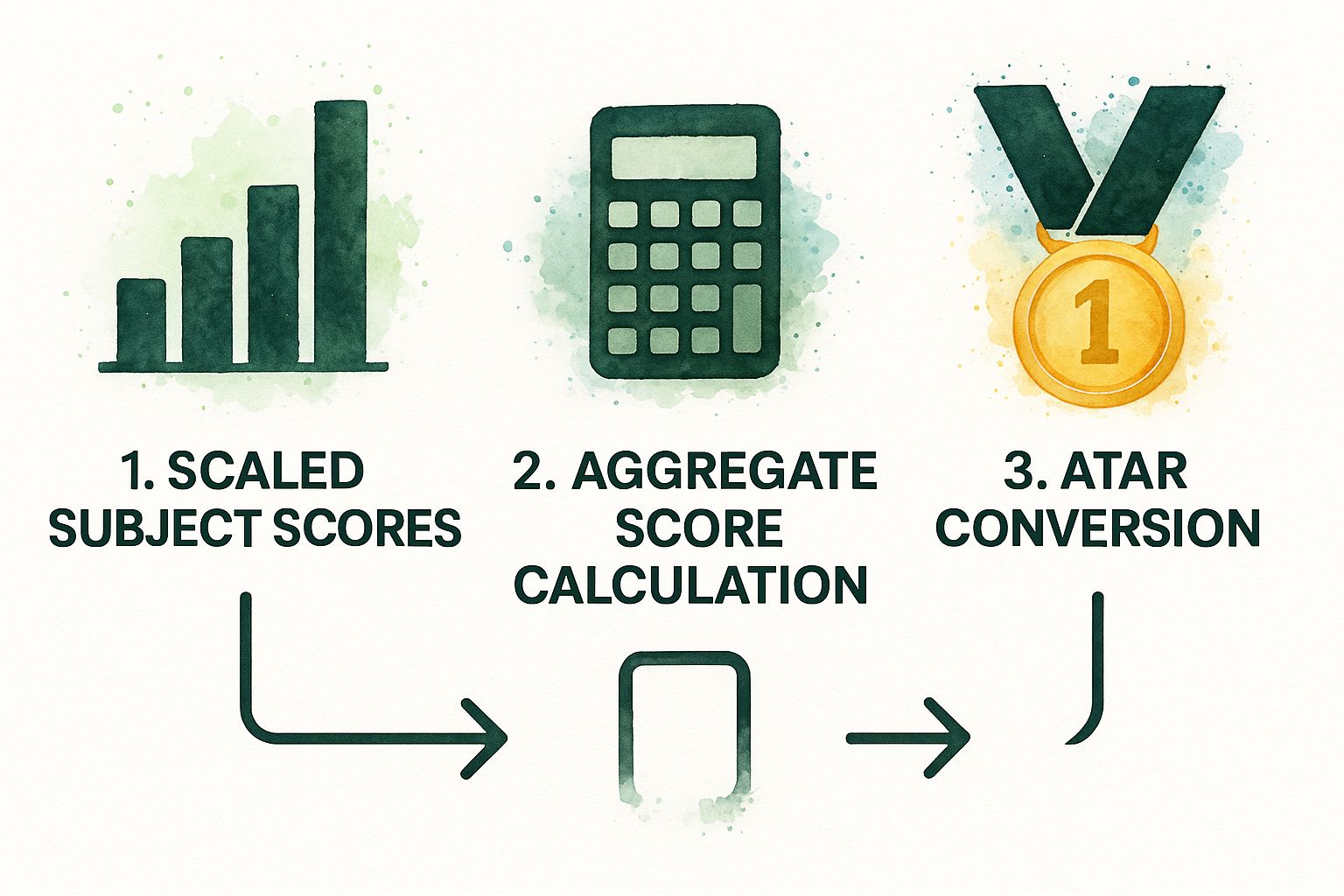
First, your individual subject marks get scaled. Then, they're combined into an aggregate score, and finally, that score is converted into your final ATAR. It's a pretty logical flow once you see it laid out.
Getting Around the Calculator Interface
Most online ATAR estimators are designed to be really straightforward. You'll usually just see a bunch of dropdown menus and boxes where you can plug in your subjects and marks. For this guide, we'll use the official UAC tool as our example.
The Universities Admissions Centre (UAC) in NSW has a popular and reliable tool called the ATAR Compass. It’s a fantastic resource because it uses scaling data from the last five years to estimate your potential ATAR. To use it, you just need to enter your HSC courses and your predicted marks, and it does the rest. You can explore the UAC ATAR Compass for yourself and follow along with us.
Once you open the tool, you'll find a clean, simple layout ready for your subject details.
The main takeaway here is just how user-friendly these tools are. They’re built to guide you through the process without any confusing or technical steps.
Entering Your Subjects and Marks Correctly
This is where your prep work really pays off. The goal is to give the calculator an accurate picture of your HSC study pattern. Here's the process I take students through to make sure we get a meaningful result.
First up, select your English course. It's compulsory, so it has to be in there. Make sure you're specific—choose between English Standard, English Advanced, or English Studies.
Next, add all your other ATAR-eligible subjects, one by one. You have to be careful with extension courses here. For instance, if you're taking Mathematics Extension 1, you need to add both "Mathematics Advanced" (2 units) and "Mathematics Extension 1" (1 unit). The calculator needs to see the whole picture.
Crucial Tip: Remember, your ATAR is calculated from your best 10 units of ATAR courses, and this must include at least two units of English. Most calculators handle this logic for you, but it’s always good practice to double-check you’ve entered at least 10 units worth of subjects.
With your subjects all listed, it's time to punch in your estimated HSC marks. Use those carefully considered numbers you worked out earlier—the ones based on your trial results, school rank, and teacher feedback. Whatever you do, don't just use your raw trial scores.
Let’s run through a quick example. Imagine a student, Chloe, is estimating her ATAR.
- English Advanced: She scored 84 in her trials but is ranked in the top quarter of her class. Her teacher thinks 88 is a realistic HSC mark, so she enters 88.
- Biology: She got an 89 in trials and is ranked 3rd in her cohort. Feeling confident, she puts in 91.
- Legal Studies: Her trial mark was a strong 92, and she's ranked 1st. She conservatively enters 93.
- Modern History & History Extension: She enters her estimated marks of 85 and 44/50, respectively.
After entering all this data, Chloe hits the "calculate" button. The tool takes her numbers, runs them through its historical scaling model, and spits out an estimated ATAR. This isn't just a random guess; it's a data-driven projection of where she might land, giving her valuable insight for that final study push.
Making Sense of Your Predicted ATAR and Subject Scaling

You’ve plugged in your subjects, entered your best-guess marks, and clicked ‘calculate’. A number is now staring back at you. So, what’s next? That predicted ATAR isn’t just a score to get excited or worried about; it’s a powerful piece of data that tells a story about your performance and, more importantly, about the world of subject scaling.
First things first, let's clear up a common myth. The ATAR is not a mark out of 100. The Australian Tertiary Admission Rank is exactly what its name implies: a rank. An ATAR of 85.00 doesn’t mean you averaged 85% across your subjects. It means you performed better than 85% of all other eligible students in your state that year.
An HSC ATAR calculator is basically predicting your spot in this massive statewide queue. Getting your head around this is the first real step. It shifts your focus from chasing a magic number to improving your overall position against everyone else. This is where the powerful, and often confusing, concept of scaling comes into play.
Demystifying Subject Scaling
Scaling is the engine room of the ATAR calculation. It’s the reason two students with identical average HSC marks can end up with wildly different ATARs.
Essentially, scaling is a statistical process used by the Universities Admissions Centre (UAC) to create a level playing field. It adjusts your raw marks to account for the simple fact that some subjects have a much more competitive group of students than others.
Think of it like a handicap in sport. A student who scores well in a subject stacked with high-achievers has delivered a seriously impressive performance. Scaling rewards that. For example, a mark of 88 in a subject like Mathematics Extension 2, which is known for its strong student cohort, will likely be scaled up. On the flip side, an 88 in a subject with a less competitive field might be scaled down.
Scaling exists to answer one key question: What would a student’s mark have been if all courses had been studied by all students? It ensures a high mark in a tougher subject is valued appropriately.
This means your ATAR doesn’t just depend on how well you did, but also on what subjects you did well in. The calculator uses years of historical scaling data to model this effect, showing you exactly how your subject choices can influence your final rank.
How Scaling Impacts Your Predicted ATAR
Let’s get practical and see how this plays out. Imagine two students, Alex and Ben. They both worked hard and have an identical average HSC mark of 85 across their best units. You’d think their ATARs would be similar, right? Not necessarily.
The table below shows how a different mix of subjects can lead to a huge difference in their final rank, even when their raw performance seems the same.
How Subject Scaling Can Change Your ATAR
| Student Profile | Subjects and Marks | Estimated ATAR | Key Takeaway |
|---|---|---|---|
| Alex | English Advanced (85), Maths Standard (85), Biology (85), Business Studies (85), PDHPE (85) | ~82.00 | Alex's subjects tend to have moderate scaling. His strong marks are great, but they don't get as much of a boost when converted to the final aggregate. |
| Ben | English Advanced (85), Maths Extension 1 (85), Chemistry (85), Physics (85), Economics (85) | ~94.00 | Ben's subjects historically have higher scaling due to the strong competition. His 85s are "worth more" when it comes to calculating his final ATAR. |
This comparison perfectly illustrates why just picking subjects you think are "easy" can backfire. Ben’s higher predicted ATAR isn’t because he’s "smarter" than Alex; it’s because he performed well in subjects with a more competitive student base. This is the exact insight an HSC ATAR calculator gives you.
The relationship between your marks and how they’re scaled is absolutely fundamental to your final rank. If you're keen to really get a handle on this, understanding the difference between raw study scores and scaled scores is essential for building a smart ATAR strategy.
With your predicted ATAR, you can see this process in action. It’s no longer some abstract idea—it’s a real number based on your choices. This knowledge is your advantage, helping you see where even small improvements could make the biggest difference to your final rank.
Using Your ATAR Estimate to Plan Your Next Move
Getting an estimated ATAR isn't about sealing your fate—it’s about giving you a powerful tool to plan your next move. When you have a realistic number from an HSC ATAR calculator, you can finally shift from that vague, anxious feeling to taking concrete action. This is where your predicted rank becomes a strategic advantage for that final HSC push.
It’s more than just a quick glance at a number. It's about using that estimate to sharpen your study plan, fine-tune your university preferences, and, most importantly, fuel your motivation for the weeks ahead.
Turning Your Estimate Into a Strategic Study Plan
Your predicted ATAR offers a crucial insight: it shows you which subjects are giving you the biggest bang for your buck. Thanks to scaling, a five-mark improvement in one subject can have a much bigger impact on your aggregate score than the same boost in another.
This is where you can play around with 'what if' scenarios on the calculator. What happens to your estimated ATAR if you can bump your Legal Studies mark from a predicted 85 up to a 90? Now, what if you did the same for another one of your subjects? The difference in the result can be a real eye-opener.
This simple exercise helps you pinpoint your "high-impact" subjects. These are the courses where putting in focused effort is most likely to translate into a real boost to your final rank. It’s not about dropping the ball on your other subjects, but about allocating your precious study time with almost surgical precision.
Setting Realistic University Course Preferences
One of the most practical ways to use your ATAR estimate is to manage your university course preferences. It’s great to be ambitious, but grounding your goals in a realistic projection can save you a world of stress and disappointment when results are released.
Your ATAR estimate acts as a reality check, allowing you to build a UAC preference list that is both aspirational and achievable. It’s about creating a balanced list with ‘dream’ courses, ‘realistic’ targets, and ‘safe’ backup options.
For instance, if your absolute dream course has a 'Lowest Selection Rank' of 95.00 but your calculator is consistently predicting an ATAR around 88.00, that’s a clear signal to get strategic. You should absolutely still aim high, but it’s smart to make sure you have other desirable course options listed that sit comfortably within or just above your estimated range.
This proactive approach means you’ll have a solid plan B (and C!) no matter what your final ATAR turns out to be. It replaces last-minute panic with calm preparation.
Using the Calculator as a Motivation Engine
From my experience, the students who really succeed are the ones who use an HSC ATAR calculator as an active motivational tool, not just a novelty. Seeing how a few extra marks can directly influence their future options gives them a powerful reason to keep pushing.
You can break this down into a few simple motivational steps:
- Establish a Baseline: Get your initial, honest ATAR estimate using marks you genuinely think you’ll get. This is your starting point.
- Set Micro-Goals: Pick one or two subjects where you think improvement is most doable. Run a new calculation showing the impact of a small, 3-5 mark increase in just those areas.
- Visualise the Outcome: Seeing the predicted ATAR jump from 88.50 to 90.10 makes the goal tangible. It’s no longer some abstract idea but a concrete target you can work towards.
This transforms the whole HSC journey from a stressful waiting game into an empowered, goal-driven mission. For students aiming high, developing this strategic mindset is a game-changer. If you're looking for more guidance, our detailed article on how ATAR tutoring can help you achieve your desired score offers even more strategies for success.
Ultimately, the number an HSC ATAR calculator spits out is just the beginning. Its real value is in how you use it to inform your actions, refine your goals, and build a clear path forward.
Common Questions About HSC ATAR Calculators
When you first start playing around with an HSC ATAR calculator, a few questions always seem to pop up. The whole process can feel a bit mysterious, wrapped up in scaling and complex calculations. I get it. Here are some straightforward answers to the questions I hear most often from students, designed to clear things up and dial down the stress.
It’s totally normal to wonder how much you can trust the number staring back at you from the screen. Let’s break it down so you can use this tool to your advantage.
How Accurate Is an HSC ATAR Calculator?
The best way to think of it is as a very well-informed estimate. An ATAR calculator's accuracy really boils down to one big unknown: how this year's subject scaling will compare to the data from previous years. These tools are fantastic at simulating what would have happened in the past, but they can't predict the future with 100% certainty.
If you plug in realistic 'aligned' mark estimates for your subjects, the calculator will give you a very solid ballpark figure. But because every cohort is different and scaling can shift from year to year, your official ATAR from UAC might be slightly different.
Your predicted ATAR is a powerful goal-setting tool, not a guarantee. Its real power is in helping you strategise your study and focus your efforts where they matter most.
Can I Just Use My Trial Marks in the Calculator?
I strongly recommend you don't do this. While it's tempting to use the only official-looking marks you have, raw trial results are unaligned. They don't reflect what your final, moderated HSC mark will be, and using them is one of the most common mistakes students make.
Plugging in raw trial marks usually spits out a depressingly low and inaccurate prediction, which can be a huge motivation-killer. A much better approach is to predict a more realistic final mark by considering:
- Your performance in the trial exams
- Your internal assessment rank within your school cohort
- Honest, direct feedback from your teachers
Using these points to estimate your final aligned HSC marks gives the calculator much better data to work with, resulting in a far more useful prediction.
What Is the Difference Between My HSC Mark and My ATAR?
This is a really important distinction that catches a lot of people out.
Your HSC mark, which you get for each subject, measures your performance against a set of standards. It's graded into performance bands—for example, a mark between 90 and 100 earns you a Band 6.
Your ATAR (Australian Tertiary Admission Rank) is something else entirely. It's not a mark but a percentile rank. It shows your overall academic standing compared to all other eligible students in NSW. An ATAR of 88.00 means you performed better than 88% of your peers. Universities use your ATAR, which is calculated from your scaled marks, for course entry.
Why Did My Friend with Lower Marks Get a Higher ATAR?
Ah, the classic question. The answer almost always comes down to one thing: subject scaling.
The ATAR is calculated using your scaled marks, not your raw HSC marks. As we've covered, subjects with a more competitive student cohort generally scale higher, giving them more influence on your final result.
This means a strong mark in a high-scaling subject can add more to your ATAR than an even higher mark in a subject that scales lower. The HSC ATAR calculator is the perfect way to see this in action and understand how your specific subject choices affect your final rank.
At Evergreen Tutoring Services, our tutors are experts at demystifying the HSC and helping you maximise your potential. With personalised, one-on-one support, we can help you turn your ATAR goals into a reality. Find out how our tailored tutoring can make a difference at Evergreen Tutoring Services.






One Response
Great information!