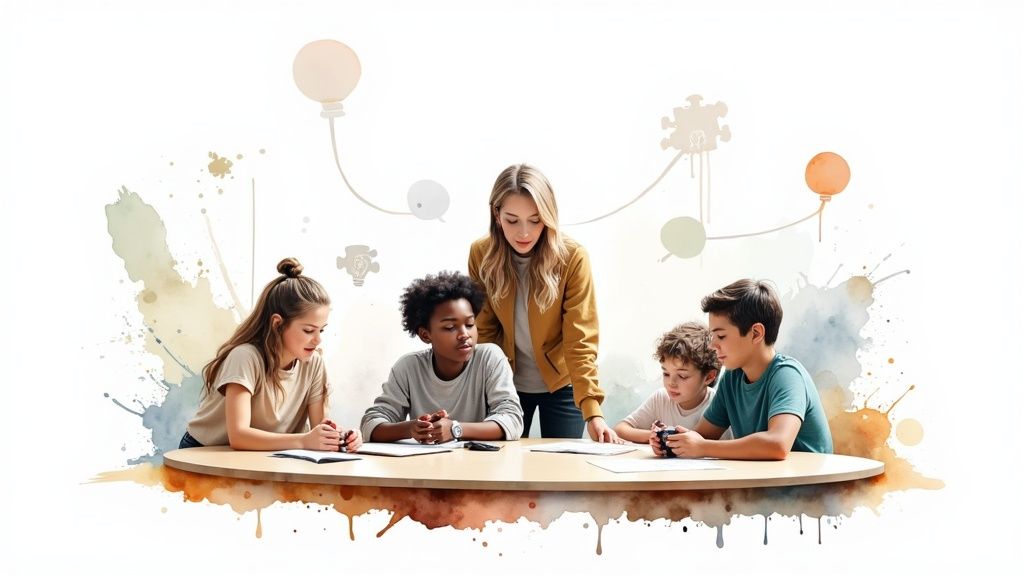
In today’s dynamic educational landscape, keeping students actively involved is more crucial and challenging than ever. The goal extends beyond simply holding attention; it's about fostering deep, meaningful connections to learning that spark genuine curiosity and build lasting knowledge. True engagement transforms learners from passive listeners into active, invested participants who take ownership of their education. When students are engaged, they are more motivated, retain information more effectively, and develop critical thinking skills essential for their academic and future success.
This guide moves directly into practical, evidence-based student engagement strategies that can be adapted for any learning context. We are skipping the long theoretical discussions to provide a comprehensive roundup of actionable techniques. You will find methods tailored for diverse age groups and learning needs, from primary school classrooms to university lecture halls and specialised tutoring sessions.
Inside this article, we will unpack ten powerful approaches, including:
- Active Learning Techniques to get students doing, not just observing.
- Gamification and Game-Based Learning to harness the power of play.
- The Flipped Classroom Model to maximise in-class interaction.
- Collaborative Learning to build teamwork and communication skills.
- Technology Integration using digital tools purposefully.
- Project-Based Learning (PBL) for real-world problem-solving.
- Differentiated Instruction to meet individual student needs.
- Inquiry-Based Learning to cultivate curiosity and self-directed discovery.
- Culturally Responsive Teaching to create an inclusive and relevant environment.
- Formative Assessment and Feedback to make learning a continuous dialogue.
Each strategy is presented with specific implementation details and practical examples, offering a clear roadmap to create a more vibrant, interactive, and effective learning environment. Let's explore the techniques that will unlock your classroom's full potential.
1. Active Learning Techniques
Active learning fundamentally reshapes the traditional classroom by moving away from passive information absorption. Instead of merely listening to a lecture, this approach requires students to actively participate in the learning process. These student engagement strategies involve higher-order thinking tasks such as analysis, synthesis, and evaluation, fostering a much deeper and more permanent understanding of the material.

The core principle is learning by doing. By engaging directly with content through collaborative work, problem-solving, and critical discussion, students construct their own knowledge. This method has been championed by leading education researchers like Eric Mazur and Carl Wieman, whose work demonstrates significant improvements in student outcomes when active learning is implemented effectively.
How to Implement Active Learning
Successfully integrating active learning involves structuring activities that guide students toward learning objectives. Rather than being a free-for-all, these techniques are carefully orchestrated by the educator.
- Think-Pair-Share: Pose a question to the class. Give students a moment to think individually, then have them discuss their thoughts with a partner before sharing with the larger group. This is highly effective in large university lectures and smaller tutorial settings.
- Problem-Based Learning (PBL): Present students with a complex, real-world problem and have them work in groups to find a solution. This is a cornerstone of medical and business school curricula but can be adapted for any subject, from analysing historical events in a Year 10 history class to solving a community issue in a VCE sociology course.
- Peer Instruction: After a brief explanation of a concept, present a multiple-choice question that tests understanding. Students first answer individually (often using clickers or a simple show of hands) and then discuss their reasoning with a neighbour, particularly if their answers differ, before voting again. This technique is excellent for STEM subjects at the university and TAFE levels.
By using these methods, you create an environment where students are accountable for their learning. They are not just receivers of information but active agents in their own education, which is crucial for engaging students who may feel disconnected.
2. Gamification and Game-Based Learning
Gamification and game-based learning transform the educational experience by applying principles of game design to non-game contexts. These student engagement strategies leverage elements like points, badges, leaderboards, and narratives to make learning more interactive and intrinsically rewarding. The goal is to tap into a student’s natural desire for competition, achievement, and social connection.

The core idea is to foster motivation through play. By framing learning as a game, educators can reduce anxiety, increase persistence, and provide immediate feedback. This approach has been popularised by researchers like Jane McGonigal and James Paul Gee, who have extensively documented how game mechanics can enhance engagement and knowledge retention.
How to Implement Gamification and Game-Based Learning
Successfully using gamification involves thoughtfully integrating game elements that support, rather than distract from, learning objectives. The key is to make the experience meaningful and aligned with the curriculum.
- Introduce a Points and Badge System: Award points for completing homework, participating in class, or mastering a new skill. Digital or physical badges can be awarded when students reach certain milestones, providing a tangible sense of accomplishment. This works well from primary school classrooms to TAFE vocational courses.
- Use Interactive Quiz Platforms: Tools like Kahoot! or Quizizz turn formative assessments into exciting, fast-paced competitions. This method is highly effective for reviewing content before an exam in high school subjects like science or history, as the competitive element encourages active recall.
- Incorporate Narrative-Based Challenges: Frame a unit or project as a quest or mission. For instance, a Year 8 English class could embark on a "quest" to analyse a novel, with each chapter's analysis unlocking the next "level". Classcraft is a platform that transforms the entire classroom into a role-playing adventure, suitable for sustained engagement over a term.
By using these methods, you create a dynamic and motivating learning environment. Students become more invested in their progress, seeing learning not as a chore but as a challenge to be overcome, which is a powerful way to boost motivation and engagement.
3. Flipped Classroom Model
The flipped classroom model fundamentally inverts the traditional teaching sequence. Instead of delivering core instructional content during class time, this model provides it to students beforehand, typically through pre-recorded videos, assigned readings, or interactive online modules. This frees up precious classroom time for what truly matters: applying knowledge through hands-on activities, collaborative problem-solving, and in-depth discussions.

The core principle is to shift direct instruction from the group learning space to the individual learning space. This student engagement strategy empowers learners to engage with foundational material at their own pace, while transforming the classroom into a dynamic, interactive environment where the educator acts as a facilitator and guide. Pioneered by educators like Jonathan Bergmann and Aaron Sams, this approach maximises face-to-face time for higher-order thinking and personalised support.
How to Implement a Flipped Classroom
Successfully flipping your classroom requires careful planning to ensure both the out-of-class and in-class components are effective and connected. The goal is to make the pre-class work accessible and the in-class activities meaningful.
- Create Focused Pre-Class Content: Develop or curate short, targeted video lessons (ideally 8-12 minutes) or readings that cover a single concept. Platforms like Khan Academy are excellent resources, but teacher-created content can be more tailored. For example, a Year 11 chemistry teacher could create a short video explaining molar mass calculations for homework.
- Check for Understanding: Embed short quizzes or reflective questions within the pre-class materials. This ensures students engage with the content before class and provides you with valuable data on their comprehension, highlighting areas that may need clarification.
- Design Active In-Class Tasks: Use class time for activities that build directly on the pre-class content. This could involve VCE Physics students working in groups to solve complex circuit problems, or university language students engaging in advanced conversation practice based on grammar concepts they reviewed beforehand.
By flipping the learning environment, you place students in control of the informational component of learning. This allows them to rewind and re-watch as needed, and come to class prepared to engage, question, and apply their knowledge in a supportive, collaborative setting.
4. Collaborative Learning and Group Work
Collaborative learning moves beyond individual effort by structuring activities where students work together to achieve shared goals. This approach emphasises interdependence and mutual accountability, transforming learning into a collective experience. Instead of competing, students pool their knowledge and skills to complete tasks, solve complex problems, and deepen their understanding as a group.

The foundation of this strategy is that students learn through social interaction and peer-to-peer explanation. Prominent educators like David and Roger Johnson have shown that well-organised collaborative environments boost academic achievement, social skills, and self-esteem. It's one of the most effective student engagement strategies for building a supportive classroom community where every member contributes.
How to Implement Collaborative Learning
Effective group work requires careful planning and facilitation from the educator to ensure it is both productive and inclusive. The goal is to create positive interdependence where students recognise they can only succeed together.
- Jigsaw Method: Divide a topic into smaller, manageable sections. Assign each student in a group one section to become an "expert" on. Students then regroup with experts from other teams to discuss their section before returning to their original group to teach their peers. This is highly effective for Year 10 history research projects or VCE English literature analysis.
- Peer Programming: In computer science or coding courses at TAFE or university, two students work together at one computer. One student, the "driver," writes the code, while the other, the "navigator," reviews each line, identifies potential errors, and thinks strategically about the overall direction.
- Literature Circles: Small groups of students in an English class read the same text and then meet to discuss it. Each member is assigned a specific role, such as "Discussion Director," "Word Wizard," or "Summariser," to guide the conversation and ensure all aspects of the text are explored.
To make collaboration successful, it is vital to establish clear group roles and provide both group and individual assessments. This structure ensures every student is accountable and actively participates in the learning process.
5. Technology Integration and Digital Tools
Technology integration involves strategically incorporating digital tools, platforms, and resources into the learning process to enhance engagement. This approach leverages technology not as a novelty but as an integral part of teaching and learning, transforming how students interact with content, collaborate with peers, and demonstrate their understanding. These digital student engagement strategies meet students in the modern world they inhabit.
The core principle is using technology to achieve pedagogical goals that might be more difficult to reach through traditional means. By thoughtfully selecting and applying digital tools, educators can create more dynamic, accessible, and personalised learning experiences. This concept has been advanced by thinkers like Ruben Puentedura, creator of the SAMR model, which guides educators in moving from simple technology substitution to truly redefining tasks.
How to Implement Technology Integration
Successful technology integration is about purpose, not just presence. It requires choosing the right tool for the learning objective and ensuring it genuinely enhances the educational experience rather than complicating it.
- Interactive Presentations and Polling: Utilise tools like Nearpod or Kahoot! to embed quizzes, polls, and collaborative activities directly into a lesson. This is highly effective for maintaining focus and gathering real-time formative assessment data in diverse settings, from a Year 8 science class to a university lecture.
- Collaborative Digital Spaces: Employ platforms like Padlet for virtual brainstorming or Google Classroom for streamlined assignment management and communication. These tools facilitate group work and discussion, allowing students to contribute ideas simultaneously, which is ideal for project-based learning in high school or TAFE courses.
- Video-Based Discussion and Creation: Use tools like Flipgrid, where students respond to prompts with short video recordings. This encourages students who may be hesitant to speak in class to share their thoughts and is a powerful way to practise communication skills for a VCE Media assessment or a university presentation.
By weaving technology into the fabric of a lesson, you provide multiple pathways for students to engage with material, catering to different learning preferences and preparing them for a digitally-driven world.
6. Project-Based Learning (PBL)
Project-Based Learning (PBL) shifts the focus from teacher-led instruction to student-driven inquiry. This dynamic instructional methodology engages students in solving complex, real-world problems or answering intricate questions over an extended period. Instead of memorising facts for a test, students gain knowledge and skills by working to investigate and respond to an authentic, engaging, and multifaceted challenge.
This approach emphasises student agency, collaboration, and critical thinking. The core idea is that learning becomes more meaningful when it is contextualised and applied to tangible outcomes. This philosophy is championed by organisations like PBLWorks (formerly the Buck Institute for Education) and builds upon the progressive education principles of thinkers like John Dewey, who argued that students learn best by doing.
How to Implement Project-Based Learning
Effective PBL is more than just a fun activity; it is a rigorously designed learning experience. The educator acts as a facilitator, guiding students as they navigate the project's complexities from inception to completion.
- Design for Real-World Connection: Frame projects around authentic community needs or genuine challenges. For example, high school science students could design a solution for a local environmental issue, or primary students could plan and create a community garden to address food accessibility.
- Establish Clear Goals and Scaffolding: Begin with a clear driving question and a detailed rubric defining success. Provide structure through regular checkpoints, workshops on necessary skills, and opportunities for feedback. A middle school history class producing a documentary film, for instance, would have deadlines for research, scriptwriting, and editing.
- Incorporate Reflection and Revision: Build in dedicated time for students to reflect on their progress, face challenges, and revise their work. This iterative process is crucial for deep learning and developing resilience. Encouraging students to present their work to an authentic audience, such as a community panel or industry professionals, raises the stakes and makes the learning more impactful.
By using PBL, you create an environment where students see the direct relevance of their education. These student engagement strategies empower learners to apply concepts from various disciplines to create something meaningful, fostering a profound connection to their learning.
7. Differentiated Instruction
Differentiated instruction is a teaching framework that reshapes the one-size-fits-all classroom model. It acknowledges that students have diverse learning needs, interests, and abilities, and tailors instruction accordingly. Rather than expecting every student to learn the same way and at the same pace, this approach provides multiple pathways to mastering content, processing information, and demonstrating understanding.
This strategy is one of the most powerful student engagement strategies because it meets students where they are. The core principle, championed by educators like Carol Ann Tomlinson, is to provide flexibility in what students learn (content), how they learn it (process), and how they show what they have learned (product). This respects individual differences and empowers students by giving them ownership over their learning journey, which significantly boosts motivation and engagement.
How to Implement Differentiated Instruction
Effective differentiation is not about creating 30 unique lesson plans; it's about making strategic adjustments to a core lesson to ensure accessibility and challenge for all learners. The key is proactive planning based on ongoing student assessment.
- Tiered Assignments: Design tasks that focus on the same core concept but have varying levels of complexity, depth, or required support. For example, in a Year 9 science class studying ecosystems, one group might identify food chains in a local habitat, while another analyses the impact of an invasive species, and a third group models the flow of energy through the entire ecosystem.
- Choice Boards: Create a grid of activities (like a tic-tac-toe board) where students must complete a certain number of tasks. The activities are designed to appeal to different interests and learning styles. For instance, a VCE English student studying a novel might choose between writing an analytical essay, creating a podcast episode from a character's perspective, or developing a storyboard for a film adaptation.
- Flexible Grouping: Group students in various ways depending on the task. They might work in mixed-ability groups for collaborative problem-solving, skill-based groups for targeted instruction, or interest-based groups for a passion project. This avoids the static labelling of traditional ability groups and keeps the learning environment dynamic.
By strategically varying the learning experience, you honour the diversity within the classroom. This ensures every student feels seen, challenged, and capable of success, creating a more inclusive and engaged learning community.
8. Inquiry-Based Learning
Inquiry-based learning shifts the classroom dynamic from the educator being the sole source of knowledge to the student becoming an active investigator. This approach centres on students asking questions, exploring topics, and discovering answers for themselves. It transforms learning into an authentic process of investigation, mirroring how scholars and scientists work in the real world.
The core idea is that students develop a deeper and more meaningful understanding when they drive the learning process through their own curiosity. This method has deep roots in the work of educational philosophers like John Dewey and Jerome Bruner, who argued that students learn best by constructing knowledge through experience and exploration.
How to Implement Inquiry-Based Learning
Successful inquiry-based learning requires a supportive environment where curiosity is encouraged and structured guidance is provided. The educator acts as a facilitator, guiding students as they develop their investigative skills.
- Model Questioning: Begin by demonstrating how to formulate powerful, open-ended questions that drive investigation. Instead of asking "When did the Eureka Stockade happen?", model a question like "What factors led ordinary people to participate in the Eureka Stockade?".
- The 5E Model: Use the Engage, Explore, Explain, Elaborate, and Evaluate (5E) model to structure lessons. This is particularly effective in primary and high school science, where students can first explore a phenomenon (e.g., watching ice melt) before the scientific explanation is introduced.
- Student-Led Investigations: Empower students to pursue their own lines of inquiry within a curriculum topic. A Year 11 English student might analyse a novel based on their own questions about its themes, while a primary student could design a simple experiment to test a hypothesis about plant growth.
By fostering this investigative mindset, you equip students with critical thinking and problem-solving skills. These student engagement strategies make learning profoundly personal and empower students to take ownership of their education, a key principle of interest-based learning.
9. Culturally Responsive Teaching
Culturally Responsive Teaching is a powerful pedagogical approach that makes learning more relevant and effective by connecting curriculum content to students' cultural backgrounds, experiences, and perspectives. This strategy moves beyond simple multicultural celebrations to fundamentally reshape the learning environment, acknowledging that culture is a critical filter through which students process information and engage with the world.
The core principle is to validate and affirm students' cultural identities within the classroom. By building a bridge between students' home life and school, educators can foster a sense of belonging and create more meaningful learning experiences. This method has been championed by prominent education scholars like Gloria Ladson-Billings and Geneva Gay, whose work highlights its role in increasing student motivation, participation, and academic achievement.
How to Implement Culturally Responsive Teaching
Successfully applying this approach involves intentionally designing a learning environment that reflects and respects student diversity. It requires educators to be learners themselves, actively seeking to understand the cultural contexts of their students.
- Incorporate Diverse Perspectives: Move beyond a single-narrative curriculum. In a Year 11 English class, this could mean analysing texts by First Nations authors alongside the traditional canon. In a primary school science unit, it might involve exploring traditional Indigenous ecological knowledge.
- Connect to Lived Experiences: Frame new concepts within contexts that are familiar to students. When teaching financial mathematics in a VCE or HSC class, use examples that reflect the diverse economic realities and community practices of your students, rather than relying on generic scenarios.
- Build Strong Relationships: Make a genuine effort to learn about your students' families, traditions, and communities. This creates trust and demonstrates that their identity is valued. This is particularly effective for engaging students from diverse backgrounds in TAFE and university settings who may feel disconnected from the institution.
By using these methods, you create an inclusive classroom where students see themselves and their communities reflected in their education. This validation is a cornerstone of effective student engagement strategies, making students feel seen, heard, and respected as active participants in their learning journey.
10. Formative Assessment and Feedback Strategies
Formative assessment moves beyond end-of-unit exams to an ongoing, interactive evaluation process. Unlike summative assessments that judge final learning, these strategies monitor student understanding during the instructional journey. This allows educators to provide immediate, targeted feedback and adjust their teaching in real-time, making it one of the most powerful student engagement strategies available.
The core principle is assessment for learning, not just of learning. By continuously checking for understanding, educators can pinpoint misconceptions and address learning gaps before they become significant obstacles. This approach has been extensively researched and popularised by education experts like Dylan Wiliam and Paul Black, whose work highlights its profound impact on student achievement and confidence.
How to Implement Formative Assessment
Effective formative assessment is about creating a classroom culture where feedback is a natural part of the learning dialogue. The goal is to gather information that guides the next steps for both the student and the teacher.
- Exit Tickets: At the end of a lesson, ask students to answer one or two quick questions on a slip of paper or digital form. These questions can check comprehension of a key concept, such as "What was the most important thing you learned today?" or "What part of today's lesson is still confusing?"
- Real-Time Polling: Use digital tools like Mentimeter or simple methods like a show of hands to gauge understanding of a concept instantly. This is highly effective in large lectures at university or TAFE and can be easily adapted for any VCE or HSC classroom setting.
- Peer Assessment: Structure activities where students provide constructive feedback on each other's work against a clear rubric. This not only lightens the teacher's marking load but also helps students develop critical thinking skills and a deeper understanding of the success criteria.
- Learning Journals: Encourage students to maintain a journal where they reflect on their learning progress, challenges, and goals. This is a fantastic tool for self-assessment and metacognition, particularly for senior school students preparing for major exams.
By using these techniques, you transform assessment from a dreaded event into a supportive and engaging process. It helps students become active participants in their learning journey, a key distinction between the informal and formal assessment methods.
Student Engagement Strategies Comparison
| Item | Implementation Complexity | Resource Requirements | Expected Outcomes | Ideal Use Cases | Key Advantages |
|---|---|---|---|---|---|
| Active Learning Techniques | Moderate to high (prep and space) | Flexible classroom space, instructor prep time | Improved retention, critical thinking, motivation | Small to medium classes, diverse learners | Enhances engagement, immediate feedback, diverse methods |
| Gamification and Game-Based Learning | High (design and tech support) | Technology infrastructure, development time | Increased motivation, engagement, progress tracking | Tech-savvy students, digital platforms | Fun, immediate rewards, fosters competition & collaboration |
| Flipped Classroom Model | High (content creation upfront) | Reliable technology, digital content production | Maximized classroom interaction, personalized pacing | Courses with online access, self-motivated students | Efficient use of class time, flexibility, peer collaboration |
| Collaborative Learning and Group Work | Moderate (group setup and monitoring) | Time for organizing groups, ongoing facilitation | Enhanced teamwork, communication, deeper understanding | Cooperative tasks, skill development | Builds interpersonal skills, peer learning, engagement |
| Technology Integration and Digital Tools | High (tech investment and training) | Hardware, software, technical support | Increased engagement, personalized learning, digital literacy | Any setting with tech access | Access to resources, collaboration, adaptive learning |
| Project-Based Learning (PBL) | High (planning and management) | Time-intensive prep, diverse materials | 21st-century skills, motivation, real-world application | Long-term projects, interdisciplinary topics | Authentic learning, motivation, critical thinking |
| Differentiated Instruction | High (planning multiple paths) | Varied materials, assessment tools | Meets diverse needs, increased engagement, academic growth | Mixed-ability classrooms, inclusive education | Personalized learning, inclusivity, student ownership |
| Inquiry-Based Learning | Moderate to high (facilitation) | Research resources, scaffolding materials | Critical thinking, motivation, research skills | Science, social studies, exploration-driven courses | Encourages curiosity, deep understanding |
| Culturally Responsive Teaching | Moderate to high (ongoing learning) | Diverse resources, community engagement | Increased engagement, improved outcomes for diverse students | Diverse classrooms, equity-focused education | Validates culture, inclusivity, global awareness |
| Formative Assessment and Feedback Strategies | Moderate (consistent application) | Assessment tools, data management systems | Improved learning through timely feedback and adjustment | All classrooms focused on ongoing improvement | Enhances motivation, guides instruction, self-regulation |
Bringing It All Together: Your Next Steps in Student Engagement
We have journeyed through a comprehensive collection of ten powerful, evidence-based student engagement strategies. From the dynamic, hands-on nature of Active Learning and Project-Based Learning to the modern integration of Technology and Gamification, it's clear there is no single "magic bullet" for capturing a student's attention. Instead, true engagement is a carefully woven tapestry of different approaches, tailored to the specific needs of the learners in the room.
The core message threading through each strategy, whether it’s the Flipped Classroom, Collaborative Learning, or Inquiry-Based Learning, is the shift from passive reception to active participation. Students are no longer just spectators in their education; they are the central actors. This requires a fundamental change in perspective, moving towards a classroom culture where curiosity is celebrated, collaboration is encouraged, and learning is made visible and relevant.
Key Takeaways for Your Toolkit
Reflecting on the strategies discussed, several crucial themes emerge. These are the foundational principles that will make your implementation successful:
- Student Agency is Paramount: The most effective student engagement strategies empower learners with choice and a sense of ownership over their educational path. This could be as simple as choosing a topic for a project or as complex as co-designing a rubric for assessment.
- Relevance Drives Motivation: Students engage deeply when they can see the connection between what they are learning and the world outside the classroom. Strategies like Project-Based Learning and Culturally Responsive Teaching are built on this very principle.
- Feedback is Fuel: The consistent, timely, and constructive feedback loop provided by Formative Assessment is not just an evaluation tool; it is a powerful engagement mechanism. It shows students you are invested in their progress and provides them with a clear path forward.
- Differentiation is Non-Negotiable: Recognising that every student learns differently is the cornerstone of an inclusive and engaging environment. Differentiated Instruction ensures that every learner, from a primary school student with dyslexia to a high-achieving VCE student, can access the curriculum and feel successful.
Your Actionable Next Steps
Feeling inspired but overwhelmed? The key is to start small and build momentum. You don't need to revolutionise your entire teaching approach overnight.
- Select One Strategy: Choose one technique from this list that resonates with you and feels achievable. Perhaps you could introduce a simple "think-pair-share" activity (Active Learning) or use a digital polling tool like Kahoot! (Technology Integration) as a lesson starter.
- Plan and Implement: Dedicate a small amount of time to planning how you will introduce this new strategy. Explain the "why" to your students so they understand the purpose behind the new activity.
- Gather Feedback and Reflect: After trying the new strategy, ask students for their honest feedback. What did they enjoy? What was confusing? Use this insight, along with your own observations, to refine your approach for next time.
- Iterate and Expand: Once you feel comfortable with one new technique, you can begin to layer in another or explore a more complex strategy like the Flipped Classroom model.
Embracing these student engagement strategies is more than just about creating a more lively classroom or improving academic results. It’s about cultivating a genuine love of learning. It’s about equipping students with the critical thinking, collaboration, and problem-solving skills they need to thrive in an ever-changing world. By fostering an environment of active, meaningful participation, you are not just teaching a subject; you are empowering a generation of confident, capable, and lifelong learners.
If you're seeking to apply these powerful strategies in a personalised, one-on-one setting to help a student reach their full potential, Evergreen Tutoring Services can help. Our expert tutors specialise in creating customised learning plans that incorporate these very techniques to boost confidence and understanding. Discover how targeted support can transform a student's learning journey at Evergreen Tutoring Services.