Welcome to the world of home education.When you decide to find a homeschooling curriculum in Australia, you’re not just choosing books and lesson plans. You’re taking the first step toward creating an entire education that fits your child like a glove. This isn't about recreating a school classroom at your kitchen table; it's about making a deliberate choice to nurture a genuine love for learning in a flexible, personalised way.
Why More Australian Families Are Choosing to Homeschool
The decision to homeschool is always a deeply personal one. It usually comes from a strong desire to offer something more than the standard one-size-fits-all model of traditional schooling. Families are drawn to home education for all sorts of reasons, but the common thread is a commitment to putting their child's wellbeing and curiosity first. And this educational shift is gaining some serious momentum across the country.
Homeschooling in Australia has seen a huge surge in recent years, with the number of families choosing this path more than doubling over the last five years. As of early 2025, it’s estimated that around 45,000 students are registered as homeschooled nationwide. This growth is significant. Take New South Wales, for example, which recorded 12,359 registered students in January 2023—a massive 37% rise from the year before. You can explore more data on this home schooling surge and what’s driving it.
The Driving Forces Behind the Homeschooling Movement
So, what’s really behind this growing trend? The motivations are as unique as the families themselves, but a few common themes keep popping up. At its core, parents are looking for an educational path that better aligns with their values and, most importantly, their child’s specific needs.
Here are some of the key reasons:
-
Educational Flexibility: The freedom to let your child dive deep into a topic they’re passionate about or, conversely, to spend extra time on a subject they find tricky.
-
Personalised Learning: The ability to craft lessons that fit a child’s individual learning style, whether they learn best by doing (kinesthetic) or by seeing (visual).
-
Nurturing Environment: Providing a safe, supportive space for children who might find the social dynamics of a traditional school, including bullying, a real struggle.
-
Values Alignment: The chance to weave family values, beliefs, or a specific educational philosophy—like the Charlotte Mason method—right into the fabric of daily learning.
For many, homeschooling isn't really about rejecting the school system. It's about embracing a more organic, child-led approach to education. It’s about swapping out rigid schedules for a natural rhythm that lets curiosity, play, and real-world learning all happen together.
Think of this guide as your complete roadmap for the journey ahead. We’re here to help you make sense of the state-specific regulations, compare different curriculum styles, and show you how to blend different resources to build a program that’s both enriching and effective. This is the first step on what can be an incredibly rewarding adventure, giving you the confidence you need to get started and truly thrive.
Understanding Homeschooling Regulations by State
When you decide to homeschool in Australia, your first step isn’t picking a curriculum or setting up a classroom. It starts with understanding the local rules of the road. Australia doesn’t have a single, national set of regulations for home education. Instead, each state and territory has its own unique requirements.
Think of it like getting a driver's licence. The goal is the same everywhere—to ensure safety—but the tests, paperwork, and renewal processes are different in New South Wales than they are in Western Australia. It’s the same with homeschooling; your legal obligations depend entirely on your postcode. This might sound intimidating, but it’s really just about knowing what your local authority needs from you.
Homeschooling in Australia is a regulated space, which means parents need to work with their state or territory education authority. The process typically involves registering your intent to homeschool, submitting a detailed educational plan, and keeping records to show your child's progress. These steps ensure that home education meets a high standard, often aligned with the state or national curriculum frameworks. You can discover more about these legal homeschooling requirements to see how they apply in your area.
Core Requirements Across Most States
While the nitty-gritty details change from state to state, the basic structure for registration and monitoring is surprisingly similar. Get your head around these core pillars, and you'll be well-prepared, no matter where you live.
Generally, you'll need to focus on three key areas:
-
Registration: This is your official application to start homeschooling. You’ll notify the state’s education department and provide them with the initial details about your family and your intention to educate your child at home.
-
Educational Plan: This is the heart of your application. It’s a document that outlines what you plan to teach (your curriculum), how you’ll teach it (your methods and resources), and how you’ll track progress.
-
Reporting and Reviews: Most states require some form of ongoing check-in. This could be an annual report, a portfolio of work samples, or a meeting with a state representative to chat about your child’s learning journey.
This image really captures how modern families can blend different resources to meet their state's requirements.
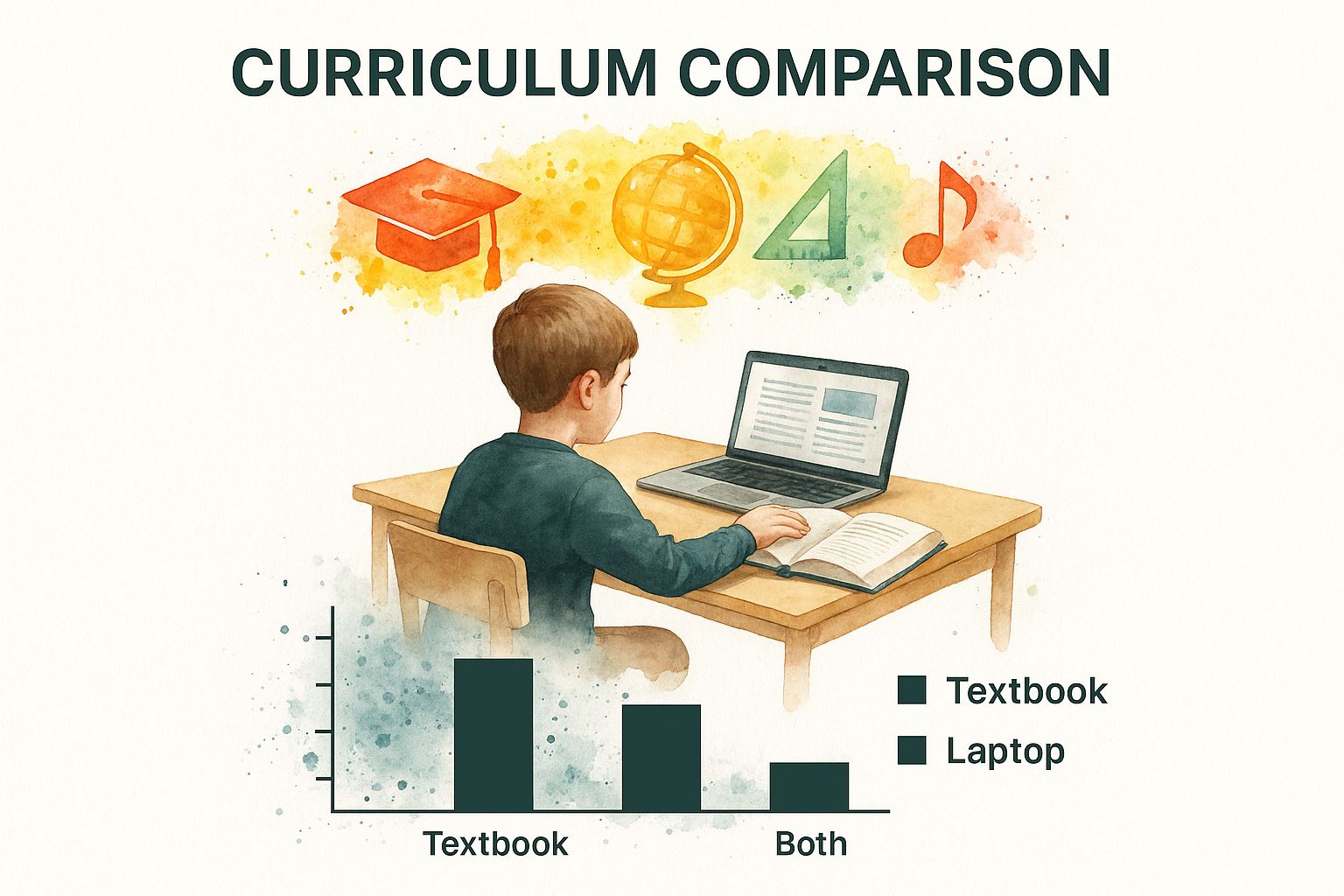
Today's homeschooling is often a dynamic mix of textbooks, online programs, and hands-on projects, all chosen to create a rich and compliant educational experience for your child.
To give you a clearer picture, this table shows how the rules can differ across some of Australia's major states.
State Homeschooling Regulation at a Glance
|
State/Territory |
Governing Body |
Key Registration Requirement |
Ongoing Reporting |
|---|---|---|---|
|
New South Wales |
NSW Education Standards Authority (NESA) |
Detailed application mapping to K-10 syllabus outcomes. |
Regular reviews and potential home visits. Initial registration is for 1 year. |
|
Victoria |
Victorian Registration and Qualifications Authority (VRQA) |
Learning plan covering 8 key learning areas. |
Annual review to ensure a “regular and efficient” education. |
|
Queensland |
Home Education Unit (HEU) |
Application with a summary of the planned educational program. |
Submission of an annual report demonstrating the child’s progress. |
While this table is a great starting point, always check with the specific governing body for the most current and detailed information.
A Quick Look at State Differences
As you can see, the flavour of regulation changes depending on where you are. Here’s a little more on what that looks like in practice.
New South Wales (NSW)
The NSW Education Standards Authority (NESA) asks for a detailed application where you map your educational program against their K-10 syllabus outcomes. Initial registration is for one year, but you may get a longer registration period after that.
Victoria (VIC)
In Victoria, the Victorian Registration and Qualifications Authority (VRQA) wants to see that you're covering eight key learning areas. You’ll submit a learning plan and have a fair bit of flexibility in how you structure it, as long as you can show you’re providing a regular and efficient education.
Queensland (QLD)
The Home Education Unit (HEU) in Queensland requires an application with a summary of your planned program. From there, you just need to submit an annual report showing your child's progress, giving you a bit more day-to-day autonomy.
The key thing to remember is this: your state authority isn’t there to catch you out. Their job is to make sure every child is getting a quality education. Your role is simply to show them, through clear planning and good records, that you are providing just that.
If you approach this process with a bit of organisation and a cooperative mindset, it becomes a manageable—and even empowering—part of your homeschool journey. It forces you to think deeply about your educational goals, which is a fantastic foundation for success.
Finding Your Homeschooling Philosophy
Before you even think about buying a single textbook or signing up for an online program, it’s worth pausing to ask a really important question: what do you want learning to feel like for your family? This is the heart and soul of your homeschooling philosophy.
It's the compass that guides your daily decisions and makes sure your approach truly fits your family’s values and, most importantly, your child's personality. Choosing a homeschooling curriculum in Australia without a clear philosophy is a bit like building a house without a blueprint. You might end up with four walls and a roof, but it probably won’t feel like the home you were dreaming of. When you define your philosophy first, you’re laying a strong foundation that makes every other choice so much clearer.
What Does Your Ideal Learning Day Look Like?
Take a moment and picture your perfect homeschool day. Is it organised and predictable, with clear blocks of time for maths and English, much like a regular school? Or is it more of a free-flowing adventure, where a question about a backyard spider spirals into an afternoon of research, sketching, and watching documentaries?
Neither is right or wrong. Your answer simply points you toward a particular style. Let's walk through some of the most common approaches to help you find your fit.
The School-at-Home Approach
This is often the most familiar starting point for new homeschoolers. It involves using a comprehensive, all-in-one curriculum that structures your day much like a classroom. It’s organised, covers all the required subjects, and usually lines up nicely with the Australian National Curriculum.
The Charlotte Mason Method
This beautiful philosophy is all about creating a gentle, rich learning environment. It swaps out dry textbooks for "living books"—engaging, narrative-driven stories—and fills the days with nature study, art appreciation, and music. The focus is on short, focused lessons and building good character habits.
Unschooling
This approach is completely child-led. It works on the principle that kids are born curious and will naturally learn what they need to, right when they're ready. Learning isn't scheduled; it happens organically through everyday life, play, and diving deep into their personal interests.
The Eclectic Approach
This is probably the most popular method you’ll find in Australia. It’s essentially a pick-and-mix style where you blend elements from different philosophies and resources to create a custom-fit education for your child.
Think of an eclectic homeschooler as a curriculum DJ. They might grab the best maths program from one provider, a literature-rich history course from another, and add in a hands-on science kit they found online. They’re mixing and matching the best "tracks" to create the perfect educational playlist for their child.
From Philosophy to Practice
Once you have a feel for which philosophy resonates with you, you can start looking at resources with a much clearer vision. A family leaning towards Unschooling, for instance, is more likely to invest in museum memberships and tools that support their child's passions, rather than a structured, boxed curriculum.
This is where the real magic of interest-based learning comes into play. When a child’s education is built around what genuinely fascinates them, their motivation skyrockets. Learning becomes a joyful discovery, not a chore. You can find out more about how to bring this to life in our guide to interest-based learning, which is packed with practical tips.
Remember, your philosophy isn’t set in stone. It will likely grow and shift as your children do. The goal is simply to start with a direction that feels authentic to your family, giving you the confidence to build a learning life you all love.
Top Homeschooling Curriculum Providers in Australia
Once you’ve got a clear picture of your educational philosophy, it’s time to dive into the amazing tools available to bring it to life. Choosing a homeschooling curriculum in Australia can feel a bit like standing in a lolly shop—there are so many colourful options, and figuring out which one is right for your family can be a little overwhelming. But the good news is, this variety is your biggest asset, giving you the freedom to find the perfect match.
This section is more than just a list of names. We'll explore some of the most respected and popular curriculum providers out there, looking at their core approach, the format they use, typical costs, and how much hands-on parent involvement is required. We'll cover everything from comprehensive "all-in-one" programs to more specialised resources.
Australian-Based Curriculum Providers
Many families naturally lean towards a curriculum built specifically for the Australian context. These providers design their programs around the Australian National Curriculum, which can make the registration and reporting process much smoother in most states. They have a deep understanding of the local educational landscape and often weave in Australian history, geography, and literature.
Here are a few of the most popular Australian providers getting a lot of attention:
-
My Homeschool: A real favourite for families who love the Charlotte Mason philosophy. It offers a structured yet gentle approach that uses "living books," nature study, and art to create a rich learning environment. It’s a complete curriculum from Kindergarten to Year 10 and is fully mapped to the Australian Curriculum outcomes, which makes reporting a breeze.
-
Euka: You might know this one by its old name, Complete Education Australia (CEA). Euka provides a flexible, all-in-one online curriculum designed to be child-led, so students can truly work at their own pace. It covers all the core subjects with interactive lessons, assessments, and teacher support, making it a great choice for parents who want structure but also need adaptability.
-
Simply Homeschool: This provider offers a much more relaxed, "living books" style of learning. It’s less like a traditional school-at-home program and is geared more towards delight-directed learning. They give you easy-to-follow weekly plans that are also highly customisable, which is perfect for families wanting a gentle start or a more eclectic approach.
For a bit of background, you can take a look at the official Australian Curriculum website, which is the framework that many of these providers build upon.
This framework is what outlines the learning all young Australians are entitled to, and using a curriculum that aligns with it ensures you're ticking all the right boxes.
Popular International Curriculums
Sometimes, the best fit for your family's approach might actually be an international program. Plenty of American and British curriculums are popular here in Australia and can be adapted quite easily to meet local registration requirements.
Think of it this way: your state registration asks you to show learning in areas like "English," "Mathematics," and "Science." A quality international curriculum will absolutely cover these subjects in depth. You just need to connect its content to your state's specific language and outcomes in your learning plan.
Some highly-regarded international options include:
-
The Good and the Beautiful: A US-based curriculum well-known for its strong Christian values, beautiful artwork, and focus on character development. It’s very literature-heavy and cleverly integrates subjects like art and geography right into its language arts units.
-
Khan Academy: While it’s not a full, standalone curriculum, this free online platform is a priceless resource for maths and science. Its video lessons and practice exercises are fantastic for supplementing any homeschooling style.
Finding the right blend of resources is really the secret. Even with a brilliant comprehensive curriculum, a child might still hit a wall with a particular subject. When that happens, targeted support can make all the difference. For families who feel they need dedicated, one-on-one assistance, exploring options for homeschool tutoring in Australia can provide that specialised focus to help your child truly master tricky topics and thrive.
How to Build a Custom Curriculum for Your Child
One of the greatest joys of home education is having the power to move beyond a one-size-fits-all model. Instead of just picking a single program off the shelf, you get to build a learning experience that truly celebrates your child’s unique spark, interests, and natural rhythm. This is where the magic of ‘eclectic homeschooling’ really shines.
Think of yourself less as a traditional teacher and more as an educational designer. Your job is to pick and choose the very best elements from different sources to create a rich, cohesive, and deeply personal learning journey. This approach allows you to build a homeschooling curriculum in Australia that not only meets state requirements but, more importantly, genuinely inspires your child.
Starting With a Strong Core
Even the most creative custom curriculum needs a solid foundation. Most families find it easiest to start by choosing a strong, reliable resource for the non-negotiables like mathematics and literacy. This gives you a clear structure and some peace of mind, knowing you're definitely covering those essential skills.
From that solid base, you can start to weave in other resources. This "core and supplement" strategy offers the perfect balance between structure and freedom.
You’re not just buying a curriculum; you're curating a collection of learning tools. This mindset shift is the key to building a program that bends and adapts to your child, rather than forcing your child to adapt to a rigid program.
For instance, you might use a structured online maths program but opt for a literature-based approach for English, using engaging "living books" instead of dry textbooks. This kind of blend is exactly what makes eclectic homeschooling so powerful and popular.
Weaving a Rich Learning Tapestry
Once your core subjects are sorted, the real fun begins. This is where you can layer in resources and activities that reflect your child’s passions and your family’s values. The goal isn't just to tick off a checklist of subjects, but to create a vibrant tapestry of learning.
Here are a few practical ways to enrich your custom curriculum:
-
Hands-On Projects: Does your child love to build? Turn that into a lesson by getting them to design a model bridge to learn about physics and engineering.
-
Nature Study: Regular walks can easily become lessons in biology, meteorology, and even art. A simple nature journal is a brilliant tool for observation, drawing, and scientific documentation.
-
Digital Tools: Make the most of educational apps, documentaries, and online platforms like Khan Academy to supplement tricky topics or explore new interests in more depth.
-
Gameschooling: Board games and card games are fantastic for developing skills in maths, logic, and strategic thinking without your child even realising they're "doing school."
This process lets you respond directly to your child’s curiosity. If a trip to the museum sparks an obsession with ancient Egypt, you have the freedom to pause your planned history lessons and dive deep into pyramids and pharaohs for a few weeks. It's about following their lead.
Adapting for Unique Learners
A custom curriculum is also an incredible asset for children who need a different approach to learning. Being able to tailor materials is absolutely essential for both gifted learners and children with special needs.
For a child who grasps concepts quickly, you can source more advanced materials or design complex projects that really challenge them. For a child who needs more support, you can slow the pace, bring in more hands-on activities, and find resources specifically designed for their learning style.
Ultimately, building a custom curriculum is about being a responsive and observant educator. You get to watch what lights your child up and give them the tools they need to explore, learn, and grow in a way that feels authentic and joyful.
Common Homeschooling Questions Answered
Starting out with home education always brings a wave of questions. It's totally normal to wonder about the nitty-gritty details, from how much it all costs to whether your child can still get into uni. This section tackles the most common queries we hear from Australian families, giving you clear, straightforward answers so you can feel confident moving forward.
Think of these as the final checks on your map before you set off. Once these practicalities are sorted, you can get back to the exciting part—creating a rich and joyful learning life for your child.
How Much Does It Cost to Homeschool in Australia?
The budget question is often top of mind for families, and the answer is: it really depends. The cost of providing a homeschooling curriculum in Australia can vary wildly depending on the path you take. But that's not a bad thing; it's one of homeschooling's greatest strengths.
If you opt for a "school-at-home" model with a comprehensive, all-in-one curriculum, you might be looking at $1,000 to $3,000+ per child each year. These packages are convenient and structured, typically including all the textbooks, lesson plans, and support materials you'll need.
On the other end of the spectrum, an eclectic or unschooling approach that pulls from libraries, free online resources, and real-world experiences can be incredibly low-cost. Most families find a sweet spot in the middle, budgeting between $500 and $1,500 per child. This usually covers quality resources for core subjects like maths, a few online subscriptions, and plenty of materials for hands-on art and science projects.
It's also worth remembering the 'hidden' costs of school you might already be paying. Things like extracurricular sports, music lessons, art supplies, and museum memberships can now be woven directly into your homeschool budget.
Do I Need a Teaching Degree to Homeschool?
This is a big one, and the answer is a firm and reassuring no. You don't need a teaching degree or any formal qualifications to homeschool your child in any Australian state or territory. The regulators aren't focused on your credentials; they care about your ability to provide a great learning environment and follow an educational plan.
The most important qualifications you have are your dedication, your organisational skills, and your deep, firsthand knowledge of your child's personality and needs. You’ve always been their first and most important teacher.
Many curriculum providers get this, designing their materials specifically for parents. Their programs often come with detailed teacher's guides, scripts, and extra support to give you the confidence to teach any subject. And if you ever feel you need a bit of backup, you can explore professional support. For instance, learning more about tutoring for homeschool students can show you how targeted, one-on-one help can fill any gaps and give your child an extra boost.
How Do Homeschooled Children Socialise?
Ah, the socialisation question—probably the most famous myth about homeschooling! The truth is, socialisation for homeschooled kids is often more deliberate, varied, and rich than what happens by chance in a schoolyard.
Instead of being limited to a single group of kids all the same age, homeschooled children regularly interact with a diverse mix of people in real-world situations.
Here are just a few ways they connect:
-
Homeschooling Co-ops and Groups: Local families organise these for group lessons, park days, excursions, and shared projects.
-
Community Activities: Signing up for local sports teams, drama clubs, music ensembles, Scouts, or art classes is a fantastic way to build friendships.
-
Volunteer Work: Getting involved in community service helps children develop empathy and connect with people from all walks of life.
-
Interest-Based Clubs: Whether it’s a coding club, a book group, or a robotics team, these activities bring kids together with peers who share their passions.
For a homeschooled child, socialisation is all about the quality and diversity of their interactions, not just the quantity.
Can My Homeschooled Child Go to University?
Absolutely. There are multiple, well-trodden paths to university for homeschooled students all across Australia. Finishing your education at home doesn't close any doors to tertiary study; it just means you might take a slightly different route to get there.
It’s a good idea to start thinking about this early and look into the specific entry requirements for the universities your child is interested in.
These are the most common pathways:
-
Enrolling for an ATAR: Some students choose to enrol in a distance education school for Years 11 and 12 to follow a traditional path and get an Australian Tertiary Admission Rank (ATAR).
-
Alternative Entry Pathways: Many universities have alternative entry schemes that look at portfolios of work, interviews, or results from the STAT (Special Tertiary Admissions Test).
-
TAFE or VET Qualifications: Completing a Certificate IV or Diploma through TAFE or another VET provider is a popular and effective pathway into many university degrees.
-
University Bridging Courses: Most unis offer foundation studies or bridging courses that prepare students for undergraduate study and often guarantee entry into certain degrees once completed successfully.
With a bit of planning, homeschooled students are more than ready to make a successful transition into higher education and whatever lies beyond.
At Evergreen Tutoring Services, we understand that every child's learning journey is unique. Our one-on-one personalised tutoring provides the dedicated support your family needs, whether you're navigating the core curriculum, preparing for exams, or exploring special interests. Find out how our expert tutors can enrich your homeschooling experience at https://www.evergreentutoringservices.com.au.