Navigating the pressures of the HSC is a defining challenge for many students, and HSC tutoring online has emerged as a powerful tool for gaining a competitive edge. It offers a flexible, accessible, and highly personalised way to get expert help, fitting specialist support directly into a packed study schedule and busy family life.
Why Online HSC Tutoring Is a Game-Changer
The shift towards online learning has fundamentally changed how students prepare for their final exams. It’s no longer just about getting homework help; it’s about accessing a comprehensive support system designed specifically for the high-stakes environment of the Higher School Certificate.
This move away from traditional, in-person sessions opens up a world of possibilities that were previously out of reach for many families.
Gone are the days of being limited to tutors in your local area. With online platforms, your geographic location is no longer a barrier. A student in regional NSW can connect with a specialist Physics tutor from Sydney who has a proven track record with the NESA syllabus. This access to a wider pool of specialised educators is one of the most significant advantages.
Unmatched Flexibility and Convenience
The demands of Year 12 are intense. School, assignments, extracurriculars, and a social life all compete for time, and it's a real balancing act. Online tutoring fits seamlessly into this dynamic schedule.
Sessions can be booked for evenings, weekends, or even during a study period, completely eliminating travel time and the logistical stress of getting to and from a physical tutoring centre. A one-hour session is exactly that—one hour of focused work, not an hour plus thirty minutes of travel on either side. This efficiency is crucial when every minute counts.
Personalised Learning Paths
Modern online tutoring platforms are far more than just video calls. They are genuinely interactive learning environments. Many services now offer fantastic tools like:
- Digital Whiteboards: Tutors and students can collaborate on maths problems or annotate essays in real-time, just as they would side-by-side.
- Session Recordings: Students can re-watch entire sessions to review complex concepts before an exam, reinforcing their understanding at their own pace.
- Resource Libraries: Easy access to practice exams, study notes, and video tutorials provides a wealth of supplementary material right at their fingertips.
This data provides a snapshot of the results seen with online tutoring, showing not just grade improvement but high student satisfaction. The data suggests that students are not only performing better but also genuinely value the flexible and effective support they receive.
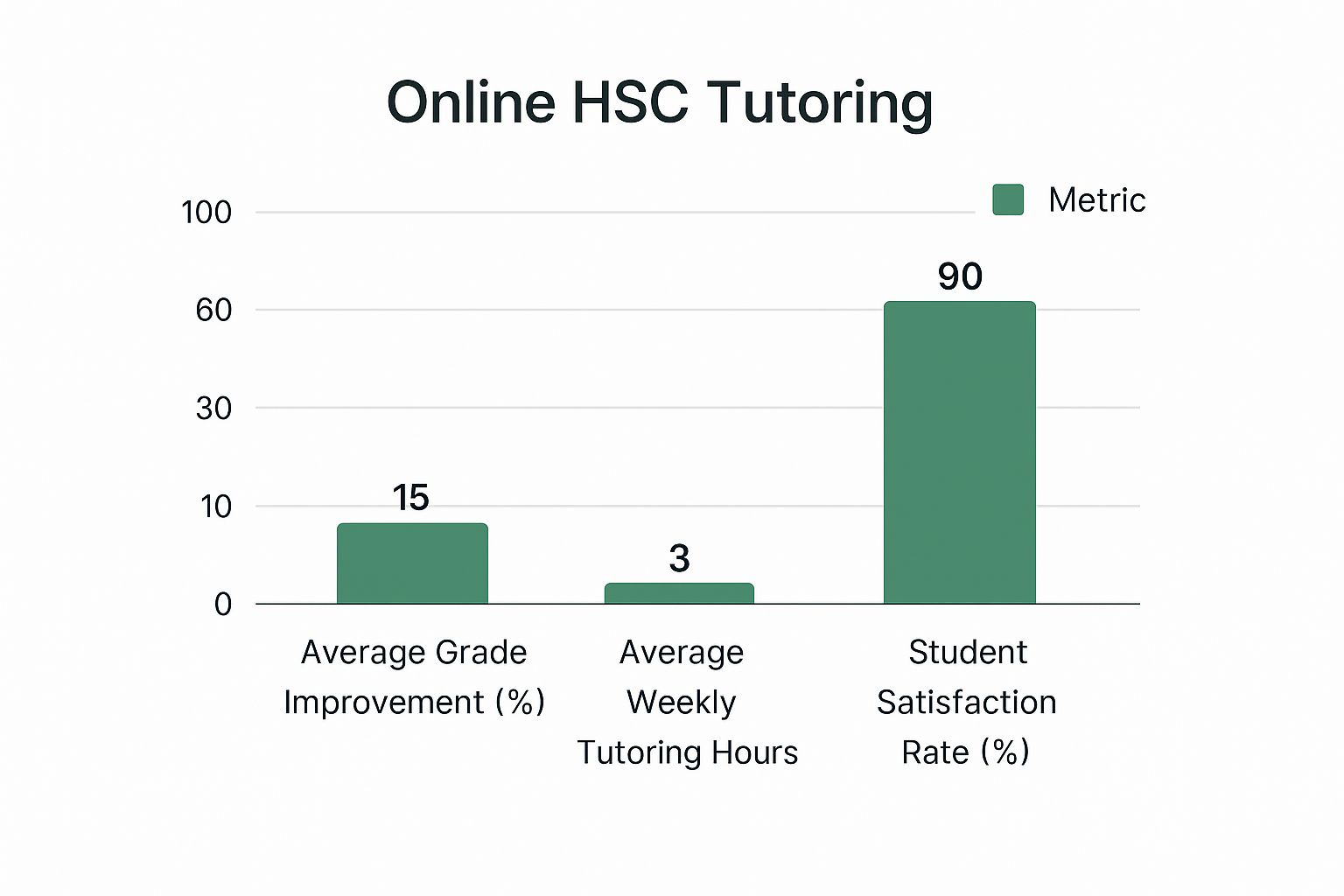
The high satisfaction rate here is telling. It indicates that the convenience and personalised nature of online support strongly resonate with students managing the unique pressures of the HSC.
Online vs In-Person Tutoring At a Glance
To help you weigh the options, here's a quick comparison of the key differences between online and traditional in-person tutoring.
| Feature | Online Tutoring | In-Person Tutoring |
|---|---|---|
| Convenience | Highly flexible scheduling, no travel required. | Fixed schedule, requires travel to a specific location. |
| Tutor Access | Access to specialists from anywhere in Australia. | Limited to tutors available in your local area. |
| Resources | Digital whiteboards, session recordings, online libraries. | Physical materials like textbooks and worksheets. |
| Cost | Often more cost-effective due to lower overheads. | Can be more expensive due to travel and facility costs. |
| Environment | Learning from the comfort and familiarity of home. | Structured learning environment at a centre or home. |
While both methods have their merits, online tutoring clearly excels in flexibility and access to a broader range of expert educators, which can be a deciding factor for HSC success.
A Growing Trend Across Australia
The move to academic support is not a small-scale phenomenon. The tutoring industry in Australia was valued at over $1.2 billion in 2020, with projections showing significant continued growth. It's estimated that by 2025, approximately one in seven Australian high school students will be receiving some form of tutoring—a clear signal of its increasing importance in our education system.
This growth is powered by the effectiveness and accessibility of online platforms. They break down traditional barriers, making it easier for students to get the specific help they need to master challenging subjects and build exam confidence.
The evolution of these services has been remarkable. What began as a simple alternative to in-person meetings has become a sophisticated ecosystem. Many providers now offer personalised learning plans, track student progress, and provide detailed feedback that helps pinpoint exact areas for improvement. You can learn more about the specific benefits of online tutoring in our detailed guide. This targeted approach ensures that every session is productive and directly contributes to achieving a student's desired ATAR.
Pinpointing Your Exact Tutoring Needs

Before you even start Googling for HSC tutoring online, taking a moment for a clear-eyed self-assessment will make your search infinitely more effective. Jumping in without a plan is a bit like driving without a destination – you’ll burn a lot of fuel and might end up somewhere, but probably not where you intended.
Understanding exactly where the academic pressure points are is the first, most crucial step. This clarity ensures you find a service that offers targeted support right where you need it, not just generic help.
Identify Your Subject-Specific Challenges
You need to get granular here. Simply saying, "I need help with Maths" is far too vague to be useful. A much more powerful approach is to pinpoint the exact topics or skills that are giving you grief.
For example, a student might feel they're struggling with English Advanced. But after a bit of thought, they realise the real issues are:
- Structuring a Band 6 essay specifically for Module A.
- Panicking and fumbling the analysis of unseen texts under exam pressure.
- Making their arguments sound sophisticated by weaving in critical readings smoothly.
It's the same for a student in Mathematics Extension 1. They might be acing calculus but consistently dropping marks on those tricky probability or mechanics questions. The more specific you can be, the better you can explain what you need to a potential tutor.
By defining your problem areas with this level of detail, you shift from a vague feeling of being overwhelmed to having a clear set of goals. This empowers you to find a tutor who has proven experience in those exact syllabus dot points.
Understand Your Personal Learning Style
How you learn best is just as important as what you need to learn. An honest look at your study habits will point you towards the right kind of tutoring dynamic. Do you learn best with structured, step-by-step instructions, or do you prefer a more collaborative, discussion-based approach where you can bounce ideas around?
Ask yourself these questions to get a clearer picture:
- Feedback Style: Do you need a tutor who will provide detailed written feedback on practice essays, or do you find real-time verbal corrections more helpful?
- Pacing: Are you looking for a patient mentor who can go back over foundational concepts, or do you need a high-level expert to push you with advanced problems?
- Interaction: Is your goal to build confidence with a supportive mentor, or do you need a taskmaster to hold you accountable with weekly goals and practice exams?
Your answers will steer you toward a tutor whose teaching methods click with your personality. This alignment is what makes HSC tutoring online genuinely productive and far less stressful, creating the rapport you need for real academic growth.
Create Your Tutoring Wishlist
Okay, now that you know your challenges and your learning style, it's time to build a "tutoring wishlist." Think of this as your personal checklist for evaluating different tutors and platforms. It’s a practical tool to make sure you don’t get sidetracked and forget what’s truly important.
Your wishlist should cover everything from the academic stuff to the practical logistics. It acts as a filter, helping you quickly weed out services that aren't a good fit and highlighting the ones that are.
Your Wishlist Checklist:
| Category | Questions to Consider |
|---|---|
| Academic Focus | Which HSC subjects and specific topics must the tutor cover? Do I need more help with exam technique, content gaps, or both? |
| Session Format | Would I prefer one-on-one sessions or could a small group work for me? How long should sessions be (e.g., 60 vs. 90 minutes)? |
| Frequency | How often do I need tutoring? Consistent weekly sessions, or an intensive block just before trial or final exams? |
| Tutor Qualities | Would I learn better from a recent high-achiever or a more experienced teacher? What qualifications matter most to me? |
| Resources | Are things like session recordings, access to extra practice questions, or detailed notes essential for how I study? |
Having this wishlist ready to go arms you with a clear, confident framework for the next stage. You can now start your search with a real sense of purpose, ready to find a service that perfectly matches your unique HSC goals.
Alright, you've got your 'tutoring wishlist' sorted. Now comes the part that can feel a bit like wading through mud: actually finding the right service. A quick search for HSC tutoring online will throw a dizzying number of options at you, but don't get overwhelmed. With a bit of a strategy, you can cut through the marketing fluff and find the real gems.
The goal here isn't to investigate every single provider. That's a surefire way to get burnt out. Instead, we want to efficiently pinpoint a handful of strong contenders. You're aiming for a solid shortlist of three to five services that genuinely tick your boxes.
How to Research and Shortlist Tutoring Platforms

Where to Actually Find Good Tutors
Just typing "HSC tutoring" into Google will give you pages of results, but the top hits are often just the ones with the biggest advertising budgets. To find credible services, you need to dig a little deeper and look for genuine, unfiltered feedback.
I always recommend starting with a mix of sources to get the full picture:
- Educational Review Sites: Obvious, I know, but sites like Google Reviews or Trustpilot are your first port of call. Don’t just look at the star rating; read the comments. Are parents consistently praising the tutors' expertise and communication? Or are there recurring complaints? Look for the patterns.
- Student Forums: This is where you get the real gold. Platforms like Bored of Studies or even the r/HSC community on Reddit are full of current and former students giving their brutally honest opinions on different companies. They have no reason to hold back.
- Your School: Don't forget this resource! Your child's subject teachers or the school's careers advisor often know which tutoring services have a good track record with past students. They've seen what works.
Gathering names from these places means you're building a list based on real experiences, not just slick ad campaigns.
Digging Deeper: What to Look for on Their Website
Once you've got a handful of names, it’s time to play detective on their websites. A professional-looking site is a good sign, but you need to see past the shiny promises of "guaranteed results."
Your job is to verify their claims and get a feel for their educational approach.
A great tutoring service is transparent. They don't hide their methods or their tutors' qualifications. Look for clear, specific information that demonstrates their expertise and commitment to student success.
Pay close attention to these details:
- Proven Results or Testimonials: Do they back up their claims? Some elite services will proudly state that a high percentage of their students achieve a Band 6 or an ATAR over 99.00. While it’s not a personal guarantee, it shows a history of success.
- Sample Resources: The best services aren't afraid to show you their goods. Can you see examples of their study notes, practice questions, or even a snippet of a video lesson? This is your chance to judge the quality of the materials for yourself.
- Clear Information: Is the pricing, session structure, and cancellation policy easy to find? If you have to hunt for this basic info, it's often a red flag. Transparency is key.
This deep dive will help you quickly sort the serious educators from the slick marketers.
The Most Important Part: Evaluating the Tutors
Ultimately, a tutoring company is only as good as its tutors. The platform, the resources, the website—none of it matters if the person teaching your child isn't up to scratch. This is where you need to be picky.
Don't be shy about asking direct questions about how they find and train their team. Any reputable service will be happy to tell you.
Here are the non-negotiables to ask about their tutors:
- What are the minimum qualifications? Do they need a sky-high ATAR themselves, a relevant university degree, or actual teaching qualifications?
- What training do they get? Are they trained on the specific NESA syllabus for each subject? Do they learn how to teach effectively online?
- Are they properly vetted? A current Working with Children Check (WWCC) is an absolute must-have for anyone working with students in Australia. No exceptions.
- How are tutors matched to students? Is there a proper process to align a tutor's specific skills (like, say, HSC English Advanced Module B) with what your child actually needs help with?
A service with a tough, rigorous hiring process gives you peace of mind that you're paying for genuine expertise. After all, you're trusting them with a critical piece of your child’s HSC journey.
By the end of this process, you should have a solid shortlist of 3-5 platforms that have passed all your checks, putting you in a great position to make that final, confident choice.
Choosing the Right Tutor for Your Success
You’ve done the research and have a solid shortlist. Now comes the most critical part: making that final choice. This is where you look past the polished websites and dig into the human side of tutoring. The right tutor doesn't just know their stuff; they know how to teach it effectively online and, just as importantly, build the confidence a student needs to walk into their HSC exams ready to perform.
This is all about the trial session. It’s your opportunity to see a tutor in their element and figure out if their personality, teaching style, and expertise are the right match for you. You're not just hiring a subject expert; you're looking for a mentor.
Key Questions for a Trial Session
Think of a trial lesson as more than just a casual chat—it's a live audition. Going in prepared with a few sharp questions will tell you everything you need to know. It moves the conversation from scheduling and prices to what actually drives results in HSC tutoring online.
Here are a few questions I always recommend asking:
- How do you specifically adapt your teaching for an online session? A vague answer like "we use Zoom" isn't enough. Look for specifics, like how they use digital whiteboards, screen sharing for live problem-solving, or other interactive tools.
- Can you talk about your experience with the current NESA syllabus for [Your Subject]? A top-tier tutor should be able to chat comfortably about specific modules, key dot points, and where students usually get stuck.
- What’s your strategy for teaching exam technique and time management? Knowing the content is only half the battle. Performing under pressure is a skill, and the best tutors have concrete methods for teaching it.
The answers to these questions will quickly show you whether you're talking to someone who just knows the subject, or a professional educator who knows how to teach it. The difference is huge.
Green Flags to Look For in a Tutor
While you're in that trial session, be on the lookout for the positive signs—the little things that signal you’ve found a great educator. These are the qualities that create real academic progress and make the learning process feel less like a chore.
An outstanding tutor does more than just explain concepts; they actively build a student's confidence and foster a sense of ownership over their learning. They make difficult subjects feel manageable and goals feel achievable.
Here are some definite green flags to watch for:
- They Ask You Questions: A great tutor wants to know your goals, what you find difficult, and how you study now. They should be listening more than they talk, at least initially.
- They Make It Interactive: The session shouldn't be a lecture. A good tutor will get you involved, asking you to solve problems on the virtual whiteboard or explain your thinking out loud.
- They Build Rapport: You should feel a natural, easy-going connection. Feeling comfortable enough to ask a "stupid" question without being judged is absolutely essential for genuine learning.
When you find a tutor who ticks these boxes, you know you're on the right path. That one-on-one connection is a game-changer, and you can read more about its power in our article on the benefits of online one-to-one tutoring.
Red Flags That Signal a Poor Fit
It’s just as important to know what to avoid. Some warning signs might seem minor at first, but they can point to a frustrating and ineffective experience later on. Spotting these "red flags" early will save you time, money, and a lot of headaches.
A few clear warning signs include:
- A One-Size-Fits-All Approach: If the tutor has a rigid lesson plan and seems unwilling to pivot based on your questions or needs, that’s a big problem. Personalisation is key.
- Technical Difficulties: An occasional glitch is one thing. But a tutor who consistently struggles with their tech or has a choppy internet connection isn't set up to provide quality online teaching.
- Vague or Evasive Answers: If they can't give you a straight answer about their qualifications, syllabus experience, or how they measure progress, it’s a good sign to look elsewhere.
Ultimately, a tutor's track record should speak for itself. In a competitive field like HSC tutoring, the best providers are proud of their student outcomes. Some leading services openly share that they’ve helped dozens of students achieve ATARs over 99.00, with some even hitting the perfect 99.95. This kind of transparency is a massive vote of confidence in their methods and is a powerful indicator of quality. Choosing a tutor with a history of proven success adds that extra layer of assurance you’re looking for.
Getting the Most Out of Your Online Sessions

Finding the perfect tutor is a huge win, but it’s only half the story. The real progress in HSC tutoring online comes from what you do before, during, and after each session. Your active engagement is what drives results, turning good advice into higher marks and genuine confidence.
Think of it like a personal training session. You wouldn't show up expecting to get fitter just by watching your trainer. You have to do the work. The same principle applies here; the more you put in, the more you’ll get out.
Prepare for Success Before the Session Begins
Walking into a session "cold" is a recipe for wasted time. A great tutor can always adapt, but they can't read your mind. Spending just 15 minutes preparing beforehand can completely change the dynamic of the session, transforming it from a general chat into a targeted, problem-solving workshop.
So, before your session, take a moment to:
- Pinpoint Your Questions: Don't just think, "I'm stuck on Module B." Get specific. Is it the exact essay question you're struggling with? Or a particular calculus problem that’s causing grief? Write it down.
- Review Your Work: Look over recent homework, class notes, or a practice paper. Where did you lose marks? What feedback did your teacher give you that didn't quite click?
- Set a Clear Goal: Decide on one or two key things you want to achieve in the hour. This could be anything from "I want to fully understand this concept" to "I want a clear plan for my next assessment."
This focused prep allows your tutor to dive straight into the areas you need the most help with, making every minute of your HSC tutoring online session count.
Actively Participate During the Session
Passive learning is the enemy of progress. An online tutoring session shouldn't be a lecture where you just sit back and listen. It’s an interactive, collaborative space designed for you to engage directly with the material. Your goal should be to be an active participant, not a quiet audience member.
The real value of one-on-one tutoring comes from the dialogue. It’s your chance to ask the questions you’d be too hesitant to ask in class and to have complex ideas explained in a way that’s tailored specifically for you.
Here’s how you can stay engaged and make the most of it:
- Use the Tools: Don't be afraid to grab the 'pen' on the digital whiteboard to work through a maths problem yourself. Share your screen to show your tutor an essay draft you’re working on.
- Ask Clarifying Questions: Never, ever just nod along if you don't understand something. Phrases like, "Could you explain that another way?" or "Can you give me an example of that?" are your best friends.
- Think Aloud: When you’re tackling a difficult problem, talk your tutor through your thought process. This lets them pinpoint exactly where your logic might be going astray and offer immediate, targeted corrections.
Consolidate Your Learning Afterwards
The session doesn't end when the video call does. That period immediately following your tutorial is a golden opportunity to solidify what you’ve just learned. Your brain is primed to make new connections, and a little effort here makes a massive difference to long-term retention.
This critical step helps transfer knowledge from your short-term to your long-term memory, ensuring you don't forget it all by next week.
A simple post-session routine could look like this:
- Summarise Key Takeaways: Spend five minutes writing down the three most important things you learned.
- Organise Your Notes: Clean up any notes you took. If the session was recorded, flag the specific timestamp of a key explanation you might want to revisit later.
- Attempt a Related Problem: Immediately apply what you learned by trying a similar practice question on your own. This is the ultimate test of whether you've truly understood it.
This simple habit of active preparation, participation, and consolidation is what will ensure you extract maximum value from your investment in HSC tutoring online, building a strong foundation for exam success.
Of course. Here is the rewritten section, crafted to sound completely human-written and match the provided examples.
Your Top Questions About Online HSC Tutoring Answered
Even when you see all the benefits laid out, it's completely normal to have a few questions before committing to HSC tutoring online. It’s a big investment of both your time and money, so getting clear, straight answers is key to feeling confident in your choice. Let's walk through some of the most common queries we get from parents and students.
How Much Does Online HSC Tutoring Cost?
This is usually the first thing on everyone's mind, and the truth is, the cost can vary quite a bit. It really depends on what you’re looking for—things like the tutor’s level of experience, the subject’s difficulty, and whether you want one-on-one sessions or are happy with a small group.
You can generally expect to pay anywhere from $50 to over $120 per hour for high-quality, one-on-one HSC tutoring. While you might find cheaper rates on open marketplace sites, established services with properly vetted, high-achieving educators tend to operate in this range. For a more budget-friendly option, small group sessions often come in at about half the price of a private lesson.
It's tempting to focus only on the hourly rate, but try to think about value instead of just cost. A slightly more expensive tutor with a proven track record and deep syllabus knowledge might get your child to their goal in fewer sessions, making them more cost-effective in the long run.
Is It Really as Effective as In-Person Tutoring?
This is a really fair question, especially if you’re new to online learning. The short answer is yes, absolutely—as long as it’s done right. Modern online tools have pretty much closed the gap between online and in-person. With interactive digital whiteboards, shared documents, and session recordings you can re-watch anytime, online tutoring can be just as good, and often more efficient.
The real keys to making it work are:
- The tutor's ability to engage: A fantastic, experienced educator knows how to build rapport and teach effectively, no matter the medium.
- The student’s willingness to participate: When a student comes prepared and actively uses the tools, they get so much more out of the online format.
Ultimately, the 'best' format is whichever one fits your child's learning style and your family's schedule. For many, the flexibility and access to top-tier tutors from anywhere is a massive advantage that outweighs any old-school hesitations.
How Do I Know if the Tutors Are Actually Qualified?
This is a critical point. The world of online tutoring is largely unregulated, so it’s up to you to check a provider’s credentials. The good news is that reputable services are usually very open about their hiring process—it’s one of their main selling points.
Here’s what you should be looking for:
- Tough Selection Criteria: The best services will only consider tutors with exceptional ATARs (often 99+), a relevant university degree, and some form of teaching or tutoring experience.
- Syllabus-Specific Training: It’s not enough to be smart; a great tutor needs to know the NESA syllabus inside and out. The service should train them specifically for this.
- Essential Checks: Every single tutor working with children in Australia must have a valid Working with Children Check (WWCC). This is non-negotiable.
Don't be shy about asking a potential provider about how they recruit and vet their tutors. How willing they are to give you a clear answer says a lot about their professionalism.
What if My Child and Their Tutor Just Don’t Click?
Rapport is everything. You can have the most qualified tutor in the world, but if their personality or teaching style doesn’t mesh with your child, it’s not going to work. A strong connection builds trust, which makes a student feel comfortable asking for help or admitting they don't understand something. This is why most quality services will offer a trial session.
If the first lesson doesn’t feel right, a professional service should have a simple process for finding a better match. They know how important the tutor-student relationship is and will have a team of educators with different approaches to choose from. It’s always a good idea to ask about their policy on switching tutors before you sign up. For those aiming for top marks, you can learn more about why the right guidance is so important in our article on ATAR tutoring and how to achieve your desired score.
Can Tutoring Help with More Than Just Better Marks?
While getting better marks is usually the main goal, the benefits of good HSC tutoring online go so much deeper. The HSC year is a marathon that tests a student’s organisation, resilience, and mindset just as much as their subject knowledge.
A great tutor often becomes a mentor, helping students build skills they’ll use for the rest of their lives:
- Time Management: They can help create study timetables that actually work and develop strategies for juggling multiple subjects.
- Confidence: That feeling of finally mastering a tough topic with a tutor's help builds a sense of self-belief that students carry with them into the exam room.
- Stress Management: Just having a calm, experienced guide in their corner can make a huge difference to the anxiety that comes with the high-stakes HSC environment.
The impact of tutoring on HSC results is undeniable. The coaching industry in Australia is now worth over $1 billion, and some Sydney colleges have claimed they taught nearly 25% of the state's top performers in tough subjects like Mathematics Extension 2. While this raises serious questions about educational equity, as detailed in this piece on the rise of HSC coaching colleges on The Educator, it clearly shows the powerful effect that targeted support can have. The goal isn’t just to give students answers, but to give them the skills and confidence to find the answers for themselves.
At Evergreen Tutoring Services, our expert tutors provide personalised, one-on-one online support to help students excel in the HSC and beyond. We are committed to matching each student with the perfect educator to help them achieve their academic goals. Find your ideal HSC tutor with us today.
Article created using Outrank